Ditapis dengan
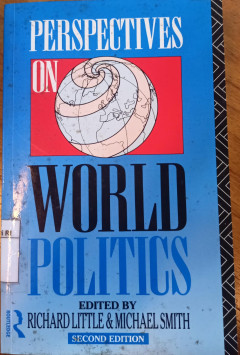
Perspectives on world politics
Perspectives on World Politics has been essential reading for students of international relations since the start of the 1980s. Its focus on three competing perspectives provides a clear and coherent organization of the divergent conceptual tools used to study world politics. Since the first edition was published, however, the orientation of each of the three perspectives has evolved and an imp…
- Edisi
- Second edition
- ISBN/ISSN
- 0-415-05624-1
- Deskripsi Fisik
- vii, 478 pages : illustrations : index ; 22 cm
- Judul Seri
- -
- No. Panggil
- 327.1 Lit p

The global future: A brief introduction to world politics
The global future introduces you to the field of international relations while providing you with a set of concepts and analytic tools to help you understand contemporary events and emerging global trends. Contents: Part I. Trend and transformation in world politics Part II. The actors in world politics Part III. The politics of global security Part IV. The politics of global welfare Pa…
- Edisi
- Second Edition
- ISBN/ISSN
- 978-0-495-00748-7
- Deskripsi Fisik
- xxi, 386 pages : illustrations : maps : index ; 24 cm
- Judul Seri
- -
- No. Panggil
- 327.1 Keg g
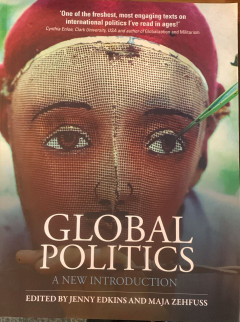
Global politics: A new introduction
Global Politics: A New Introduction is an innovative new textbook that provides a completely original way of teaching and learning about world politics. The book engages directly with the issues in global politics that students are most interested in, helping them to understand the key questions and theories and also to develop a critical and inquiring perspective.
- Edisi
- -
- ISBN/ISSN
- 978-0-415-43131-6
- Deskripsi Fisik
- xxxix, 524 pages : index ; 25 cm
- Judul Seri
- -
- No. Panggil
- 327.1 Edk g

Hollow hegemony: Rethinking global Politics, power and resistance
There is a widespread belief today that politics, power and resistance operate at the global level rather than at the level of nation states - the traditional subjects of international relations. This shift, from the national to the global, is asserted as much by representatives of leading western states and international institutions as it is by the radical critics of the international order. …
- Edisi
- First published
- ISBN/ISSN
- 978-0-7453-2920-8
- Deskripsi Fisik
- ix, 255 pages : index ; 22 cm
- Judul Seri
- -
- No. Panggil
- 327.1 Cha h

International politics: States, power, and conflict since 1945
International politics (or international relations) is a subject rather than a discipline, a field rather than a form of knowledge. In contrast to a discipline, which is distinguished chiefly by the application of a singular form of testing to its propositions, a subject derives its identity simply from its focus of analysis (or 'subject matter'); its tests of truth are borrowed from the discip…
- Edisi
- 2nd edition
- ISBN/ISSN
- 0-7450-0987-5
- Deskripsi Fisik
- xiv, 249 pages : illustration : index ; 24 cm
- Judul Seri
- -
- No. Panggil
- 327.1 Ber i

The globalization of world politics: An introduction to international relations
The Globalization of World Politics is the essential text for all International Relations students. With its established authority and reputation, the new edition is an invaluable resource, which provides a clear and insightful introduction to International Relations and acts as a comprehensive point of reference thereafter.
- Edisi
- 3rd edition
- ISBN/ISSN
- 0-19-927118-6
- Deskripsi Fisik
- xxxvii, 811 pages : illustrations : index ; 25 cm
- Judul Seri
- -
- No. Panggil
- 327.1 Bay g

The globalization of world politics: An introduction to international relations
An introductory text for students with no previous knowledge of contemporary world politics. After an overview chapter on the concept of globalization and arguments for and against it, four sections cover the historical background to contemporary world politics, major theories, structures and process of world politics, and leading issues, such as nuclear proliferation, human rights, global trad…
- Edisi
- -
- ISBN/ISSN
- 0-19-878109-1
- Deskripsi Fisik
- xxviii, 526 pages : illustrations : index ; 25 cm
- Judul Seri
- -
- No. Panggil
- 327.1 Bay g
International relations theory and the Asia-Pacific
Annotation What will the Asia-Pacific rim look like in the years ahead? What tools will international relations theorists need to understand the complex relationship among China, Japan, and the United States as the three powers shape the economic and political future of this crucial region?Some of the best and most innovative scholars in international relations and Asian area studies gather her…
- Edisi
- -
- ISBN/ISSN
- 978-0-231-12590-1
- Deskripsi Fisik
- vi, 450 pages : index ; 24 cm
- Judul Seri
- -
- No. Panggil
- 327.095 Ike i

Playing God: Seven fateful moments when great men met to change the world
Throughout time, leaders at the pinnacle of power - popes and kings, presidents and prime ministers, even czars and generals - have subscribed to the belief that they can change the course of history, not by the force of arms, but through charm, skillful negotiation, honesty, deceit, and all the other arts of peaceful human exchange. Now, in Playing God, Charles L. Mee, Jr. - author of the crit…
- Edisi
- -
- ISBN/ISSN
- 0-671-67888-4
- Deskripsi Fisik
- 269 pages : index ; 24 cm
- Judul Seri
- -
- No. Panggil
- 327.09 Mee p
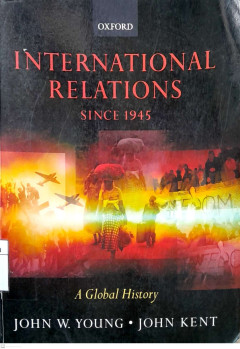
International relations since 1945: A global history
This textbook provides description and analysis of the Cold War and its aftermath. It covers the period from all angles with focus on regional developments as well as global interactions, and also gives due consideration to economic and strategic issues.
- Edisi
- -
- ISBN/ISSN
- 0-19-878164-4
- Deskripsi Fisik
- xx, 743 pages : bibl: hlm 719-728 : index ; 25 cm
- Judul Seri
- -
- No. Panggil
- 327 You i
 Karya Umum
  Filsafat
  Agama
Agama  Ilmu-ilmu Sosial
  Bahasa
  Ilmu-ilmu Murni
  Ilmu-ilmu Terapan
  Kesenian, Hiburan, dan Olahraga
  Kesusastraan
  Geografi dan Sejarah