Ditapis dengan

Japan's changing political and security role: Domestic and international aspects
The central objective of this study is to describe and analyse the politics of security policy change in Japan and its significance to the Asia-Pacific region as a whole.
- Edisi
- -
- ISBN/ISSN
- 981-3035-98-6
- Deskripsi Fisik
- 57 pages ; 24 cm
- Judul Seri
- -
- No. Panggil
- 327.3433952 Kat j

The Diplomatic Record 1990-1991
Provides information on international diplomatic relations during 1990-91. This book focuses on the crisis in the Gulf, with six essays exploring diplomatic initiatives. Additional essays highlight German reunification, post-Cold War Europe and the Nuclear Nonproliferation Treaty.
- Edisi
- -
- ISBN/ISSN
- 0-8133-1386-4
- Deskripsi Fisik
- xii, 331 pages : bibl: hlm 305-312 : index ; 26 cm
- Judul Seri
- -
- No. Panggil
- 327.2 New d

Confronting challenges, maximising opportunities : a new diplomacy for market…
The Study: Confronting Challenges, Maximising Opportunities. A New Diplomacy for Market Access, traces the region's responses to many of these challenges as they appeared to our respective countries in the years since becoming independent nations. Indeed, what the Study has done is not merely to acknowledge the existence of these challenges, but it addresses their changing faces as well. The es…
- Edisi
- First Published
- ISBN/ISSN
- 978-976-637-326-9
- Deskripsi Fisik
- xli, 186 pages : bibl: hlm 161-186 ; 23 cm.
- Judul Seri
- -
- No. Panggil
- 327.2 Hal c
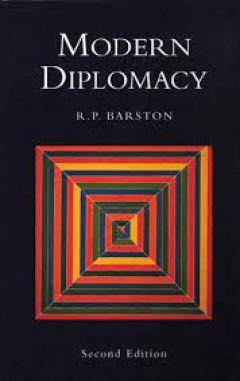
Modern diplomacy
For this Second Edition, Modern Diplomacy has been extensively updated and expanded to take in not only important changes in diplomacy, but also several new chapters. These cover environmental diplomacy, mediation, the process of normalisation and case examples of environmental negotiations and international agreements.
- Edisi
- Second Edition
- ISBN/ISSN
- 0-582-09953-6
- Deskripsi Fisik
- xiv, 308 pages : index ; 22 cm
- Judul Seri
- -
- No. Panggil
- 327.2 Bar m

Constructing a security community in Southeast Asia: ASEAN and the problem of…
"This book contains the most comprehensive and critical account available of the evolution of ASEAN's norms and the viability of the ASEAN Way of conflict management. It is an invaluable resource for students and scholars of Asian Studies, International Relations and Politics."
- Edisi
- -
- ISBN/ISSN
- 0-415-15763-3
- Deskripsi Fisik
- xix, 234 pages : index ; 23 cm.
- Judul Seri
- -
- No. Panggil
- 327.170959 Ach c

Nuclear politics: Towards a safer world
The past few years have witnessed a number of remarkable developments in the field of nuclear arms control and non proliferation. The United States and the Soviet Union (now Russia) signed the START I and II agreements, which promised to reduce the nuclear arsenals of the two countries by two-thirds, to approximately 3,000 nuclear warheads each by the year 2003. President Bush's announcement on…
- Edisi
- -
- ISBN/ISSN
- 1-932705-02-3
- Deskripsi Fisik
- ix, 672 pages : bibl: hlm 626-650 : index ; 22 cm
- Judul Seri
- -
- No. Panggil
- 327.174 Cho m

Understanding international conflicts: An introduction to theory and history
In revising classic works in political science, Longman celebrates the contributions its authors and their research have made to the discipline The Longman Classics in Political Science series honors these authors and their work Providing students with an updated context, each title in the series includes a foreword, written by one of today's top scholars, offering a fresh, in-depth analysis of…
- Edisi
- fifth edition
- ISBN/ISSN
- 0-321-20945-1
- Deskripsi Fisik
- xii, 276 pages : illustrations : index ; 24 cm
- Judul Seri
- -
- No. Panggil
- 327.16 Nye u

Non-aligned movement : Its future and action programme
This book comes out of papers and comments presented during the international conference on The Future of the Non-Aligned Movement held by CSIS 16-17 June 1992, and it reflects the interests and aspirations of the participants. The conference was attended by participants from Non-Aligned countries - India, Indonesia, Yugoslavia, Pakistan, Ghana, Cyprus, Malaysia, Vietnam and Egypt.
- Edisi
- First Published
- ISBN/ISSN
- 979-8026-22-5
- Deskripsi Fisik
- vi, 115 pages ; 21 cm
- Judul Seri
- -
- No. Panggil
- 327.11 Ban n

Emergent actors in world politics: How states & nations develop & dissolve
The disappearance and formation of states and nations after the end of the Cold War have proved puzzling to both theorists and policymakers. Lars-Erik Cederman argues that this lack of conceptual preparation stems from two tendencies in conventional theorizing. First, the dominant focus on cohesive nation-states as the only actors of world politics obscures crucial differences between the state…
- Edisi
- -
- ISBN/ISSN
- 0-691-02148-1
- Deskripsi Fisik
- xiv, 258 pages : illustrations (black and white) : bibl: hlm 233-253 : index ; 23 cm
- Judul Seri
- -
- No. Panggil
- 327.101 Ced e

Non-aligned movement in a changing world
This book contains publications about the non-aligned movement in a changing world that show the political, economic and social emancipation of the third non-aligned movement. The sequence of events starting with the unique Bandung Conference, followed by the meetings in Brioni and Cairo, culminated at the 1961 Belgrade Summit which formally started the periodic gatherings of the Heads of State…
- Edisi
- -
- ISBN/ISSN
- 979-8373-00-6
- Deskripsi Fisik
- iv, 148 pages : illustrations ; 21 cm
- Judul Seri
- -
- No. Panggil
- 327.1 Sia n
 Karya Umum
  Filsafat
  Agama
Agama  Ilmu-ilmu Sosial
  Bahasa
  Ilmu-ilmu Murni
  Ilmu-ilmu Terapan
  Kesenian, Hiburan, dan Olahraga
  Kesusastraan
  Geografi dan Sejarah