Ditapis dengan
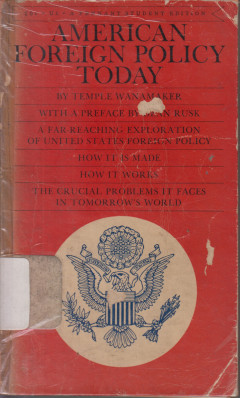
American foreign policy today
This book provides an overview of the principles, goals, and challenges of United States foreign policy during the mid-twentieth century. Written by Temple Wanamaker with a preface by then–Secretary of State Dean Rusk, it analyzes America’s international role in the context of Cold War tensions, global diplomacy, and emerging political shifts in Asia, Africa, and Latin America. The text dis…
- Edisi
- -
- ISBN/ISSN
- -
- Deskripsi Fisik
- 250 pages ; 18 cm
- Judul Seri
- -
- No. Panggil
- 327.73 WAN a
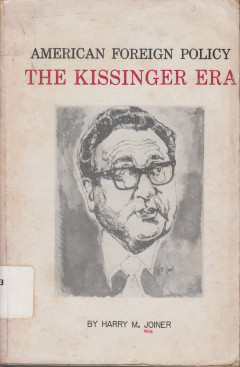
American foreign policy: The Kissinger era
American Foreign Policy: The Kissinger Era provides an analytical overview of the United States’ foreign policy during the period in which Henry Kissinger played a dominant role as National Security Advisor and Secretary of State. The book explores Kissinger’s strategic doctrines, diplomatic negotiations, and the geopolitical challenges of the Cold War. It examines the principles guiding U.…
- Edisi
- -
- ISBN/ISSN
- 87397-126-4
- Deskripsi Fisik
- 308 pages ; 23 cm
- Judul Seri
- -
- No. Panggil
- 327.73 JOI a

Let us live in peace and friendship: The Visit of N. S. Khrushchov to the U.S…
This publication documents the historic visit of Soviet Premier Nikita S. Khrushchev to the United States from September 15 to 27, 1959, during a critical phase of the Cold War. The booklet presents speeches, statements, meetings, and public appearances made throughout his tour, emphasizing the Soviet Union’s call for peaceful coexistence and improved international relations. It highlights di…
- Edisi
- -
- ISBN/ISSN
- -
- Deskripsi Fisik
- 404 pages : illustrations ; 21 cm
- Judul Seri
- -
- No. Panggil
- 327.172 KHR l

Mixed messages: American politics and international organization 1919–1999
Mixed Messages explores the complex relationship between the United States and major international organizations from the end of World War I through the end of the twentieth century. Edward C. Luck analyzes how American domestic politics, shifting national interests, and public opinion have shaped U.S. engagement with institutions such as the League of Nations and the United Nations. The book h…
- Edisi
- -
- ISBN/ISSN
- 0-8157-5308-X
- Deskripsi Fisik
- xvi, 374 pages ; 23 cm
- Judul Seri
- -
- No. Panggil
- 341.23 LUC m
Technology transfer and U.S. foreign policy
This book examines the complex relationship between technology transfer and United States foreign policy. Henry R. Nau analyzes how technological capabilities influence political decisions, international power structures, and global economic development. The work discusses the mechanisms of transferring advanced technologies abroad, the political and strategic implications for U.S. interests, a…
- Edisi
- -
- ISBN/ISSN
- 0-275-56790-7
- Deskripsi Fisik
- xv, 325 pages : illustrations ; 24,5 cm
- Judul Seri
- -
- No. Panggil
- 327.73 NAU t
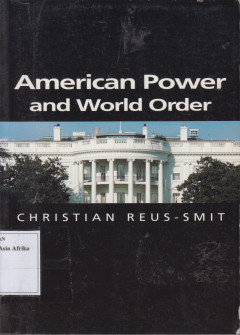
American power and world order
American Power and World Order examines how the United States exercised global leadership after the end of the Cold War and especially following the attacks of September 11, 2001. Christian Reus-Smit analyzes the rise of American unilateralism, the structural and institutional foundations of U.S. power, and the challenges to American dominance in the emerging international system. The book expl…
- Edisi
- -
- ISBN/ISSN
- 0-7456-3167-3
- Deskripsi Fisik
- xii, 184 pages ; 19 cm
- Judul Seri
- -
- No. Panggil
- 327.73 SMI a

The American ascendancy: How the United States gained and wielded global domi…
The American Ascendancy examines how the United States rose to global dominance and developed its international influence from the 19th century through the modern era. Michael H. Hunt analyzes the political, economic, and ideological forces that shaped America’s expanding role in world affairs, highlighting pivotal moments in foreign relations, the evolution of U.S. hegemony, and the geopolit…
- Edisi
- -
- ISBN/ISSN
- 978-0-8078-3090-1
- Deskripsi Fisik
- 404 pages : illustrations ; 24 cm
- Judul Seri
- -
- No. Panggil
- 327.7300904 HUN a
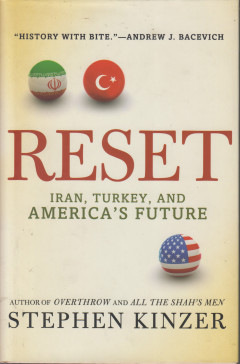
Reset: Iran, Turkey, and America’s future
“Reset: Iran, Turkey, and America’s Future” explores the complex geopolitical relationships between the United States and two pivotal Middle Eastern nations: Iran and Turkey. Stephen Kinzer argues that U.S. foreign policy has long relied on outdated assumptions and alliances, and proposes a strategic realignment that prioritizes diplomatic engagement with Iran and cooperation with Turkey.…
- Edisi
- -
- ISBN/ISSN
- 978-0-8050-9127-4
- Deskripsi Fisik
- 274 pages : illustrations ; 24,5 cm
- Judul Seri
- -
- No. Panggil
- 327.73055 KIN r
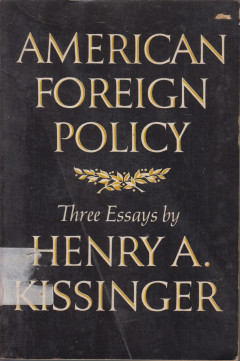
American foreign policy: Three essays
American Foreign Policy: Three Essays presents Henry A. Kissinger’s influential analyses of the strategic challenges confronting the United States during the Cold War era. In these essays, Kissinger examines the central issues of American foreign policy, the ideological and geopolitical forces shaping global power, and the need for a coherent national strategy. His reflections provide insight…
- Edisi
- -
- ISBN/ISSN
- 393-09853-2
- Deskripsi Fisik
- 143 pages ; 20,5 cm
- Judul Seri
- -
- No. Panggil
- 327.73 KIS a
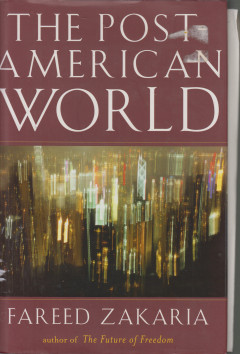
The Post-American world
The Post-American World by Fareed Zakaria explores the shifting global landscape in which the dominance of the United States is challenged by the rapid rise of other nations, particularly China and India. Rather than describing the decline of America, Zakaria argues that the world is entering a “post-American” phase characterized by the rise of the rest. He examines historical patterns of g…
- Edisi
- -
- ISBN/ISSN
- 978-0-393-06235-9
- Deskripsi Fisik
- 292 pages ; 24 cm
- Judul Seri
- -
- No. Panggil
- 303.49 ZAK p
 Karya Umum
  Filsafat
  Agama
Agama  Ilmu-ilmu Sosial
  Bahasa
  Ilmu-ilmu Murni
  Ilmu-ilmu Terapan
  Kesenian, Hiburan, dan Olahraga
  Kesusastraan
  Geografi dan Sejarah