Ditapis dengan
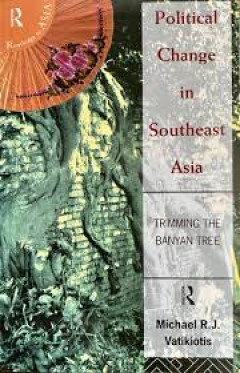
Political change in Southeast Asia: Trimming the banyan tree
Southeast Asia was one of the poorest regions in the world; it is now one of the most desirable areas for foreign investment. An economic miracle? Perhaps. Development in Southeast Asia, however, is not fuelling political change quite as quickly as might be predicted from the experience of industrialisation in the West. Progress towards participatory democracy has been slow. Is Southeast Asia s…
- Edisi
- First Published
- ISBN/ISSN
- 0-415-13484-6
- Deskripsi Fisik
- xiv, 230 pages : index ; 22 cm
- Judul Seri
- -
- No. Panggil
- 320.959 Vat p
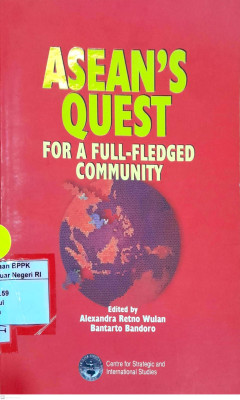
ASEAN's quest for a full-fledged community
In 2003 ASEAN member states decided to transform ASEAN into security community. This is perhaps the most important step taken by ASEAN in the post economic and financial crises which will bring ASEAN into a new nature of internal and external interactions. At the Kuala Lumpur Summit in 2005, the member states agreed to enact a charter providing institutional framework for solving various proble…
- Edisi
- -
- ISBN/ISSN
- 978-979-1295-04-8
- Deskripsi Fisik
- v, 116 pages : illustrations ; 24 cm
- Judul Seri
- -
- No. Panggil
- 327.0959 Wul a
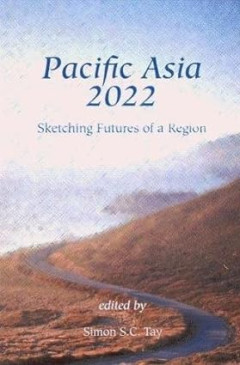
Pacific Asia 2022: Sketching futures of a region
The profound effects of the 1997-98 Asian financial crisis encompass more than economic concerns. Throughout Asia Pacific the crisis prompted a reassessment of governance, values, social safety structures, the commitment of the United States to the region, and the value of such institutions as the Asia Pacific Economic Cooperation forum. In this book, six authors from the region present a polic…
- Edisi
- -
- ISBN/ISSN
- 4-88907-064-8
- Deskripsi Fisik
- vii, 241 pages : bibliography ; 23 cm
- Judul Seri
- -
- No. Panggil
- 320.959 Tay p

Southeast Asia in the new international era
The fourth edition of Southeast Asia in the New International Era updates the region at a time of critical change. In the 1990s, Southeast Asia was known as an area of stability and movement toward development and democracy. At the beginning of the millennium, many of the region's nations are undergoing rapid change that belies the standard perception of stability. Since January 2000, Indonesia…
- Edisi
- -
- ISBN/ISSN
- 0813339928
- Deskripsi Fisik
- xv, 301 pages : index ; 23 cm
- Judul Seri
- -
- No. Panggil
- 327.59 Neh s

Strategic centrality: Indonesia's changing role in ASEAN
This monograph seeks to assess the role that Indonesia has played in ASEAN following the serious economic and political crisis that engulfed the state from late 1997. The paper gives an overview of Indonesian foreign policy since independence, and its subsequent relation to ASEAN.
- Edisi
- -
- ISBN/ISSN
- 981-230-103-8
- Deskripsi Fisik
- 87 pages ; 24 cm.
- Judul Seri
- -
- No. Panggil
- 327.595 Smi s

ASEAN-Japan cooperation: A foundation for East Asian community
Assesses the importance of enhanced ASEAN-Japan cooperation as a step toward a greater East Asian regional community. Fifteen international relations experts review the history and current status of this bilateral relationship and propose how it can be strengthened.
- Edisi
- -
- ISBN/ISSN
- 4-88907-071-0
- Deskripsi Fisik
- xii, 234 pages : bibl: hlm 234 ; 23 cm.
- Judul Seri
- -
- No. Panggil
- 327.59052 Akr a

The fukuda doctrine and ASEAN: New dimensions in Japanese foreign policy
A burgeoning Japanese rote in the Asia-Pacific region has been one of the most contentious issues to the Southeast Asian Countries in recent years with its positive and negative implications. It is thus timely and significant to come to terms with Japan's "design" in the region from a historical perspective. Attributing Japan's active involvement in Southeast Asian affairs to the proclamation o…
- Edisi
- -
- ISBN/ISSN
- 981-3016-14-0
- Deskripsi Fisik
- xiv, 277 pages : bibl: hlm 256-271 : index ; 23 cm
- Judul Seri
- -
- No. Panggil
- 327.520595 Sud f

Japan-ASEAN Intellectual Exchange Open Symposium: Japan and ASEAN toward a ne…
In particular, we wish to express our sincere appreciation to ambassador Yushita and secretary siazon for gracing this occasion with their presence and for having graciously agreed to deliver keynote addresses.
- Edisi
- -
- ISBN/ISSN
- 971-8916-06-7
- Deskripsi Fisik
- 165 pages ; 22 cm
- Judul Seri
- -
- No. Panggil
- 327.52059 Ins j

Peace building in the Asia Pacific Region: Perspectives from Japan and Australia
This collection canvasses the current requirements of T achieving and consolidating peace in the Asia Pacific region, from the special perspectives of two 'outsiders' in the region, Australia and Japan. It explores the strategic, political, economic and cultural dimensions of peace building, with special emphasis on ASEAN and APEC, and concludes that Japan's role as indispensable economic hub a…
- Edisi
- Frist Published
- ISBN/ISSN
- 1-86448-115-3
- Deskripsi Fisik
- ix, 150 pages : index ; 22 cm
- Judul Seri
- -
- No. Panggil
- 327.52 Kin p

China and Southeast Asia: Global changes and regional challenges
The relations between ASEAN and China occupy a unique and important position in the foreign relations of the Asia-Pacific region. China and Southeast Asia's political, strategic and economic importance in the realm of international relations has been transformed by the region's unprecedented economic growth, unexpected financial crisis, and turbulent political changes.
- Edisi
- -
- ISBN/ISSN
- 981-230-298-0
- Deskripsi Fisik
- xxvii, 327 pages ; 23 cm
- Judul Seri
- -
- No. Panggil
- 327.510 59 Leo c
 Karya Umum
  Filsafat
  Agama
Agama  Ilmu-ilmu Sosial
  Bahasa
  Ilmu-ilmu Murni
  Ilmu-ilmu Terapan
  Kesenian, Hiburan, dan Olahraga
  Kesusastraan
  Geografi dan Sejarah