Ditapis dengan

China's entry to the WTO: Strategic issues and quantitative assessments
This volume provides a detailed up-to-date analysis of the strategic issues and policy options of China's accession to the WTO. Quantitative analysis demonstrates how tariff reduction resulting from China's accession to the WTO will benefit the Chinese economy as well as the rest of the world. The book argues that there is no single trade policy initiative likely to result in larger gains in in…
- Edisi
- Cet. 1
- ISBN/ISSN
- 0-415-24101-4
- Deskripsi Fisik
- xiii, 227 pages : illustrations (black and white) ; 24 cm
- Judul Seri
- -
- No. Panggil
- 382.951 Dry c
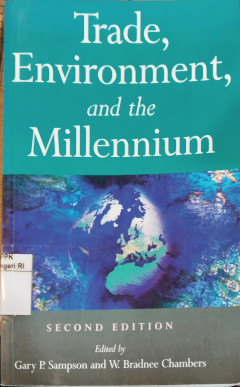
Trade, environment, and the millennium
This book contains about: 1. Trade and environment: Strengthening complementarities 2. Trade and environment: How real is the debate? 3. Breaking the deadlock: A positive agenda on trade, environment, and development 4. The WTO dispute settlement system etc.
- Edisi
- Ed. 2
- ISBN/ISSN
- 92-808-1064-2
- Deskripsi Fisik
- xi, 450 pages ; 23 cm
- Judul Seri
- -
- No. Panggil
- 382.92 Sam t

Strengthening the global trading system: From GATT to WTO
This book contains about: 1. Why the world needs the GATT/WTO 2. The multilateral trading system: What it is, how it works 3. Implications of the Uruguay round for the world economy 4. Designing national administration for good trade policy practice etc.
- Edisi
- Cet. 1
- ISBN/ISSN
- 0-86396-365-X
- Deskripsi Fisik
- xii, 238 pages : illustrations (black and white) ; 21 cm
- Judul Seri
- -
- No. Panggil
- 382.9 And s

Southeast Asia in the WTO: Southeast Asia background series no.5
In this large-scale ISEAS study, Razeen Sally looks at Southeast Asia in the World Trade Organization, against the background of national trade policy trends post-Asian crisis, sluggish ASEAN economic integration, and the recent high-speed proliferation of bilateral and regional trade negotiations. ASEAN co-operation in the WTO has broken down, with little prospect of revival. Nevertheless, Sal…
- Edisi
- Cet. 1
- ISBN/ISSN
- 981-230-268-9
- Deskripsi Fisik
- vi, 98 pages ; 22 cm
- Judul Seri
- -
- No. Panggil
- 382.959 Sal s

Twenty-Seventh meeting of the ASEAN economic ministers
- Edisi
- -
- ISBN/ISSN
- 0854-6258
- Deskripsi Fisik
- 28 pages : illustrations ; 29 cm
- Judul Seri
- -
- No. Panggil
- 330.959 Min t
- Edisi
- -
- ISBN/ISSN
- 0854-6258
- Deskripsi Fisik
- 28 pages : illustrations ; 29 cm
- Judul Seri
- -
- No. Panggil
- 330.959 Min t

Twenty-Sixth meeting of the ASEAN economic ministers
This book contains: 1. Fifth AFTA ministerial council meeting 2. Twenty-Sixth meeting of the ASEAN economic ministers 3. Post AEM with MITI-Japan
- Edisi
- -
- ISBN/ISSN
- 0854-6258
- Deskripsi Fisik
- 22 pages ; 29 cm
- Judul Seri
- -
- No. Panggil
- 330.959 Min t
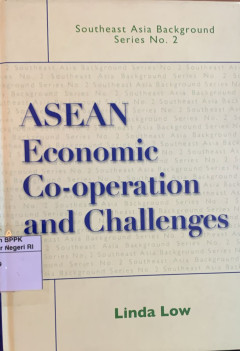
ASEAN economic co-operation and challenges
This book is written in an easily understood style. It explains the background of the origin of ASEAN (Association of Southeast Asian Nations) of which there are 10 member-countries. The author looks at the progress made, as well as the problems that the association faces. This is the 2nd book in the ISEAS Southeast Asia Background Series. Table of …
- Edisi
- -
- ISBN/ISSN
- 981-230-264-6
- Deskripsi Fisik
- vi, 80 pages ; 21 cm
- Judul Seri
- -
- No. Panggil
- 330.59 Low a

APEC as an institution: Multilateral governance in the Asia-Pacific
APEC is an experimental multilateralism, relying not on a large bureaucracy but rather upon national government agencies, semi-autonomous inter-govermental committees and "virtual" associations. Organized around the principles of enforced through monitoring and robust compliance mechanisms. This volume assesses the strengths and weaknesses of APEC's "soft" institutionalism, and it's the credibi…
- Edisi
- -
- ISBN/ISSN
- 981-230-209-3
- Deskripsi Fisik
- xvi, 275 pages ; 23 cm
- Judul Seri
- -
- No. Panggil
- 337.1 Fei a
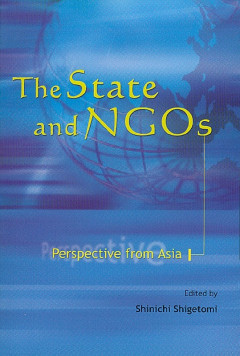
The state and NGOs: Perspective from Asia
In many developing countries the presence of non-governmental organizations (NGOs) can no longer be ignored. They are engaged in an extensive array of activities, including philanthropic work to people left out of the developmental process as well as efforts at addressing problems of environmental destruction and other negative consequences of economic development, and efforts to institutionali…
- Edisi
- -
- ISBN/ISSN
- 981-230-151-8
- Deskripsi Fisik
- xi, 337 pages ; 22 cm
- Judul Seri
- -
- No. Panggil
- 361.7 Shi s
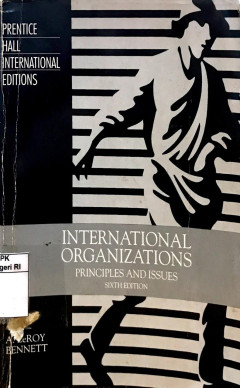
International organizations: Principles and issues (6th edition)
This book is on the break-up of the Soviet Union and its effects on East- west global, regional and private international and transitional organizations, changing role of the United Nations peacemaking operations to a peace-enforcing operation.
- Edisi
- 6th. ed
- ISBN/ISSN
- 0131832034
- Deskripsi Fisik
- xiv, 480 pages ; 23 cm.
- Judul Seri
- -
- No. Panggil
- 341 Ben i
 Karya Umum
  Filsafat
  Agama
Agama  Ilmu-ilmu Sosial
  Bahasa
  Ilmu-ilmu Murni
  Ilmu-ilmu Terapan
  Kesenian, Hiburan, dan Olahraga
  Kesusastraan
  Geografi dan Sejarah