Ditapis dengan

The political economy of growth and impoverishment in the Marcos Era
Contents: 1. The Setting 2. The Growth and Distribution : An Overview 3. The Green Revolution 4. What Price Rice? 5. The New Rice Technology and Rural Inequality 6. Farming for the World Market, etc.
- Edisi
- -
- ISBN/ISSN
- 971-550-096-x
- Deskripsi Fisik
- xv, 405 pages : illustrations (black and white) : bibl; hlm.353-390 : index ; 22 cm
- Judul Seri
- -
- No. Panggil
- 330.9599 Boy p

Why states recover : Changing walking societies into winning nations-from Afg…
State failure takes many forms, from the collapse of central authority à la Somalia to the subversion of democracy in Venezuela and Zimbabwe. Assessing why and how states fail is only half of the story, however. More important is pinpointing why they recover. Based on fieldwork in over 40 countries, Why States Recover incorporates first-hand interviews with leadership to disaggregate various s…
- Edisi
- -
- ISBN/ISSN
- 978-1-77010-325-2
- Deskripsi Fisik
- xiv, 689 pages : illustrations : index ; 23 cm
- Judul Seri
- -
- No. Panggil
- 330.96891 Mil w

Sudan, 1950-1985 : death of a dream
This book on Sudan reveals the background of national and international political intrigue.
- Edisi
- First Edition
- ISBN/ISSN
- 1850772169
- Deskripsi Fisik
- xiv, 255 pages : illustrations : bibl: hlm 245-248 : index ; 24 cm
- Judul Seri
- -
- No. Panggil
- 327.9624 Tho s

The Vanishing country: Is it too late to save Canada?
Is it all over for Canada? There are a number of thoughtful people who think so. Mel Hurtig, however, believes there is still a chance to reassert Canadian independence. But first, Canadians need to understand how much has been lost. Our politicians are not telling us. Our business leaders certainly are not telling us. And our media definitely are not telling us. The border dividing Canada and …
- Edisi
- -
- ISBN/ISSN
- 978-7710-4217-1
- Deskripsi Fisik
- xix, 449 pages : index ; 23 cm
- Judul Seri
- -
- No. Panggil
- 330.971 Hur v

A declaration of interdependence : Why America should join the world
Great societies, this book holds, are marked by essential core values: the social contract that enhances its citizens' lives, an honest and enlightened economy, a vital public realm, and a recognition that the world is an interdependent place, one best governed under international law. With the triumph of conservatism in America, each of these values has withered. Rampant materialism, corporate…
- Edisi
- -
- ISBN/ISSN
- 0-393-32560-1
- Deskripsi Fisik
- xvi, 319 pages : index ; 21 cm
- Judul Seri
- -
- No. Panggil
- 330.973 Hut d

National insecurity : the Howard government's betrayal of Australia
Uncovers the truth behind the Howard Government's international trade treaties with the US and how crucial parts of Australia's domestic economy, international markets, defence and health security, research, energy policy and culture are being handed over to the US
- Edisi
- -
- ISBN/ISSN
- 9781741750515
- Deskripsi Fisik
- xi, 298 pages : illustrations : bibl: hlm 287-298 ; 20 cm
- Judul Seri
- -
- No. Panggil
- 327.94073 Wei n
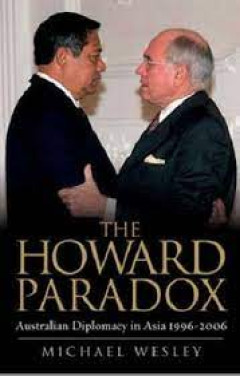
The Howard paradox : Australian diplomacy in Asia, 1996-2006
Paul Keating famously said that Asian countries wouldn't deal with John Howard. In the early years of the Howard Government, Australia's relations with China and Indonesia had never been worse. More than ten years later, the Howard Government, the reality is completely different. The Howard Government has achieved an intimacy in diplomatic ties with Asian countries and gained seats at regional …
- Edisi
- -
- ISBN/ISSN
- 9780733320781
- Deskripsi Fisik
- viii, 264 pages : illustrations : index ; 21 cm
- Judul Seri
- -
- No. Panggil
- 327.9405 Wes h

Facing north: A century of Australian engagement with Asia
Presents a history of Australia's relations with Asia since Federation. This volume chronicles Australian-Asian relations from 1901 to the 1970s. It explains the major changes in official Australian policies towards Asia, together with the broader cultural challenges. It is aimed at those interested in Australia's relations with Asian countries.
- Edisi
- Volume 1
- ISBN/ISSN
- 0522849539
- Deskripsi Fisik
- xx, 523 pages : ilustrations : bibl: hlm 470-495 : index ; 25 cm
- Judul Seri
- -
- No. Panggil
- 327.9405 Gol f
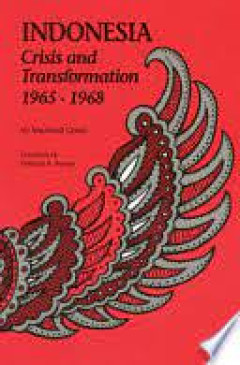
Indonesia crisis and information 1965-1968
Here, published for the first time, is the story of Washington's role in one of the most significant turning points in Asian history - the turbulent transfer of power from President Sukarno to President Suharto in Indonesia, one of the world's largest and most important countries. After much speculation over covert U.S. action in the Indonesian drama, this book records with authority and candor…
- Edisi
- -
- ISBN/ISSN
- 0-929590-02-3
- Deskripsi Fisik
- xiv, 172 pages : illustrations : index ; 24 cm
- Judul Seri
- -
- No. Panggil
- 327.730598 Gre i

The United States and the struggle for Southeast Asia, 1945-1975
This book puts American policy in Southeast Asia and the traumatic events of the second Indochina War into the larger perspective of the Cold War.
- Edisi
- -
- ISBN/ISSN
- 0-275-95124-3
- Deskripsi Fisik
- 190 pages : bibl: hlm 173-181 : index ; 25 cm
- Judul Seri
- -
- No. Panggil
- 327.73059 Lev u
 Karya Umum
  Filsafat
  Agama
Agama  Ilmu-ilmu Sosial
  Bahasa
  Ilmu-ilmu Murni
  Ilmu-ilmu Terapan
  Kesenian, Hiburan, dan Olahraga
  Kesusastraan
  Geografi dan Sejarah