Ditapis dengan
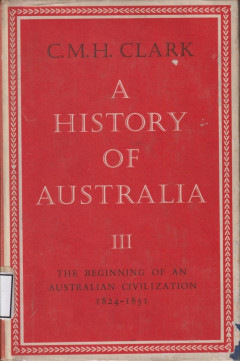
A History of Australia, Volume III
This third volume of A History of Australia explores the formative years of Australian civilization between 1824 and 1851. C. M. H. Clark examines the political, social, and cultural transformations that shaped the colonies during this period, including the development of colonial government, the growth of settler society, economic expansion, and complex interactions between European settlers a…
- Edisi
- 3
- ISBN/ISSN
- 0-522-84054-X
- Deskripsi Fisik
- xv, 491 pages : illustration ; 24 cm
- Judul Seri
- -
- No. Panggil
- 994 CLA h
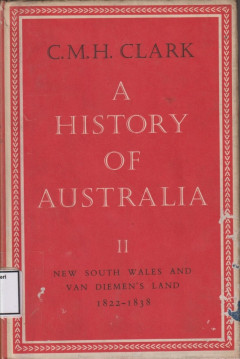
A History of Australia, Volume II
This second volume of A History of Australia covers the critical years between 1822 and 1838, tracing the social, political, and administrative evolution of the Australian colonies. Clark examines the growth of New South Wales and Van Diemen’s Land, the transformation of penal settlements, the development of local governance, and the tensions between authority and emerging settler society. Dr…
- Edisi
- 2
- ISBN/ISSN
- 0-522-84166-X
- Deskripsi Fisik
- 364 pages : illustration ; 24 cm
- Judul Seri
- -
- No. Panggil
- 994.03 CLA h
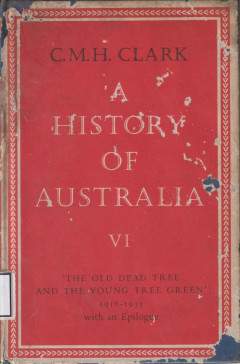
A History of Australia, Volume VI
This sixth volume of C. M. H. Clark’s monumental “A History of Australia” explores the nation’s political, cultural, and social transformations from 1916 to 1935. Through the metaphor of “the old dead tree and the young tree green,” Clark examines the tensions between tradition and emerging modern identities in Australia during the interwar years. The book traces shifts in national …
- Edisi
- 6
- ISBN/ISSN
- 0-522-84352-2
- Deskripsi Fisik
- xvi, 522 pages : illustration ; 24 cm
- Judul Seri
- -
- No. Panggil
- 994.04 CLA h
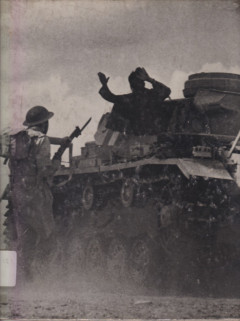
The War in the desert
The War in the Desert provides a vivid and detailed narrative of the North African Campaign during World War II. Written by Richard Collier and the editors of Time-Life Books, it chronicles the dramatic battles fought across Libya and Egypt between Allied and Axis forces. The book explores key figures such as Field Marshal Erwin Rommel and the British Eighth Army, highlighting strategy, militar…
- Edisi
- -
- ISBN/ISSN
- -
- Deskripsi Fisik
- 208 pages : illustration ; 29 cm
- Judul Seri
- -
- No. Panggil
- 940.54 COL w
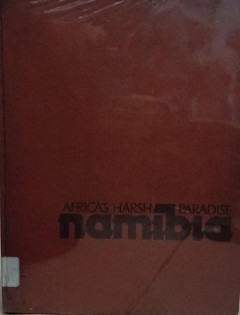
Africa’s harsh paradise: Namibia
Africa's Harsh Paradise: Namibia is a visual and narrative documentation of Namibia's landscape, biodiversity, and ecological conditions. Compiled by nature photographer Anthony Bannister and writer Peter Johnson, the book features high-quality photographs depicting Namibia's wildlife, deserts, coastlines, and protected areas. Supported by scientific literature and expert consultation, the book…
- Edisi
- -
- ISBN/ISSN
- 0-600-30446-9
- Deskripsi Fisik
- 250 pages : illustration ; 32,5 cm
- Judul Seri
- -
- No. Panggil
- 916.88 BAN a
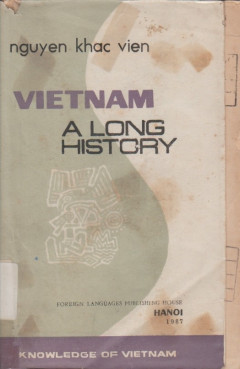
Vietnam: A Long history
Vietnam: A Long History presents a concise yet comprehensive overview of Vietnam’s historical development from its ancient origins to the modern era. Written by Nguyen Khac Vien, the book highlights major political, cultural, and social milestones that shaped the Vietnamese nation, including early kingdoms, Chinese domination, struggles for independence, dynastic periods, colonial rule, and t…
- Edisi
- -
- ISBN/ISSN
- -
- Deskripsi Fisik
- 402 pages : illustration ; 21 cm
- Judul Seri
- -
- No. Panggil
- 959.7 NGU v
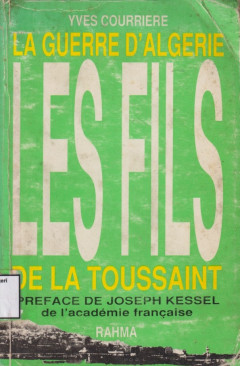
Les Fils de la Toussaint
Les Fils de la Toussaint is the first volume of Yves Courrière’s monumental series on the Algerian War. This book recounts the events surrounding the outbreak of the Algerian Revolution in 1954, beginning with the "Toussaint Rouge" uprising orchestrated by the FLN. Courrière combines investigative journalism, interviews, military accounts, and historical documentation to narrate the politic…
- Edisi
- -
- ISBN/ISSN
- -
- Deskripsi Fisik
- 483 pages : illustration ; 24 cm
- Judul Seri
- -
- No. Panggil
- 965.04 YVE l
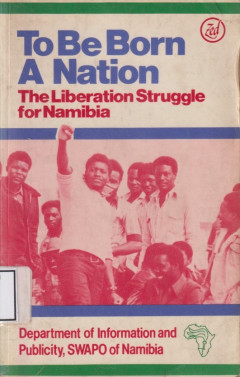
To be born a nation: The Liberation struggle for Namibia
To Be Born a Nation is a comprehensive documentation of Namibia's struggle for liberation from South African colonialism. Compiled by SWAPO's Information and Publicity Department, it details Namibia's political history, the roots of the conflict, the development of the resistance movement, and the diplomatic and military strategies pursued toward independence. Complete with maps, diagrams, and …
- Edisi
- -
- ISBN/ISSN
- 0-905762-73-8
- Deskripsi Fisik
- v, 354 pages : illustration ; 21,5 cm
- Judul Seri
- -
- No. Panggil
- 968.803 DEP b

The 30-Year War 1945–1975 (Volume II: 1954–1975)
The 30-Year War 1945–1975 (Volume II: 1954–1975) presents a detailed account of the political, military, and social developments in Vietnam during the period following the Geneva Agreement of 1954 up to the end of the Vietnam War in 1975. The volume examines the division of Vietnam, the escalation of conflict between North and South, foreign intervention, and the strategies employed by the …
- Edisi
- -
- ISBN/ISSN
- -
- Deskripsi Fisik
- viii, 311 pages : illustration ; 21 cm
- Judul Seri
- -
- No. Panggil
- 959.7042 TIM t

Glory of the royal cities: A Visual celebration of ancient Sri Lanka
This book presents a vivid photographic exploration of the ancient royal cities of Sri Lanka, capturing their architectural splendor, cultural heritage, and historical significance. Through high-quality visual documentation, Sunil de Costa showcases the grandeur of monuments, temples, palaces, and archaeological sites that shaped Sri Lanka’s ancient civilization. The work serves both as an ar…
- Edisi
- -
- ISBN/ISSN
- 978-955-50332-1-3
- Deskripsi Fisik
- xvii, 243 pages : illustration ; 29 cm
- Judul Seri
- -
- No. Panggil
- 954.93 COS g
 Karya Umum
  Filsafat
  Agama
Agama  Ilmu-ilmu Sosial
  Bahasa
  Ilmu-ilmu Murni
  Ilmu-ilmu Terapan
  Kesenian, Hiburan, dan Olahraga
  Kesusastraan
  Geografi dan Sejarah