Ditapis dengan

The limits of government: An essay on the public goods argument
The most widely accepted justification for political authority is that coercive institutions are necessary to provide for public goods. Making use of the tools of rational choice theory, economics, and the law of contracts, the author offers a critique of this argument. Along the way, he makes significant contributions to our understanding of the logic of contractarian arguments, the prisoner's…
- Edisi
- -
- ISBN/ISSN
- 0813308704
- Deskripsi Fisik
- xviii, 197 pages ; 23 cm.
- Judul Seri
- -
- No. Panggil
- 338.9 Sch l

Solutions for the world's biggest problems: Costs and benefits
Solutions for the World's Biggest Problems offers a rigorous overview of twenty-three of the world's biggest problems relating to the environment, governance, economics, and health and population. Leading economists provide a short survey of the state-of-the-art analysis and sketch out some promising policy solutions for which they provide cost-benefit ratios.
- Edisi
- First Published
- ISBN/ISSN
- 9780521715973
- Deskripsi Fisik
- xvii, 442 pages : illustration ; 24 cm
- Judul Seri
- -
- No. Panggil
- 338.9 Lom s

In defense of globalization
In the passionate debate that currently rages over globalization, critics have been heard blaming it for a host of ills afflicting poorer nations, everything from child labor to environmental degradation and cultural homogenization. Now Jagdish Bhagwati, the internationally renowned economist, takes on the critics, revealing that globalization, when properly governed, is in fact the most powerf…
- Edisi
- -
- ISBN/ISSN
- 978-0-19-533093-9
- Deskripsi Fisik
- xii, 330 pages : illustrations (black and white) ; 23 cm
- Judul Seri
- -
- No. Panggil
- 337 Bha i

Globalization and its discontents
Globalization and its discontents adalah sebuah buku yang diterbitkan pada tahun 2002 oleh pemenang Nobel 2001 Joseph E. Stiglitz. Buku ini mengacu pada pengalaman pribadi Stiglitz sebagai ketua Dewan Penasihat Ekonomi di bawah Bill Clinton dari tahun 1993 dan kepala ekonom di Bank Dunia dari tahun 1997. Selama periode ini Stiglitz menjadi kecewa dengan IMF dan lembaga-lembaga internasional lai…
- Edisi
- -
- ISBN/ISSN
- 0-393-05124-2
- Deskripsi Fisik
- xxii, 288 pages ; 21 cm
- Judul Seri
- -
- No. Panggil
- 337 Sti g

The collapse of globalism
Globalization, like many great geopolitical ideologies before it, is now dead. Despite the almost-religious certainty with which it was originally conceived, a growing vagueness now surrounds the original promise of the global ideal that the fading power of nation states would be replaced by global markets that economics, not politics or arms, would determine the course of human events and that…
- Edisi
- -
- ISBN/ISSN
- 1-84354-408-3
- Deskripsi Fisik
- 309 pages ; 24 cm
- Judul Seri
- -
- No. Panggil
- 337 Sau c

How rich countries got rich...and why poor countries stay poor
In this refreshingly revisionist history, Erik Reinert shows how rich countries developed through a combination of government intervention, protectionism, and strategic investment, rather than through free trade. Reinert suggests that this set of policies in various combinations has driven successful development from Renaissance Italy to the modern Far East. Yet despite its demonstrable sucess,…
- Edisi
- -
- ISBN/ISSN
- 978-1-84529-874-6
- Deskripsi Fisik
- vi, 365 pages ; 23,5 cm.
- Judul Seri
- -
- No. Panggil
- 338.900922 Rei h
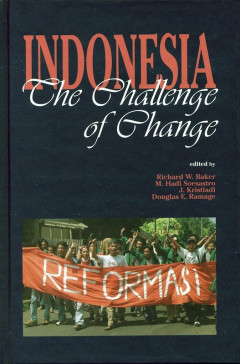
Indonesia: The challenge of change
Indonesian and US political scholars explore the impact of economic growth on twelve major Indonesian institutions, including private and public enterprises, formal political institutions, the armed forces, the bureaucracy, non-governmental organizations, the media, and trade unions. They find that the growing gap between a governing structure that is slow to change and a dynamic broader societ…
- Edisi
- -
- ISBN/ISSN
- 9813055693
- Deskripsi Fisik
- xvii,305 pages.; 23 cm
- Judul Seri
- -
- No. Panggil
- 338.9598 Bak i
ASEAN economic co-operation
This handbook provides basic information on the Association of Southeast Asian Nations (ASEAN), its organization and the various co-operation activities associated with it. The emphasis here is on economic co-operation. Although such information is available in many forms, it is mostly scattered in official documents and various literature on ASEAN. There is, thus, a need to provide the basic i…
- Edisi
- -
- ISBN/ISSN
- 981-3035-66-8
- Deskripsi Fisik
- vii, 231 pages : illustrations (black and white) ; 21 cm
- Judul Seri
- -
- No. Panggil
- 334.959 Rie a
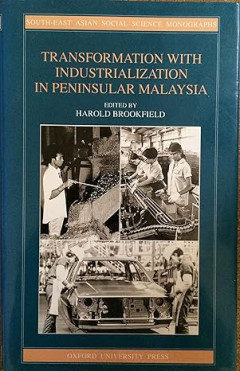
Transformation with industrialization in Peninsular Malaysia
From colonial times until the late 1970s the driving force of the Peninsular Malaysia economy was the production and export of primary products--first tin, than rubber and timber, and finally petroleum. In the 1980s export-oriented industrial production took over as the leading sector economy, enabling Malaysia to become a world-class economic performer. This volume shows how a small country wi…
- Edisi
- -
- ISBN/ISSN
- 9676530301
- Deskripsi Fisik
- xxii, 317 pages : illustration (black and white) ; 23 cm.
- Judul Seri
- -
- No. Panggil
- 338.095951 Bro t

The economics of sustainable development: The case of India
This book provides a look at the current status and future potential of sustainable development in India. Macroeconomic developments, regional disparity and poverty situation, the trend in natural resource depletion and environmental degradation, trajectory of economic development, and conventional wealth are discussed.
- Edisi
- -
- ISBN/ISSN
- 978-0-387-98175-8
- Deskripsi Fisik
- xiv, 297 pages : illustration (black and white) ; 27 cm.
- Judul Seri
- -
- No. Panggil
- 338.1 Kum t
 Karya Umum
 Filsafat
 Agama
 Ilmu-ilmu Sosial
 Bahasa
 Ilmu-ilmu Murni
 Ilmu-ilmu Terapan
 Kesenian, Hiburan, dan Olahraga
 Kesusastraan
 Geografi dan Sejarah