Ditapis dengan

The long view from Delhi: To define the Indian grand strategy for foreign policy
Analyzing some of the major influences on foreign and security policy in India, this synthesis of insights assesses emerging global scenarios from an Indian perspective and details their likely impact on India's current and future national interests. This study first uses the Net Assessment method to detail the scenarios_that the country will face in 2020 and then utilizes a transparent method …
- Edisi
- -
- ISBN/ISSN
- 9788171888009
- Deskripsi Fisik
- 182 pages : 29 cm
- Judul Seri
- -
- No. Panggil
- 327.54 Men l
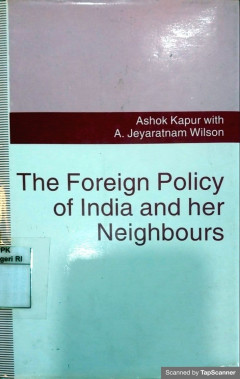
Foreign policy of India and her neighbours
This study of perceptions, interests and strategies of South Asian states reveals the analytical and empirical richness of three kinds of states in the region: India - the regional hegemon; Pakistan-India's permanent competitor; and other South Asian states who do not accept Pakistani perceptions, interests and strategies concerning India. This book assesses the diplomatic and strategic princip…
- Edisi
- First Published
- ISBN/ISSN
- 0-333-55829-4
- Deskripsi Fisik
- ix, 186 pages : illustrations : index ; 23 cm
- Judul Seri
- -
- No. Panggil
- 327.54 Kap f

India's foreign policy: Nehru to Rao
India's foreign policy is a culmination of the past ways of thinking of the people and the past declarations of their leaders. The stand of the Indian National Congress at its Madras Session 1927 was very much against the use of India as a base for the Britishers launching attacks on the freedom of other people. Shri Jawaharlal Nehru, the first Prime Minister of Independent India, was a partici…
- Edisi
- -
- ISBN/ISSN
- -
- Deskripsi Fisik
- x, 184 pages : illustrations : index ; 23 cm
- Judul Seri
- -
- No. Panggil
- 327.54 Jos i

Assignment Colombo
J. N. Dixit, former Foreign Secretary was India's High Commissioner in Sri Lanka from 1985 to 1989. He was an active participant in events leading to the signing of the Indo-Sri Lanka agreement and induction of the IPKF into Sri Lanka. This book is an attempt to put matters in perspective in the context of India's motivation which remain misunderstood. The author feels that the peoples of In…
- Edisi
- -
- ISBN/ISSN
- 81-220-0499-7
- Deskripsi Fisik
- xxi, 393 pages : illustrations (black and white) : index ; 22 cm
- Judul Seri
- -
- No. Panggil
- 327.54 Dix a

Across borders : Fifty years of India's foreign policy
In the course of this illuminating narrative the author projects, in a dronological order, the various facets of India's foreign policy as they evolved. He also describes their immact on both the national and international fronts. This volume puts into perspective significant epoch-making events which profoundly affected the orientation of India's foreign policy priorities and also incisively a…
- Edisi
- -
- ISBN/ISSN
- 81-87285-02-8
- Deskripsi Fisik
- xii, 453 pages : index ; 23 cm
- Judul Seri
- -
- No. Panggil
- 327.54 Dix a
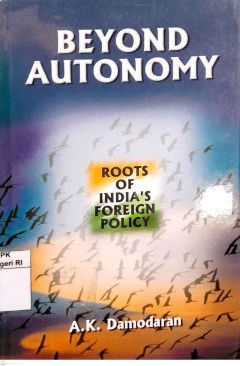
Beyond autonomy: India's foreign policy
In a world of instant communication, no country can remain in isolation. The impact of socio-cultural and economic trends receive instant reverberations the world over. This is equally true of foreign policy. While the balance of power and ideology may have undergone changes, the fundamentals of Indian diplomatic expression has remained the same, with its commitment to our national interests an…
- Edisi
- -
- ISBN/ISSN
- 81-7039-241-1
- Deskripsi Fisik
- xv, 246 pages : index ; 23 cm
- Judul Seri
- -
- No. Panggil
- 327.54 Dam b

The Japanese and sukarno's Indonesia: Tokyo-Jakarta Relations 1951-1966
This book treats the relationship between Japan and Indonesia, between an industrialized nation with sparse natural resources and a developing nation with rich natural resources, over the period from 1951 to 1966.
- Edisi
- -
- ISBN/ISSN
- 0-8248-0379-5
- Deskripsi Fisik
- xvii, 244 pages : bibl: hlm 219-230 : index ; 22 cm
- Judul Seri
- -
- No. Panggil
- 327.520598 Nis t

The fukuda doctrine and ASEAN: New dimensions in Japanese foreign policy
A burgeoning Japanese rote in the Asia-Pacific region has been one of the most contentious issues to the Southeast Asian Countries in recent years with its positive and negative implications. It is thus timely and significant to come to terms with Japan's "design" in the region from a historical perspective. Attributing Japan's active involvement in Southeast Asian affairs to the proclamation o…
- Edisi
- -
- ISBN/ISSN
- 981-3016-14-0
- Deskripsi Fisik
- xiv, 277 pages : bibl: hlm 256-271 : index ; 23 cm
- Judul Seri
- -
- No. Panggil
- 327.520595 Sud f

Japan-ASEAN Intellectual Exchange Open Symposium: Japan and ASEAN toward a ne…
In particular, we wish to express our sincere appreciation to ambassador Yushita and secretary siazon for gracing this occasion with their presence and for having graciously agreed to deliver keynote addresses.
- Edisi
- -
- ISBN/ISSN
- 971-8916-06-7
- Deskripsi Fisik
- 165 pages ; 22 cm
- Judul Seri
- -
- No. Panggil
- 327.52059 Ins j
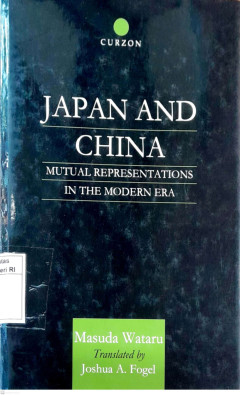
Japan and China: Mutual representations in the modern era
This volume ties together the histories of Japan and China for the modern period prior to the 20th century. Twenty-nine chapters deal with Chinese or Japanese works which were written in response to events in the other country. None of these works has received any sustained attention in the West. As a result we get a view of how Chinese and Japanese saw each other at a time when there were few …
- Edisi
- First Published
- ISBN/ISSN
- 0-7007-1120-1
- Deskripsi Fisik
- ix, 298 pages : illustrations : index ; 25 cm
- Judul Seri
- -
- No. Panggil
- 327.5202 Wat j
 Karya Umum
  Filsafat
  Agama
Agama  Ilmu-ilmu Sosial
  Bahasa
  Ilmu-ilmu Murni
  Ilmu-ilmu Terapan
  Kesenian, Hiburan, dan Olahraga
  Kesusastraan
  Geografi dan Sejarah