Ditapis dengan

In search of Southeast Asia: A modern history
This book is not a traditional symposium in which each writer submits a chapter or chapters on a particular geographical area of the region. Rather, it is a work in which each scholar can take equal pride in the entire production because it was a joint intellectual pursuit.
- Edisi
- -
- ISBN/ISSN
- 0824809874
- Deskripsi Fisik
- xiv, 524 pages : maps, bibliography, index ; 23 cm
- Judul Seri
- -
- No. Panggil
- 959 Ste s

Arms, transparency and security in South-East Asia: SIPRI research report no. 13
This report, jointly sponsored by SIPRI and the Maritime Institute of Malaysia (MIMA), draws together the work of eight experts on armaments and Asia-Pacific security affairs to present analysis and extensive data on arms and defence related tranparency mechanisms in South-East Asia. It also includes a de facto arms trade re gister for South-East Asia covering the period 1975-96. The book will …
- Edisi
- -
- ISBN/ISSN
- 0-19-829286-4
- Deskripsi Fisik
- vii, 152 pages ; maps, index ; 22 cm
- Judul Seri
- -
- No. Panggil
- 959 Gil a

The ruler's imperative: Strategies for political survival in Asia and Africa
This book on political leadership in underdeveloped Africa and Asia as- sumes that a ruler's first desire is to retain his position at the apex of government while others press to displace him. THE RULER'S IMPERATIVE asks: Once positioned at the apex, what must a ruler do to remain in power and pursue more effectively the nation- building goals he sets for himself and his polity? How can he act…
- Edisi
- -
- ISBN/ISSN
- -
- Deskripsi Fisik
- ix, 275 pages : index ; 24 cm
- Judul Seri
- -
- No. Panggil
- 320.59960 Wri r

Behind the myth : Business, money and power in Southeast Asia
This book describes the links between business and politics in Southeast Asia, an unseen system of business favouritism that lies behind the myth of free market enterprise. At a broader level, my central point is this: despite the glitter, Southeast Asia's prosperity rests on shaky foundations and depends on external forces well beyond its control. The region's growth, in its essence, results p…
- Edisi
- First Edition
- ISBN/ISSN
- 0-04-302011-9
- Deskripsi Fisik
- xiii, 275 pages ; 24 cm
- Judul Seri
- -
- No. Panggil
- 330.959 Cla b

The rise of ersatz capitalism in South-East Asia
This stimulating book calls attention to the growth of an inefficient superlayer in the economies of South-East Asia and invites the reader to think about the problems this poses to economic development in the future. The author argues that technological backwardness, the low quality of government intervention, and discrimination against those pf Chinese descent have prevented capitalism from s…
- Edisi
- -
- ISBN/ISSN
- 019588888 X
- Deskripsi Fisik
- xiii, 297 pages ; 22 cm
- Judul Seri
- -
- No. Panggil
- 330.959053 Kun r
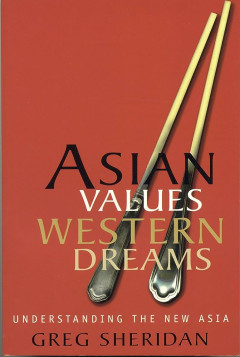
Asian values Western dreams: Understanding the new Asia
This text provides an examination of one of the most controversial issues in Asia today - how the region reconciles its homegrown values with the conflicting and often Western values of modernization, globalization and economic development. In a series of chapters, each devoted to a country, the book explores just what "Asian values" - a highly charged term in modern Asia - means to the individ…
- Edisi
- -
- ISBN/ISSN
- 1-86448-496-9
- Deskripsi Fisik
- x, 326 pages ; 23 cm
- Judul Seri
- -
- No. Panggil
- 303.4825 She a
America's role in Asia: Asian views
In the post-Cold War world, U.S. Asian relations remain central to U.S. policy. Fault lines in the Taiwan Straits and on the Korean peninsula require the daily vigilance of U.S. and Asian policymakers. Asia's continued recovery from the 1997 financial crisis depends in part upon the health of the American economy. And as domestic political change accelerates across Asia, relations must be recal…
- Edisi
- First Edition
- ISBN/ISSN
- 9781892325037
- Deskripsi Fisik
- xii, 102 pages ; 23 cm
- Judul Seri
- -
- No. Panggil
- 330. 973 95 Asi a
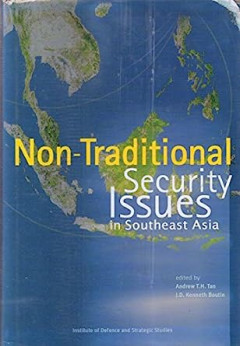
Non-traditional security issues: In South East Asia
The regional economic crisis of 1997 greatly affected Southeast Asia, with Thailand, Indonesia, the Philippines and Malaysia grappling with economic and currencies. In Indonesia, in particular, the consequences of the crisis have been far-reaching and traumatic. Indeed, the aftermath of the crisis has placed into focus such issues as the impact of globalisation on security, the subject of gover…
- Edisi
- -
- ISBN/ISSN
- 9814022160
- Deskripsi Fisik
- iv, 581 pages : illustration ; 24 cm
- Judul Seri
- -
- No. Panggil
- 327. 1160959 Tan n

Political Islam in Southeast Asia: Moderates, radicals and terrorists
Events since 11 September 2001 have dramatically altered the security environment in the Muslim world and in Southeast Asia in particular. With the uncovering of an extensive terrorist network in Southeast Asia, the region has emerged as a major battleground in the global war on terrorism. Yet the issues raised by political Islam in Southeast Asia are much broader than the problem of terrorism.…
- Edisi
- First Edition
- ISBN/ISSN
- 0198529112
- Deskripsi Fisik
- 82 pages : illustration ; 23 cm
- Judul Seri
- -
- No. Panggil
- 297. 0959 Rab p

Democratic transitions in Asia
"Democratic Transitions in Asia" focuses on political changes in the Asian region. Since the 1997 economic crisis, countries of the region are seeing greater demands for the accountability of leaders. Symbolic of the region's continuing struggle for democratisation, the President of South Korea, Kim Dae Jung was awarded the Nobel Peace Prize in 2000, joining other recent Asian Nobel laureates, …
- Edisi
- -
- ISBN/ISSN
- 9814022179
- Deskripsi Fisik
- iv, 286 pages ; illustration ; 22 cm
- Judul Seri
- -
- No. Panggil
- 320. 959 Joh d
 Karya Umum
  Filsafat
  Agama
Agama  Ilmu-ilmu Sosial
  Bahasa
  Ilmu-ilmu Murni
  Ilmu-ilmu Terapan
  Kesenian, Hiburan, dan Olahraga
  Kesusastraan
  Geografi dan Sejarah