Ditapis dengan
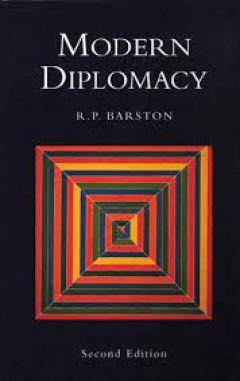
Modern diplomacy
For this Second Edition, Modern Diplomacy has been extensively updated and expanded to take in not only important changes in diplomacy, but also several new chapters. These cover environmental diplomacy, mediation, the process of normalisation and case examples of environmental negotiations and international agreements.
- Edisi
- Second Edition
- ISBN/ISSN
- 0-582-09953-6
- Deskripsi Fisik
- xiv, 308 pages : index ; 22 cm
- Judul Seri
- -
- No. Panggil
- 327.2 Bar m

Nuclear politics: Towards a safer world
The past few years have witnessed a number of remarkable developments in the field of nuclear arms control and non proliferation. The United States and the Soviet Union (now Russia) signed the START I and II agreements, which promised to reduce the nuclear arsenals of the two countries by two-thirds, to approximately 3,000 nuclear warheads each by the year 2003. President Bush's announcement on…
- Edisi
- -
- ISBN/ISSN
- 1-932705-02-3
- Deskripsi Fisik
- ix, 672 pages : bibl: hlm 626-650 : index ; 22 cm
- Judul Seri
- -
- No. Panggil
- 327.174 Cho m

Non-aligned movement : Its future and action programme
This book comes out of papers and comments presented during the international conference on The Future of the Non-Aligned Movement held by CSIS 16-17 June 1992, and it reflects the interests and aspirations of the participants. The conference was attended by participants from Non-Aligned countries - India, Indonesia, Yugoslavia, Pakistan, Ghana, Cyprus, Malaysia, Vietnam and Egypt.
- Edisi
- First Published
- ISBN/ISSN
- 979-8026-22-5
- Deskripsi Fisik
- vi, 115 pages ; 21 cm
- Judul Seri
- -
- No. Panggil
- 327.11 Ban n

Emergent actors in world politics: How states & nations develop & dissolve
The disappearance and formation of states and nations after the end of the Cold War have proved puzzling to both theorists and policymakers. Lars-Erik Cederman argues that this lack of conceptual preparation stems from two tendencies in conventional theorizing. First, the dominant focus on cohesive nation-states as the only actors of world politics obscures crucial differences between the state…
- Edisi
- -
- ISBN/ISSN
- 0-691-02148-1
- Deskripsi Fisik
- xiv, 258 pages : illustrations (black and white) : bibl: hlm 233-253 : index ; 23 cm
- Judul Seri
- -
- No. Panggil
- 327.101 Ced e

Non-aligned movement in a changing world
This book contains publications about the non-aligned movement in a changing world that show the political, economic and social emancipation of the third non-aligned movement. The sequence of events starting with the unique Bandung Conference, followed by the meetings in Brioni and Cairo, culminated at the 1961 Belgrade Summit which formally started the periodic gatherings of the Heads of State…
- Edisi
- -
- ISBN/ISSN
- 979-8373-00-6
- Deskripsi Fisik
- iv, 148 pages : illustrations ; 21 cm
- Judul Seri
- -
- No. Panggil
- 327.1 Sia n
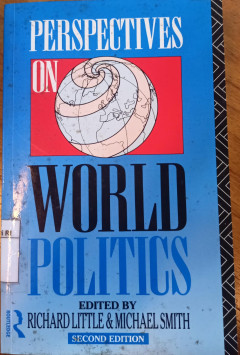
Perspectives on world politics
Perspectives on World Politics has been essential reading for students of international relations since the start of the 1980s. Its focus on three competing perspectives provides a clear and coherent organization of the divergent conceptual tools used to study world politics. Since the first edition was published, however, the orientation of each of the three perspectives has evolved and an imp…
- Edisi
- Second edition
- ISBN/ISSN
- 0-415-05624-1
- Deskripsi Fisik
- vii, 478 pages : illustrations : index ; 22 cm
- Judul Seri
- -
- No. Panggil
- 327.1 Lit p

The global future: A brief introduction to world politics
The global future introduces you to the field of international relations while providing you with a set of concepts and analytic tools to help you understand contemporary events and emerging global trends. Contents: Part I. Trend and transformation in world politics Part II. The actors in world politics Part III. The politics of global security Part IV. The politics of global welfare Pa…
- Edisi
- Second Edition
- ISBN/ISSN
- 978-0-495-00748-7
- Deskripsi Fisik
- xxi, 386 pages : illustrations : maps : index ; 24 cm
- Judul Seri
- -
- No. Panggil
- 327.1 Keg g

Hollow hegemony: Rethinking global Politics, power and resistance
There is a widespread belief today that politics, power and resistance operate at the global level rather than at the level of nation states - the traditional subjects of international relations. This shift, from the national to the global, is asserted as much by representatives of leading western states and international institutions as it is by the radical critics of the international order. …
- Edisi
- First published
- ISBN/ISSN
- 978-0-7453-2920-8
- Deskripsi Fisik
- ix, 255 pages : index ; 22 cm
- Judul Seri
- -
- No. Panggil
- 327.1 Cha h

International politics: States, power, and conflict since 1945
International politics (or international relations) is a subject rather than a discipline, a field rather than a form of knowledge. In contrast to a discipline, which is distinguished chiefly by the application of a singular form of testing to its propositions, a subject derives its identity simply from its focus of analysis (or 'subject matter'); its tests of truth are borrowed from the discip…
- Edisi
- 2nd edition
- ISBN/ISSN
- 0-7450-0987-5
- Deskripsi Fisik
- xiv, 249 pages : illustration : index ; 24 cm
- Judul Seri
- -
- No. Panggil
- 327.1 Ber i

The globalization of world politics: An introduction to international relations
The Globalization of World Politics is the essential text for all International Relations students. With its established authority and reputation, the new edition is an invaluable resource, which provides a clear and insightful introduction to International Relations and acts as a comprehensive point of reference thereafter.
- Edisi
- 3rd edition
- ISBN/ISSN
- 0-19-927118-6
- Deskripsi Fisik
- xxxvii, 811 pages : illustrations : index ; 25 cm
- Judul Seri
- -
- No. Panggil
- 327.1 Bay g
 Karya Umum
  Filsafat
  Agama
Agama  Ilmu-ilmu Sosial
  Bahasa
  Ilmu-ilmu Murni
  Ilmu-ilmu Terapan
  Kesenian, Hiburan, dan Olahraga
  Kesusastraan
  Geografi dan Sejarah