Ditapis dengan

Power! Black workers, their unions and the struggle for freedom in South Africa
POWER! examines the crucial role of Black workers and trade unions in the struggle against apartheid in South Africa. Written by Denis MacShane, Martin Plaut, and David Ward, the book illustrates how the labor movement contributed to social and political change through industrial action, grassroots organizing, and civil disobedience. The analysis demonstrates the close relationship between econ…
- Edisi
- -
- ISBN/ISSN
- 0-89608-244-X
- Deskripsi Fisik
- 195 pages ; 21 cm
- Judul Seri
- -
- No. Panggil
- 331.88 MAC p
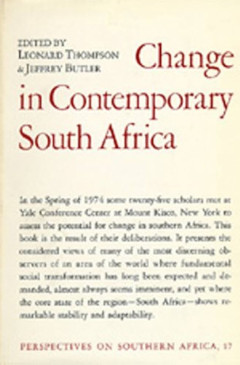
Change in contemporary South Africa
In the Spring of 1974 some twenty-five scholars met at Yale Conference Center at Mount Kisco, New York to assess the potential for change in southern Africa. This book is the result of their deliberations. It presents the considered views of many of the most discerning observers of an area of the world where fundamental social transformation has long been expected and de-manded, almost always s…
- Edisi
- -
- ISBN/ISSN
- 0-520-02839-2
- Deskripsi Fisik
- 447 pages; 24 cm
- Judul Seri
- -
- No. Panggil
- 320.968 THO c

The White tribe of Africa : South Africa in perspective
To their many detractors, Afrikaners are impractical, wild-eyed, racist fanatics. To their less numerous supporters, they are fervent anti-Communist crusaders, safeguarding stability and progress at the tip of the 'dark continent'. These strongly held, politically charged, and incompatible views make it virtually impossible for outsiders to distance themselves sufficiently, both intellectually …
- Edisi
- -
- ISBN/ISSN
- 0-520-05066-5
- Deskripsi Fisik
- vii, 307 pages : illustrations ; 24 cm
- Judul Seri
- -
- No. Panggil
- 305.896 HAR w
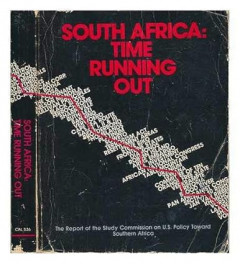
South Africa: Time running out
South Africa. Many Americans regard it as remote and of little concern United States. Yet within the past few yegrs it has become increasingly important to our country. How dependent is America on South Africa's strategic minerals? Can the United States do anything to help end apartheid? How dangerous is South Africa as a potential point of entry for Soviet influence? Is the Cape sea route u…
- Edisi
- -
- ISBN/ISSN
- 0-520-04594-1
- Deskripsi Fisik
- xxvii, 517 pages : illustrations ; 23 cm
- Judul Seri
- -
- No. Panggil
- 327.73068 STU s
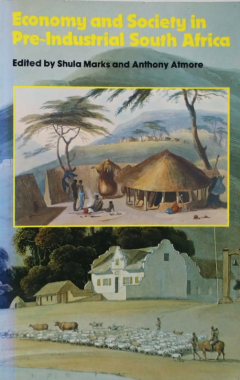
Economy and society in pre-industrial South Africa
Over the past forty years there has been a revolution in South African historiography, yet no broadly interpretative essay on South African history has appeared. The essays in this volume aim to provide such a reinterpretation for the nineteenth century before the discovery of minerals transformed the nature of South African societies, and help to shed light on earlier phases of South Africa's …
- Edisi
- -
- ISBN/ISSN
- 0-582-64656-1
- Deskripsi Fisik
- 385 pages ; 22 cm
- Judul Seri
- -
- No. Panggil
- 330.68 MAR e
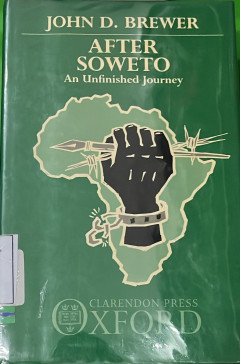
After Soweto : An Unfinished journey
The 1976 uprising in Soweto transformed the nature of both internal and external opposition to apartheid in South Africa, and the effects of this vociferous and sustained protest are felt more strongly than ever today. This book examines the nature of opposition among the African community to apartheid in the crucial years since Soweto by analysing internal African initiatives for bringing abou…
- Edisi
- -
- ISBN/ISSN
- 0-19-827480-7
- Deskripsi Fisik
- xv, 448 pages ; 22 cm
- Judul Seri
- -
- No. Panggil
- 305.800968 BRE a

Up against apartheid : The Role and the plight of the press in South Africa
A firsthand report of the workings of the press in the intensely troubled nation, complete with portions of the Erasmus Commission Reports never before published in the United States on the so-called Muldergate scandal. Pollak was the co-founder and editor of MORE magazine, which specialized in media analysis. After observing the workings of the press in South Africa, he believes that in…
- Edisi
- -
- ISBN/ISSN
- 0-8093-1013-9
- Deskripsi Fisik
- 157 pages ; 21 cm
- Judul Seri
- -
- No. Panggil
- 079.68 POL u

U.S. Relations With South Africa, An Annotated Bibliography
A comprehensive annotated bibliography of books and mono-graphs, journal articles, government documents, documents of nongovernmental organizations, and substantive magazine and newspaper articles published since the late nineteenth century. Annotated entries contain a short abstract, a table of contents, and information on reviews. Each volume contains an author and subject index, and a period…
- Edisi
- Volume One
- ISBN/ISSN
- 0-8133-7138-4
- Deskripsi Fisik
- xvi, 468 pages : index ; 23 cm
- Judul Seri
- -
- No. Panggil
- 327.73068 Lul u

International diplomacy in Southern Africa: From Reagan to Mandela
This book will prove an essential resource for students and scholars of political science, international affairs and history. It is useful to journalists, government officials, diplomats and all those with a keen interest in con- temporary Southern African politics and events in that region.
- Edisi
- -
- ISBN/ISSN
- 0951635409
- Deskripsi Fisik
- 195 pages : index ; 21 cm
- Judul Seri
- -
- No. Panggil
- 327.68073 Cha i
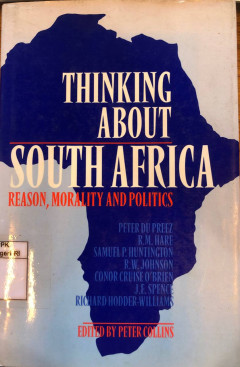
Thinking about South Africa: Reason, morality and politics
Since 1948, South Africa has moved from being a respected member of the British Commonwealth to being a pariah state of the world. How has this come about and what can be done about it? Why, indeed, does it generate far more intense moral passion than do other, arguably worse, regimes?
- Edisi
- First Published
- ISBN/ISSN
- 0-7450-0501-2
- Deskripsi Fisik
- x, 205 pages : index ; 23 cm
- Judul Seri
- -
- No. Panggil
- 320.968 Col t
 Karya Umum
  Filsafat
  Agama
Agama  Ilmu-ilmu Sosial
  Bahasa
  Ilmu-ilmu Murni
  Ilmu-ilmu Terapan
  Kesenian, Hiburan, dan Olahraga
  Kesusastraan
  Geografi dan Sejarah