Ditapis dengan
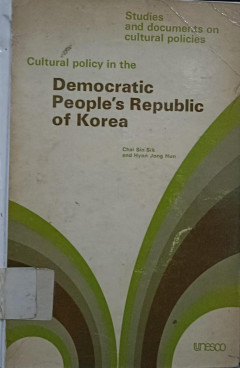
Cultural policy in the Democratic People's Republic of Korea
This book explains the cultural policies of the Democratic People's Republic of Korea, emphasizing the role of culture in the construction of socialism. Discussions include cultural education, the arts, media, historical preservation, and the role of culture in mass mobilization. It demonstrates how state policies are directed at shaping national identity and ideological allegiance through art …
- Edisi
- -
- ISBN/ISSN
- 92-3-101645-8
- Deskripsi Fisik
- 39 pages : 24 cm
- Judul Seri
- -
- No. Panggil
- 306.209519 SIK c
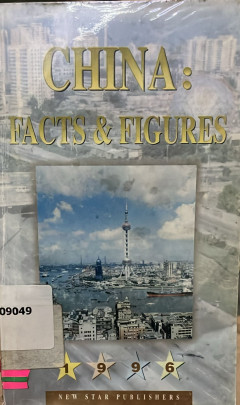
China : Facts and figures 1996
China: Facts and Figures 1996 is a comprehensive reference book that presents the latest data, statistics, and information on the People's Republic of China in the mid-1990s. This book provides a comprehensive overview of the political, economic, social, and cultural conditions, as well as scientific and technological developments in China after two decades of reform and openness. Through table…
- Edisi
- -
- ISBN/ISSN
- 7-80102-497-4
- Deskripsi Fisik
- 87 pages : illustrations ; 18 cm
- Judul Seri
- -
- No. Panggil
- 951.09049 BEI c
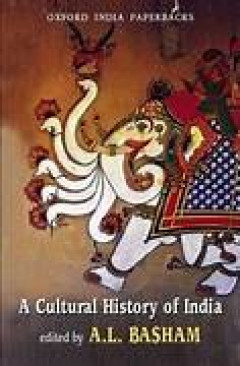
A Cultural History of India
The book covers important aspects such as religion, philosophy, social organization, literature, art, architecture, music, and scientific developments. It also includes a special section on the influence of Indian civilization on the world, as well as on Indian political history, which provides a chronological framework for non-specialist readers. Contributors include renowned figures such as S…
- Edisi
- -
- ISBN/ISSN
- 0-19-563921-9
- Deskripsi Fisik
- xx, 585 pages : illustrations ; 23,7 cm
- Judul Seri
- -
- No. Panggil
- 954 BAS c
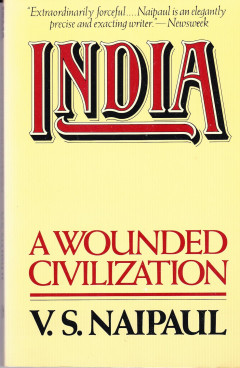
India: A Wounded civilization
V. S. Naipaul's India: A Wounded Civilization is both a personal reflection and a trenchant analysis of India, written after his visit to the country in 1975 during the Emergency. Naipaul examines India's complex history, religion, and social structure, arguing that centuries of foreign rule have left deep psychological and cultural scars. He depicts a nation grappling with poverty, disillusion…
- Edisi
- -
- ISBN/ISSN
- 0-394-72463-1
- Deskripsi Fisik
- xi, 191 pages ; 20 cm
- Judul Seri
- -
- No. Panggil
- 954 NAI i

Jawaharlal Nehru: The Discovery of India
The Discovery of India by Jawaharlal Nehru is a profound and reflective work written during his imprisonment at Ahmadnagar Fort (1942–1945). Nehru writes about India’s vast cultural, historical, and philosophical journey — from the ancient Indus Valley civilization, through the Vedic period, all the way to the British colonial era and the rise of nationalism. He draws on texts like the Ve…
- Edisi
- -
- ISBN/ISSN
- -
- Deskripsi Fisik
- 582 pages ; 21 cm
- Judul Seri
- -
- No. Panggil
- 954.042 GAN j
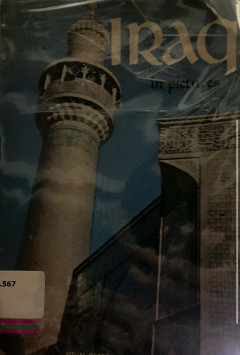
Iraq in pictures
Iraq in Pictures offers a visual portrayal of Iraq through a collection of photographs that capture the country’s landscapes, cultural heritage, historical landmarks, and daily life. The book provides an accessible overview of Iraq’s diverse regions, showcasing its ancient civilizations, urban environments, and vibrant traditions. Through vivid imagery and concise descriptions, this pictori…
- Edisi
- 1
- ISBN/ISSN
- 0-8069-01114-8
- Deskripsi Fisik
- 64 pages : illustrations ; 24,5 cm
- Judul Seri
- -
- No. Panggil
- 915.5 TET i

Japanese culture A Study of origins and characteristics
Explores the historical roots and key characteristics of Japanese cultural identity. Through an anthropological perspective, Ishida examines how geography, early social structures, religious traditions, and external influences shaped Japan’s values, rituals, and patterns of thought. The book offers a concise overview of the main cultural factors that have defined Japan’s development over time.
- Edisi
- -
- ISBN/ISSN
- -
- Deskripsi Fisik
- ix, 156 pages ; 23,5 cm
- Judul Seri
- -
- No. Panggil
- 306.152 ISH j
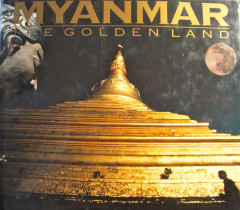
Myanmar : The Golden land
This book provides a comprehensive overview of Myanmar, covering its geography, social diversity, and cultural traditions that shape the country's identity. It begins with an introduction to Myanmar's history and general characteristics, followed by a discussion of its landscape, social life, and preserved traditions. The main section of the book explores important regions such as Mandalay and …
- Edisi
- -
- ISBN/ISSN
- -
- Deskripsi Fisik
- 114 pages : ilustrations ; 25 cm
- Judul Seri
- -
- No. Panggil
- 915.591 OHN m
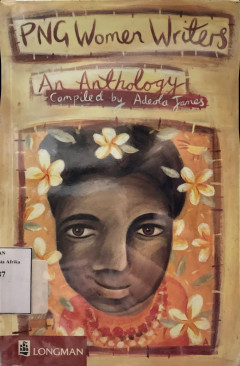
PNG women writers an anthology: Compiled by Adeola James
PNG Women Writers: An Anthology is a groundbreaking collection that highlights the voices and creative expressions of women authors from Papua New Guinea. Compiled by Adeola James, the anthology brings together poems, short stories, essays, and personal reflections that illuminate women’s experiences within the cultural, social, and political landscape of PNG. The works explore themes such as…
- Edisi
- First Edition
- ISBN/ISSN
- 0 582 80943 6
- Deskripsi Fisik
- x, 310 pages; 21,5 cm
- Judul Seri
- -
- No. Panggil
- 820.8 JAM p

The Enigma of Japanese power: People and politics in a stateless nation
The Enigma of Japanese Power explores the underlying mechanisms of Japan’s political, economic, and social system from a critical outsider’s perspective. Karel van Wolferen argues that despite its outward cohesion and stability, Japan’s power structure lacks a truly independent state in the Western sense: its institutions act as intermediaries rather than sovereign rulers. The book delves…
- Edisi
- -
- ISBN/ISSN
- 0-333-44321-7
- Deskripsi Fisik
- 496 pages ; 21,5 cm
- Judul Seri
- -
- No. Panggil
- 952.048 WOL e
 Karya Umum
  Filsafat
  Agama
Agama  Ilmu-ilmu Sosial
  Bahasa
  Ilmu-ilmu Murni
  Ilmu-ilmu Terapan
  Kesenian, Hiburan, dan Olahraga
  Kesusastraan
  Geografi dan Sejarah