Ditapis dengan

The commanding heights: The battle of the government and the marketplace that…
The "commanding heights," according to Pulitzer Prize-winner Daniel Yergin and international business advisor Joseph Stanislaw, are those dominant enterprises and industries that form the high economic ground in nations around the globe. In their analysis of the new world economy, The Commanding The Battle Between Government and the Marketplace That Is Remaking the Modern World, they examine "t…
- Edisi
- -
- ISBN/ISSN
- 0-684-82975-4
- Deskripsi Fisik
- 457 pages : illustration (black and white) ; 24 cm.
- Judul Seri
- -
- No. Panggil
- 338.9 Yer c

Inside the new Europe
The purpose of this book is to tell the story of contemporary Western Europe's slow, determined effort to become a more powerful and, above all, a united force in world affairs. It will attempt to explain how and why the Common Market, for the first time since its founding in 1958, is challenging the United States and Japan for dominance in world trade and high technology. The buildup of Europe…
- Edisi
- Cetakan Pertama
- ISBN/ISSN
- 0060391014
- Deskripsi Fisik
- xv, 356 pages ; 25 cm
- Judul Seri
- -
- No. Panggil
- 337. 142 Kra i

The age of sustainable development
Jeffrey D. Sachs has shown himself to be one of the world's most perceptive and original analysts of global development in his groundbreaking books, including The End of Poverty and Common Wealth: Economics for a Crowded Planet. Now, in this major new work he presents a compelling and practical framework for how global citizens can address the seemingly intractable worldwide problems of persist…
- Edisi
- -
- ISBN/ISSN
- 978-1515910879
- Deskripsi Fisik
- xvi, 543 pages : illustration ; 23 cm.
- Judul Seri
- -
- No. Panggil
- 338.927 Sac a
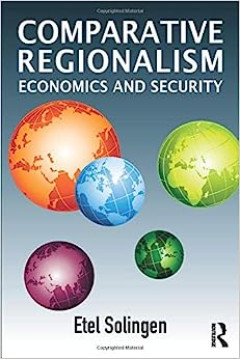
Comparative regionalism economics and security
This book comprises key essays on comparative regionalism and, more broadly, on regional conflict and cooperation by Professor Etel Solingen. The study of regionalism, a subject pioneered by Solingen in the 1990s, is now an established field of inquiry, with a large community of scholars and practitioners around the world. This book provides a window into an evolving conceptual framework for c…
- Edisi
- cet.1
- ISBN/ISSN
- 978-0-415-62779-0
- Deskripsi Fisik
- xiv, 290 pages : illustrations (black and white) ; 23 cm
- Judul Seri
- -
- No. Panggil
- 337 Sol c

The limits of government: An essay on the public goods argument
The most widely accepted justification for political authority is that coercive institutions are necessary to provide for public goods. Making use of the tools of rational choice theory, economics, and the law of contracts, the author offers a critique of this argument. Along the way, he makes significant contributions to our understanding of the logic of contractarian arguments, the prisoner's…
- Edisi
- -
- ISBN/ISSN
- 0813308704
- Deskripsi Fisik
- xviii, 197 pages ; 23 cm.
- Judul Seri
- -
- No. Panggil
- 338.9 Sch l

Solutions for the world's biggest problems: Costs and benefits
Solutions for the World's Biggest Problems offers a rigorous overview of twenty-three of the world's biggest problems relating to the environment, governance, economics, and health and population. Leading economists provide a short survey of the state-of-the-art analysis and sketch out some promising policy solutions for which they provide cost-benefit ratios.
- Edisi
- First Published
- ISBN/ISSN
- 9780521715973
- Deskripsi Fisik
- xvii, 442 pages : illustration ; 24 cm
- Judul Seri
- -
- No. Panggil
- 338.9 Lom s

In defense of globalization
In the passionate debate that currently rages over globalization, critics have been heard blaming it for a host of ills afflicting poorer nations, everything from child labor to environmental degradation and cultural homogenization. Now Jagdish Bhagwati, the internationally renowned economist, takes on the critics, revealing that globalization, when properly governed, is in fact the most powerf…
- Edisi
- -
- ISBN/ISSN
- 978-0-19-533093-9
- Deskripsi Fisik
- xii, 330 pages : illustrations (black and white) ; 23 cm
- Judul Seri
- -
- No. Panggil
- 337 Bha i

Globalization and its discontents
Globalization and its discontents adalah sebuah buku yang diterbitkan pada tahun 2002 oleh pemenang Nobel 2001 Joseph E. Stiglitz. Buku ini mengacu pada pengalaman pribadi Stiglitz sebagai ketua Dewan Penasihat Ekonomi di bawah Bill Clinton dari tahun 1993 dan kepala ekonom di Bank Dunia dari tahun 1997. Selama periode ini Stiglitz menjadi kecewa dengan IMF dan lembaga-lembaga internasional lai…
- Edisi
- -
- ISBN/ISSN
- 0-393-05124-2
- Deskripsi Fisik
- xxii, 288 pages ; 21 cm
- Judul Seri
- -
- No. Panggil
- 337 Sti g

The collapse of globalism
Globalization, like many great geopolitical ideologies before it, is now dead. Despite the almost-religious certainty with which it was originally conceived, a growing vagueness now surrounds the original promise of the global ideal that the fading power of nation states would be replaced by global markets that economics, not politics or arms, would determine the course of human events and that…
- Edisi
- -
- ISBN/ISSN
- 1-84354-408-3
- Deskripsi Fisik
- 309 pages ; 24 cm
- Judul Seri
- -
- No. Panggil
- 337 Sau c

How rich countries got rich...and why poor countries stay poor
In this refreshingly revisionist history, Erik Reinert shows how rich countries developed through a combination of government intervention, protectionism, and strategic investment, rather than through free trade. Reinert suggests that this set of policies in various combinations has driven successful development from Renaissance Italy to the modern Far East. Yet despite its demonstrable sucess,…
- Edisi
- -
- ISBN/ISSN
- 978-1-84529-874-6
- Deskripsi Fisik
- vi, 365 pages ; 23,5 cm.
- Judul Seri
- -
- No. Panggil
- 338.900922 Rei h
 Karya Umum
  Filsafat
  Agama
Agama  Ilmu-ilmu Sosial
  Bahasa
  Ilmu-ilmu Murni
  Ilmu-ilmu Terapan
  Kesenian, Hiburan, dan Olahraga
  Kesusastraan
  Geografi dan Sejarah