Ditapis dengan

The role of the nation-state in the 21st century: Human rights, international…
The premise of this paper is that the international human rights movement is facing growing problems of irrelevance to people's daily concerns, marginalisation in local and global politics, and cooptation by ruling elites, privileged classes and global economic forces in local as well as global politics. In order to resolve these problems, the movement needs to critically re-examine some of its…
- Edisi
- -
- ISBN/ISSN
- 9041111417
- Deskripsi Fisik
- xv, 504 pages : illustrations ; 25 cm
- Judul Seri
- -
- No. Panggil
- 341.481 Bae r
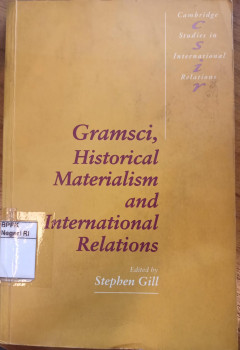
Gramsci, historical materialism and international relations
The essays collected here relate the writings of Antonio Gramsci and others to the contemporary reconstruction of historical materialist theories of international relations. The contributors analyse the contradiction between globalized and territorially based social and political forces in the context of past, present, and future world orders, and view the emerging world order as undergoing a s…
- Edisi
- -
- ISBN/ISSN
- 521435234
- Deskripsi Fisik
- xii, 320 pages ; 23 cm
- Judul Seri
- -
- No. Panggil
- 327.101 Gil g

New millennium, new perspectives: The United Nations, security, and governance
New Millennium, New Perspectives:The United Nations, Security, and Governance analyzes a number of pressing international challenges relating to security and gover nance in a policy oriented, forward looking manner.The authors address a number of overarching questions - such as the impact of globalization, key challenges in the short and medium terms, the manner in which national governments an…
- Edisi
- -
- ISBN/ISSN
- 9280810545
- Deskripsi Fisik
- vii, 334 pages : index ; 24 cm
- Judul Seri
- -
- No. Panggil
- 320 Tak n

Annual report of the Asean standing committee 1984-1985
Annual Report of the ASEAN Standing Committee 1984-1985 the book chronicles the activities, achievements, and challenges faced by the ASEAN Standing Committee during the period of 1984-1985. The ASEAN Standing Committee served as a crucial body responsible for coordinating and facilitating the efforts of the Association of Southeast Asian Nations (ASEAN) member states to enhance regional cooper…
- Edisi
- -
- ISBN/ISSN
- -
- Deskripsi Fisik
- 141 pages ; 31 cm
- Judul Seri
- -
- No. Panggil
- 330. 959 Ind a

The little red dot: Reflections by Singapore's diplomats
This book provides a fascinating set of insights into Singaporean diplomacy and demonstates how the excellence of Singapore's foreign service has enabled the country to punch far above its weight in international affairs. A must read for anyone interested in the exercise of foreign policy.
- Edisi
- -
- ISBN/ISSN
- 9812564144
- Deskripsi Fisik
- 469 pages : 23 cm.
- Judul Seri
- -
- No. Panggil
- 327. 20922 Koh l
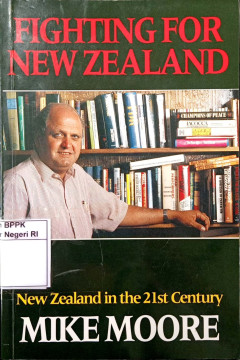
Fighting for New Zealand: New Zealand in the 21st century
Here Mike Moore examines the implications of the post industrial economy, the emerging information age, and how New Zealand can best prosper within the global economy. He warns of the serious economic consequences of ignoring our social, intellectual and infrastructural deficits and makes a case for New Zealand's endangered middle class, advancing the significant proposition that New Zealand mo…
- Edisi
- First Edition
- ISBN/ISSN
- 0-473-01769-5
- Deskripsi Fisik
- viii, 197 pages ; 20 cm
- Judul Seri
- -
- No. Panggil
- 993.1 Moo f

Through secret channels: The Road to Oslo : Senior plo leader Abu Mazen's rev…
The book tells the story of the clandestine contacts between the Israelis and the PLO which culminated in the crucial talks in Oslo. Mahmoud Abbas, who wielded great influence from behind the scenes, also explains how the negotiating team (led by Abu Ala) and their Israeli counterparts overcame their mutual suspicion and how, despite various setbacks, they used the freedom afforded by secrecy f…
- Edisi
- First English Edition
- ISBN/ISSN
- 1-85964-047-8
- Deskripsi Fisik
- 252 pages : index ; 25 cm
- Judul Seri
- -
- No. Panggil
- 956 Abb t

The role of security and economic cooperation structures in the Asia Pacific …
On 12 November 1995 CSIS in conjunction with Australian Defence Studies Centre (ADSC), Canberra organised a workshop on "Potential Linkages between Economic and Regional Security Fora". The papers presented at the workshop have been edited and compiled in this volume entitled The Role of Security and Economic Cooperation Structures in the Asia Pacific Region Indonesian and Australian Views This…
- Edisi
- -
- ISBN/ISSN
- 979-8026-42-X
- Deskripsi Fisik
- vi, 168 pages ; 25 cm
- Judul Seri
- -
- No. Panggil
- 341.720 918 23 Soe r

Global paradox: The bigger the world economy, the more powerful its smallest …
Book Megatrends (1982) sold more than 8 million copies world wide and remained at the top of the bestseller lists for two years. That book, and Megatrends 2000, established John Naisbitt as one of the world's foremost forecasters of social, economic, political and cultural trends. In those books, he accurately predicted trends ranging from the globalisation of the econo- my to the surging Impac…
- Edisi
- -
- ISBN/ISSN
- 1-85788-051-X
- Deskripsi Fisik
- 304 pages ; 24 cm
- Judul Seri
- -
- No. Panggil
- 330.900112 Nai g

The quest for world order: Perspectives of a pragmatic idealist
A collection of speeches and writings by Professor Tommy Koh, Singapore's long-time ambassador to the UN. He provides an insider's view of the workings and failings of the UN system, multilateral negotiations, bargaining, and Singapore's economic progress and foreign policy options. Accessible to general readers, policy makers, and academic specialists interested in international organizations …
- Edisi
- Cetakan Pertama
- ISBN/ISSN
- 981-210-108-x
- Deskripsi Fisik
- xxxi, 416 pages : illustrations, index ; 22 cm
- Judul Seri
- -
- No. Panggil
- 327.1 Koh q
 Karya Umum
  Filsafat
  Agama
Agama  Ilmu-ilmu Sosial
  Bahasa
  Ilmu-ilmu Murni
  Ilmu-ilmu Terapan
  Kesenian, Hiburan, dan Olahraga
  Kesusastraan
  Geografi dan Sejarah