Ditapis dengan

1999 Victory without war
In 1999 the former President answers all these questions and others. He gives us the basis for understanding how the world operates and how the United States should operate in the world. As we come to the end of this century of war and wonder of unprecedented bloodshed and political turmoil 1999 is an indispensable guide for avoiding repetition of our past mistakes as a nation, and fulfilling o…
- Edisi
- -
- ISBN/ISSN
- 0671627120
- Deskripsi Fisik
- 336 pages : index ; 25 cm
- Judul Seri
- -
- No. Panggil
- 327.73 Nix v

From dominoes to dynamos: The transformations of Southeast Asia
The demise of America's Cold War-era foreign policy, has transformed Southeast Asia's relationship with the United States. No longer seen in the political context of communist containment, the countries of Southeast Asia - Thailand, Indonesia, Malaysia, Singapore, the Philippines, and Vietnam - are becoming increasingly powerful players in the world economy. Their unparalleled economic growth w…
- Edisi
- -
- ISBN/ISSN
- 0-87609-166-4
- Deskripsi Fisik
- x, 115 pages : ilustrasi ; 23 cm
- Judul Seri
- -
- No. Panggil
- 330. 959053 Bre f

The great universal embrace: Arms summitry-a skeptic's account
In The Great Universal Embrace, Kenneth L. Adelman-President Reagan's colorful arms advisor-delivers an outspoken book on why arms talks don't reduce arms and an insider's view of how foreign and defense policies were made and misunderstood during the Reagan era. Adelman's wit and easy way with words make this enormously important topic understandable and compelling. And, for once, the message …
- Edisi
- -
- ISBN/ISSN
- 0-671-67206-1
- Deskripsi Fisik
- 366 pages ; 25 cm
- Judul Seri
- -
- No. Panggil
- 327.1740973 Ade g
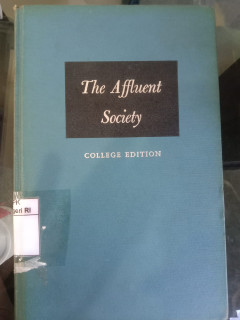
The affluent society
On the whole, economics is rather progressive in making the improvements and refinements and rather backward in accommodating itself to underlying change. Dozens of com- petent scholars have labored to show how the individual and the community react to the problem of consumer choice. Demand curves and indifference surfaces have given increas- ing precision to these ideas. The course by which, i…
- Edisi
- -
- ISBN/ISSN
- -
- Deskripsi Fisik
- xiv, 368 index ; 21 cm
- Judul Seri
- -
- No. Panggil
- 339.2 Gal a
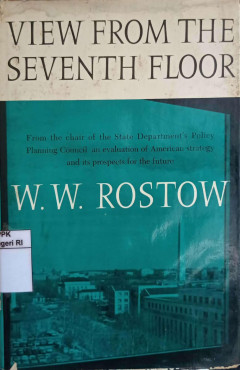
View from the seventh floor
This book contains the relationship between American diplomacy and military policy and global strategy. The book's five sections cover the broad lines of America's strategy and the relation between force and diplomacy; the home base for our foreign policy: our relations with the free world's more advanced nations and our efforts to build a global partner- ship which will supplant the postwar re…
- Edisi
- -
- ISBN/ISSN
- -
- Deskripsi Fisik
- xi, 178 pages : index ; 22 cm
- Judul Seri
- -
- No. Panggil
- 337.73 Ros v

The stages of economic growth: A non-communist manifesto
This book is a generalitation from the whole span of modern history. It gives an account of economic growth, based on a dynamic theory of production and interpreted in terms of actual societies. It helps to explain historical changes and to predict major political and economic trends: and it provides the significant links between economic and non-economic behavior which Karl Marx failed to discern
- Edisi
- -
- ISBN/ISSN
- -
- Deskripsi Fisik
- x, 178 pages : index ; 21 cm
- Judul Seri
- -
- No. Panggil
- 338.9 Ros s

The price of power: Kissinger in the Nixon White House
This book is an account of the foreign policy of the United States, led by Henry Kissinger, during Richard Nixon's first term in the White House. It is also a story of a collaborative relationship that appears to be a series of diplomatic victories that can be reshaped. These were the years when China was reclaimed by American diplomacy; when the much-touted agreement on Strategic Arms Limitati…
- Edisi
- -
- ISBN/ISSN
- 0-671-44760-2
- Deskripsi Fisik
- 698 pages ; 24 cm
- Judul Seri
- -
- No. Panggil
- 327.73 Her p

The intemperate zone: The third world challenge to U.S foreign policy
There is at last a lucid, penetrating and comprehensive guidebook for U.S. policy in the Third World. And Richard Feinberg has written it. The Intemperate Zone displays encyclopedic knowledge at the command of a mind equally at home with strategic and moral issues. A gracefully written book for experts and amateurs alike
- Edisi
- -
- ISBN/ISSN
- 0-393-30143-5
- Deskripsi Fisik
- 287 pages : index ; 20 cm
- Judul Seri
- -
- No. Panggil
- 327.73 Fei i

Self-determination in the new world order
In this book, the authors review U.S. and international responses to self-determination claims during and after the Cold War. Arguing that outdated Cold War perspectives continue to influence the current policies of the United States and the international community toward self-determination movements, they provide a framework for evaluating the nature and legitimacy of self-determination moveme…
- Edisi
- -
- ISBN/ISSN
- 0-87003-018-3
- Deskripsi Fisik
- xiv, 178 pages ; 23 cm
- Judul Seri
- -
- No. Panggil
- 327.73 Hal s

Madam secretary a memoir
Madam Secretary: A Memoir is the autobiography of United States Secretary of State Madeleine Albright, published in 2003. It covers both her life and the eight years she spent in the Clinton administration, first as United States Ambassador to the United Nations and then as head of the State Department.
- Edisi
- -
- ISBN/ISSN
- 0-7868-6843-0
- Deskripsi Fisik
- xiv, 562 pages : index ; 25 cm
- Judul Seri
- -
- No. Panggil
- 920 Alb m
 Karya Umum
  Filsafat
  Agama
Agama  Ilmu-ilmu Sosial
  Bahasa
  Ilmu-ilmu Murni
  Ilmu-ilmu Terapan
  Kesenian, Hiburan, dan Olahraga
  Kesusastraan
  Geografi dan Sejarah