Ditapis dengan
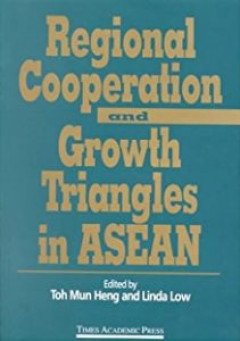
Regional cooperation and growth triangles in ASEAN
Comprising papers presented at an international symposium on the Growth Triangle, this book analyses (a) the development of the Southern Growth Triangle - which consists of Singapore, Johor in Malaysia and the Riau Islands in Indonesia; (b) the potential of a Northern Growth Triangle; and (c) external views of the Growth Triangle. The economic and political implications to establish similar int…
- Edisi
- -
- ISBN/ISSN
- 9812100210
- Deskripsi Fisik
- xx, 236 pages ; 23 cm
- Judul Seri
- -
- No. Panggil
- 334.0959 Hen r
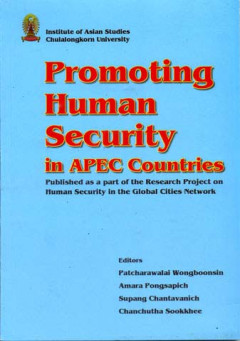
Promoting human security in APEC countries
Contents: Part I - Defining impact of the APEC process - Human security in the APEC region - Needs for a human securty surveillance system Part II - Human security issues and surveillance economic indicators - Indicators for redistribution of economic benefits towards health security - Human security issues and surveillance indicator food, etc.
- Edisi
- -
- ISBN/ISSN
- 974-9980-68-9
- Deskripsi Fisik
- iii, 170 pages : illustrations (black and white) ; 21 cm
- Judul Seri
- -
- No. Panggil
- 362.9 Won p
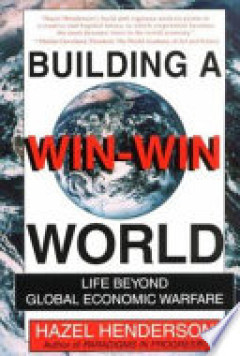
Building a win-win world: Life beyond global economic warfare
World-renowned futurist Hazel Henderson extends her twenty-five years of work in economics to examine the havoc the current economic system is creating at the global level. Markets are now spreading worldwide - a spread which is often equated with the hope of democracy spreading along with it. But markets still run on old textbook models that ignore social and environmental costs - leading to a…
- Edisi
- -
- ISBN/ISSN
- 1-881052-90-7
- Deskripsi Fisik
- x, 398 pages : illustrations (black and white) ; 23 cm
- Judul Seri
- -
- No. Panggil
- 363.7 Hen b
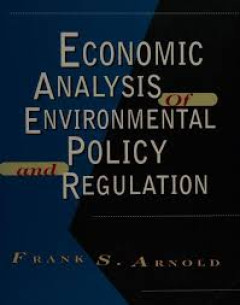
Economic analysis of environmental policy and regulation
While many topics and issues are canvassed here, overall the book pursues three fundamental themes. First, it focuses on why environmental economics in practice is not primarily an exercise in estimating the value of pollution damages and then promulgating taxes to make polluters internalize those harms, but consists mainly of applied cost-benefit analysis. Of course, many researchers are occup…
- Edisi
- Ed. 1
- ISBN/ISSN
- 0-471-00084-1
- Deskripsi Fisik
- x, 251 pages : illustrations (black and white) ; 23 cm
- Judul Seri
- -
- No. Panggil
- 363.7 Arn e

APEC as an institution: Multilateral governance in the Asia-Pacific
APEC is an experimental multilateralism, relying not on a large bureaucracy but rather upon national government agencies, semi-autonomous inter-govermental committees and "virtual" associations. Organized around the principles of enforced through monitoring and robust compliance mechanisms. This volume assesses the strengths and weaknesses of APEC's "soft" institutionalism, and it's the credibi…
- Edisi
- -
- ISBN/ISSN
- 981-230-209-3
- Deskripsi Fisik
- xvi, 275 pages ; 23 cm
- Judul Seri
- -
- No. Panggil
- 337.1 Fei a
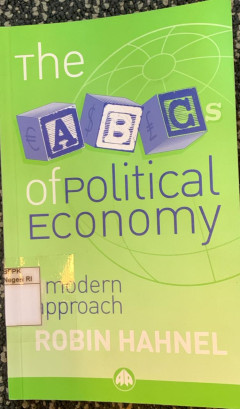
The ABCs of political economy
The ABCs of political economy is an accessible introduction to modern political economy. While informed by the work of Marx, Keynes, Veblen, Kalecki, Robinson and other great political economists. ABCs teaches readers the essential tools necessary to understand economic issues today from a modern perspective. Dispelling myths about markets, macroeconomic policies, and globalization, ABCs offers…
- Edisi
- -
- ISBN/ISSN
- 0-7453-1857-6
- Deskripsi Fisik
- xv, 304 pages ; 22 cm
- Judul Seri
- -
- No. Panggil
- 330 Hah a
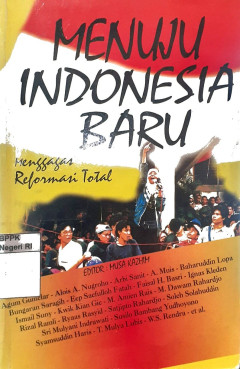
Menuju Indonesia baru: Menggagas reformasi total
Buku ini berisi tentang : CIMM (Center of Information for Mass Media) - Reformasi ekonomi - Reformasi sosial-politik - Reformasi budaya - Reformasi hukum - Reformasi industri-teknologi - Reformasi pendidikan
- Edisi
- cet.1
- ISBN/ISSN
- 979-9109-12-4
- Deskripsi Fisik
- 347 halaman : ilustrasi ; 21 cm
- Judul Seri
- -
- No. Panggil
- 361.24 Kaz m
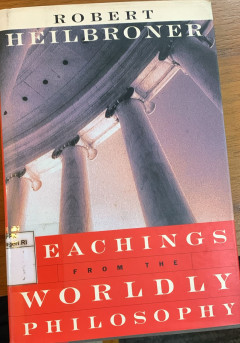
Teachings from the worldly philosophy
This is an examination of the writings of the philosophers featured in the author's book "The Worldly philosophers". Heilbroner guides the reader through works culled from the history of economic thought, and considers the core arguments of works seldom read, but often referred to. The works introduced range from the earliest economic thought found in the Bible and Aquinas, to major works such …
- Edisi
- -
- ISBN/ISSN
- 0-393-03919-6
- Deskripsi Fisik
- xiv, 353 pages ; 24 cm
- Judul Seri
- -
- No. Panggil
- 330.901 Hei t

Economic and social survey of Asia and the Pacific 2009: Addressing triple th…
The Economic and Social Survey of Asia and the Pacific 2009 analyses how three global crises of 2008 – Great Recession in developed countries, food and fuel price volatility and climate change - threaten the development in the Asia-Pacific region. The publication also talks about subregional variations in performance and policy responses. It concludes with converging crises and redirecting po…
- Edisi
- -
- ISBN/ISSN
- 978-92-1-120577-0
- Deskripsi Fisik
- xxvii, 195 pages : illustrations ; 27 cm
- Judul Seri
- -
- No. Panggil
- 330.95 Pac e

Economic report of the President: Transmitted to the congress February 1997
This book contains: 1. Growth and opportunity: Creating a new economic order 2. Macroeconomic policy and performance 3. Economic challenges of an aging population 4. The labor market 5. Inequality and economic rewards 6. Refining the role of government in the United States market economy 7. American leadership in the emerging global economy
- Edisi
- -
- ISBN/ISSN
- 0-16-048928-8
- Deskripsi Fisik
- 423 pages ; 23 cm
- Judul Seri
- -
- No. Panggil
- 330 Adv e
 Karya Umum
  Filsafat
  Agama
Agama  Ilmu-ilmu Sosial
  Bahasa
  Ilmu-ilmu Murni
  Ilmu-ilmu Terapan
  Kesenian, Hiburan, dan Olahraga
  Kesusastraan
  Geografi dan Sejarah