Ditapis dengan

UN peacekeeping operations and the protection of civilians: Saving succeeding…
This book is based on the author´s experience of working for more than two decades in over thirty conflict and post-conflict zones. It is written for those involved in UN peacekeeping and the protection of civilians. It is intended to be accessible to non- lawyers working in the field who may need to know the applicable legal standards relating to issues such as the use of force and arrest and…
- Edisi
- -
- ISBN/ISSN
- 978-1-108-41624-5
- Deskripsi Fisik
- xvi, 418 pages ; 23 cm
- Judul Seri
- -
- No. Panggil
- 341.584 Fol u
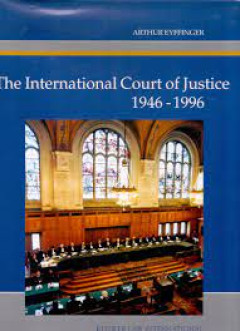
The International Court of Justice 1946-1996
A lavish volume published to mark the first half-century of the Court. It provides a well-documented and abundantly illustrated retrospective of the Court's activities from its origins to the present day, and also investigates the history of the development of the law, from the early notions of justice and equity as they originated in municipal spheres to their assembling on an international le…
- Edisi
- -
- ISBN/ISSN
- 90-411-0221-3
- Deskripsi Fisik
- xvi, 428 pages : illustration, bibliography, index ; 30 cm
- Judul Seri
- -
- No. Panggil
- 341.552 Eyf i
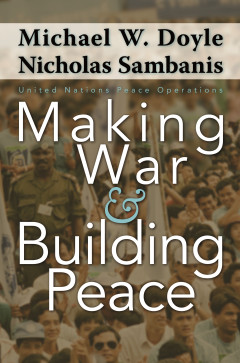
Making war & building peace: United nation peace operations
Making War and Building Peace examines how well United Nations peacekeeping missions work after civil war. Statistically analyzing all civil wars since 1945, the book compares peace processes that had UN involvement to those that didn’t. Michael Doyle and Nicholas Sambanis argue that each mission must be designed to fit the conflict, with the right authority and adequate resources. UN mission…
- Edisi
- -
- ISBN/ISSN
- 0-691-12275-X
- Deskripsi Fisik
- xvi, 400 pages : illustrations (black and white) ; 23 cm
- Judul Seri
- -
- No. Panggil
- 341.584 Doy m

Diplomatic interventions: Conflict and chage in a globalizing world
Diplomatic Interventions argues that war is a social construction. In so doing, it unsettles the definition of intervention, as a coercive interference by one state in the affairs of another, to examine the range of communicative or 'diplomatic' practices which through their presence modify the experience of war. The tension between claims that war is pervasive and that war is a social construc…
- Edisi
- -
- ISBN/ISSN
- 1-4039-1541-5
- Deskripsi Fisik
- xiv, 221 pages ;21 cm
- Judul Seri
- -
- No. Panggil
- 341.584 Fie d
Contemporary international law: A concise introduction
Individual sections discuss the relationship between international law and other law, methods and principles for creating international law, the subjects of international law, and concepts such as sovereign immunity and nonintervention. Other sections examine the concepts of boundaries and spatial sovereignty, the meanings of personal and material jurisdiction, the law relating to aliens, inter…
- Edisi
- 2nd ed.
- ISBN/ISSN
- 0-8133-1094-6
- Deskripsi Fisik
- xv, 365 pages ; 23 cm.
- Judul Seri
- -
- No. Panggil
- 341 Lev c
Indonesia and the security of Southeast Asia
In Southeast Asia, patterns of relationship between regional coun- tries and major powers have always been the main issue in discussions on security arrangement. In this book, Dewi Fortuna Anwar specifically discusses Indonesia's relations with major powers- China and Japan. She also examines Indonesia's role and position in several security issues in Southeast Asia during the 1980s. This prese…
- Edisi
- -
- ISBN/ISSN
- 979-8026-19-5
- Deskripsi Fisik
- iii, 65 pages ; 20 cm
- Judul Seri
- -
- No. Panggil
- 341.247 3 Anw i
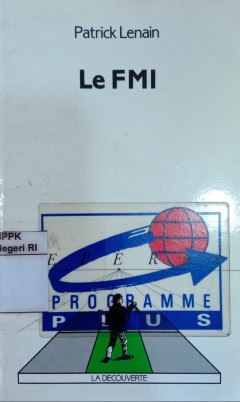
Le FMI
Why and how was the International Monetary Fund created? How is it organized? What are its operating rules? Where does the IMF get its financial resources? Under what conditions does he grant his credits? What assessment can we make of its interventions in the Third World and in Eastern countries? Can the IMF prevent and cure financial crises? Is it responsible for a rise in inequalities and po…
- Edisi
- -
- ISBN/ISSN
- 2-7071-2268-8
- Deskripsi Fisik
- 125 pages ; 18 cm
- Judul Seri
- -
- No. Panggil
- 332.15 Len l

The commanding heights: The battle of the government and the marketplace that…
The "commanding heights," according to Pulitzer Prize-winner Daniel Yergin and international business advisor Joseph Stanislaw, are those dominant enterprises and industries that form the high economic ground in nations around the globe. In their analysis of the new world economy, The Commanding The Battle Between Government and the Marketplace That Is Remaking the Modern World, they examine "t…
- Edisi
- -
- ISBN/ISSN
- 0-684-82975-4
- Deskripsi Fisik
- 457 pages : illustration (black and white) ; 24 cm.
- Judul Seri
- -
- No. Panggil
- 338.9 Yer c
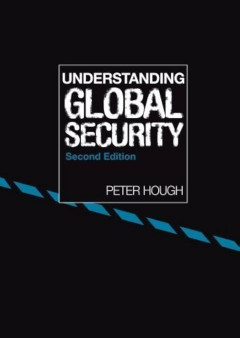
Understanding global security
Fully revised to incorporate recent developments in world politics, the second edition of Understanding Global Security analyzes the variety of ways in which people's lives are threatened and/or secured in contemporary global politics. The traditional focus of Security Studies texts - war, deterrence and terrorism - are analyzed alongside non-military security issues such as famine, crime, dise…
- Edisi
- ed. 2
- ISBN/ISSN
- 978-0-415-42142-3
- Deskripsi Fisik
- xvii, 293 pages : illustrations (black and white) ; 24,5 cm
- Judul Seri
- -
- No. Panggil
- 332.65 Hou u
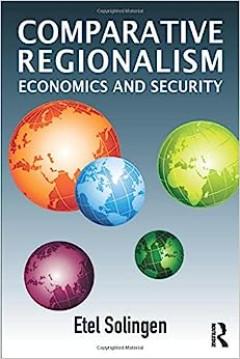
Comparative regionalism economics and security
This book comprises key essays on comparative regionalism and, more broadly, on regional conflict and cooperation by Professor Etel Solingen. The study of regionalism, a subject pioneered by Solingen in the 1990s, is now an established field of inquiry, with a large community of scholars and practitioners around the world. This book provides a window into an evolving conceptual framework for c…
- Edisi
- cet.1
- ISBN/ISSN
- 978-0-415-62779-0
- Deskripsi Fisik
- xiv, 290 pages : illustrations (black and white) ; 23 cm
- Judul Seri
- -
- No. Panggil
- 337 Sol c
 Karya Umum
 Filsafat
 Agama
 Ilmu-ilmu Sosial
 Bahasa
 Ilmu-ilmu Murni
 Ilmu-ilmu Terapan
 Kesenian, Hiburan, dan Olahraga
 Kesusastraan
 Geografi dan Sejarah