Ditapis dengan

Twenty-Sixth meeting of the ASEAN economic ministers
This book contains: 1. Fifth AFTA ministerial council meeting 2. Twenty-Sixth meeting of the ASEAN economic ministers 3. Post AEM with MITI-Japan
- Edisi
- -
- ISBN/ISSN
- 0854-6258
- Deskripsi Fisik
- 22 pages ; 29 cm
- Judul Seri
- -
- No. Panggil
- 330.959 Min t
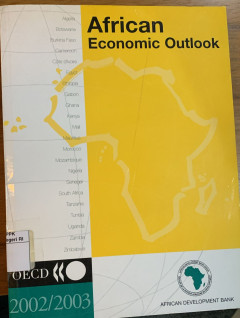
African economic outlook
The African economic outlook is a joint project between the African development bank and the OECD development centre. The project, initially funded by the European commission, combines the expertise accumulated by the OECD, which produces the OECD economic outlook twice a year, and the knowledge of the African development Bank on African economies. The objective is to review annually the recent…
- Edisi
- -
- ISBN/ISSN
- 92-64-10003-2
- Deskripsi Fisik
- 419 pages ; 27 cm
- Judul Seri
- -
- No. Panggil
- 330.6 Ban a

Economic and social survey of Asian and the Pacific 2008: Sustaining growth a…
This book contains survey examines the region's key short- and medium-term prospects and challenges in macroeconomic and selected social areas, especially from the point of view of minimizing human sufering; be it form economic hardships or social instabillity. The survey also explores critical long-term development issues relevant to all developing countries in the region.
- Edisi
- -
- ISBN/ISSN
- 978-92-1-120537-4
- Deskripsi Fisik
- xxiii, 190 pages : illustrations ; 26 cm.
- Judul Seri
- -
- No. Panggil
- 330.95 Pac e
Towards an ASEAN strategy of globalization
This book was going for about decision makers in developing countries to adopt adequate policies that make use of the opportunities and minimize the negative effects of globalization. With the focus on the discussions of an ASEAN strategy of globalization, this book is organized into five parts. It begins with introduction, followed by a part presenting four views, which is the reproduction of…
- Edisi
- -
- ISBN/ISSN
- 979-8026-73-X
- Deskripsi Fisik
- v, 158 pages ; 25 cm.
- Judul Seri
- -
- No. Panggil
- 337.959 Stu t
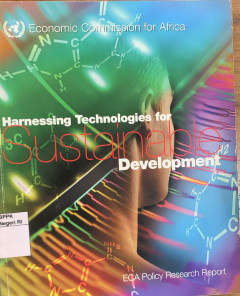
Harnessing technologies for sustainable development
New and emerging technologies can yield a high payoff in catalyzing Africa's transition to sustainable development. Where effective, the new technologies can lower the incidence of disease, reduce food insecurity, and reduce vulnerability to environmental damage by allowing more flexible crop management systems. These are some of the conclusions in harnessing technologies for sustainable dev…
- Edisi
- -
- ISBN/ISSN
- 92-1-125086-2
- Deskripsi Fisik
- x, 167 pages ; 24 cm.
- Judul Seri
- -
- No. Panggil
- 338.96 Com h

The wealth and poverty of nations: why some are so rich and so poor
The Wealth and Poverty of Nations is David S. Landes' acclaimed and bestselling exploration of one of the most debated and contentious questions of our time: Why do some nations achieve economic success while others remain mired in poverty? The answer, as Landes definitively illustrates, is a complex interplay between cultural mores and historical circumstances. Rich with anecdotal evidence, in…
- Edisi
- -
- ISBN/ISSN
- 0-393-04017-8
- Deskripsi Fisik
- xxi, 650 pages ; 23 cm
- Judul Seri
- -
- No. Panggil
- 330.1 Lan w

Vietnam's dilemmas and options: The challenge of economic transition in the 1…
New and exciting economic, political, and social developments have been rapidly unfolding in Vietnam since the mid-1980s. Doi moi (revolution) marks a new stage in the economic development of Vietnam, transforming the failed command/control economy into a market-oriented one. The drastic changes brought about by doi moi within Vietnam and the international events that impinge on it have stimula…
- Edisi
- -
- ISBN/ISSN
- 981-3016-38-8
- Deskripsi Fisik
- xvi, 306 pages ; 23 cm
- Judul Seri
- -
- No. Panggil
- 330.9597 Tha v
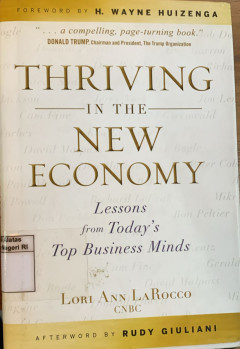
Thriving in the new economy
These are make-or-break times for business leaders. In today's defining moment, the "New Economy," CEOs and other leaders in a wide variety of industries must face unprecedented conditions. Thriving in the New Economy gives you a unique look into some of today's best economic and business minds. A series of close profiles, the book offers inspirational personal stories, useful advice, and ac…
- Edisi
- -
- ISBN/ISSN
- 978-0-470-55731-0
- Deskripsi Fisik
- xiv, 290 pages ; 24 cm
- Judul Seri
- -
- No. Panggil
- 330.1 Roc t
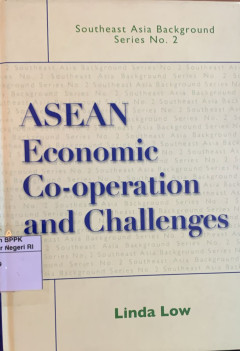
ASEAN economic co-operation and challenges
This book is written in an easily understood style. It explains the background of the origin of ASEAN (Association of Southeast Asian Nations) of which there are 10 member-countries. The author looks at the progress made, as well as the problems that the association faces. This is the 2nd book in the ISEAS Southeast Asia Background Series. Table of …
- Edisi
- -
- ISBN/ISSN
- 981-230-264-6
- Deskripsi Fisik
- vi, 80 pages ; 21 cm
- Judul Seri
- -
- No. Panggil
- 330.59 Low a

Voluntary carbon markets: An international business guide to what they are an…
The global carbon markets are growing at a staggering rate. The growth prospects for business are enormous and the potential positive impacts for greenhouse gas emission reductions, climate policy options, renewable energy investment, development projects and efficiency gains are increasingly apparent. A unique part of the market in greenhouse gas emissions is the rapidly growing voluntary carb…
- Edisi
- Ed. 2
- ISBN/ISSN
- 978-1-84407-561-4
- Deskripsi Fisik
- xxiii, 160 pages : illustrations (black and white) ; 24 cm
- Judul Seri
- -
- No. Panggil
- 363.738746 Bay v
 Karya Umum
  Filsafat
  Agama
Agama  Ilmu-ilmu Sosial
  Bahasa
  Ilmu-ilmu Murni
  Ilmu-ilmu Terapan
  Kesenian, Hiburan, dan Olahraga
  Kesusastraan
  Geografi dan Sejarah