Ditapis dengan

APEC as an institution: Multilateral governance in the Asia-Pacific
APEC is an experimental multilateralism, relying not on a large bureaucracy but rather upon national government agencies, semi-autonomous inter-govermental committees and "virtual" associations. Organized around the principles of enforced through monitoring and robust compliance mechanisms. This volume assesses the strengths and weaknesses of APEC's "soft" institutionalism, and it's the credibi…
- Edisi
- -
- ISBN/ISSN
- 981-230-209-3
- Deskripsi Fisik
- xvi, 275 pages ; 23 cm
- Judul Seri
- -
- No. Panggil
- 337.1 Fei a

Economic and social survey of Asia and the Pacific 2009: Addressing triple th…
The Economic and Social Survey of Asia and the Pacific 2009 analyses how three global crises of 2008 – Great Recession in developed countries, food and fuel price volatility and climate change - threaten the development in the Asia-Pacific region. The publication also talks about subregional variations in performance and policy responses. It concludes with converging crises and redirecting po…
- Edisi
- -
- ISBN/ISSN
- 978-92-1-120577-0
- Deskripsi Fisik
- xxvii, 195 pages : illustrations ; 27 cm
- Judul Seri
- -
- No. Panggil
- 330.95 Pac e
The state and NGOs: Perspective from Asia
In many developing countries the presence of non-governmental organizations (NGOs) can no longer be ignored. They are engaged in an extensive array of activities, including philanthropic work to people left out of the developmental process as well as efforts at addressing problems of environmental destruction and other negative consequences of economic development, and efforts to institutionali…
- Edisi
- -
- ISBN/ISSN
- 981-230-151-8
- Deskripsi Fisik
- xi, 337 pages ; 22 cm
- Judul Seri
- -
- No. Panggil
- 361.7 Shi s
The environment and security in Pacific Asia
Pacific Asia faces environmental challenges ranging from pollution and rapid population growth to increasing water, energy and food scarcity. To what extent will these issues shape the regional security agenda? This paper argues that, in themselves, environmental difficulties are unlikely to be the primary cause of major conflict between the states. Nonetheless, Pacific Asia suffers from many t…
- Edisi
- Cet. 1
- ISBN/ISSN
- 0-19-922370-X
- Deskripsi Fisik
- 94 pages : illustrations (black and white) ; 24 cm
- Judul Seri
- -
- No. Panggil
- 363.7 Dup e
Asia Pacific security outlook 2004
The book includes two topical chapters discussing the North Korean crisis and terrorism in Southeast Asia as well as a general South Asia paper. Also presents country perspectives from ASEAN Regional Forum (ARF) member countries, based on background papers written in almost all cases by nationals of the countries concerned. The aim is to increase understanding of each other's viewpoints among s…
- Edisi
- -
- ISBN/ISSN
- 4889070702
- Deskripsi Fisik
- 219 pages ; 23 cm
- Judul Seri
- -
- No. Panggil
- 341.7 Mor a
Asian maritime strategies: Navigating troubled waters
Asian Maritime Strategies explores one of the world's most complex and dangerous maritime arenas. Asia, stretching from the Aleutian Islands to the Persian Gulf, contains the world's busiest trade routes. It is also the scene of numerous maritime territorial disputes, pirate attacks, and terrorist threats. In response, the nations of the region are engaged in a nascent naval arms race. In t…
- Edisi
- First Printing
- ISBN/ISSN
- 978-1-59114-162-4
- Deskripsi Fisik
- xiv, 304 pages : 25 cm.
- Judul Seri
- -
- No. Panggil
- 359. 03095 Col a
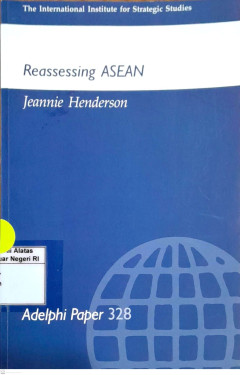
Reassessing ASEAN
With Cambodia's admission on 30 April 1999, the Association of South-East Asian Nations (ASEAN) finally incorporated all ten South-East Asian states. But ASEAN in 1999 is a pale imitation of the organisation which emerged from the Cold War as a model regional institution. Since July 1997, the enlarged Association has faced unprecedented challenges. Its members are beset with economic difficulti…
- Edisi
- -
- ISBN/ISSN
- 0199224315
- Deskripsi Fisik
- 85 pages : illustrations, maps, charts ; 24 cm
- Judul Seri
- -
- No. Panggil
- 341.2473 Hen r
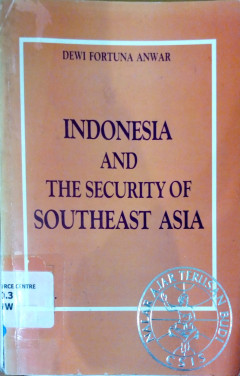
Indonesia and the security of Southeast Asia
In Southeast Asia, patterns of relationship between regional coun- tries and major powers have always been the main issue in discussions on security arrangement. In this book, Dewi Fortuna Anwar specifically discusses Indonesia's relations with major powers- China and Japan. She also examines Indonesia's role and position in several security issues in Southeast Asia during the 1980s. This prese…
- Edisi
- -
- ISBN/ISSN
- 979-8026-19-5
- Deskripsi Fisik
- iii, 65 pages ; 20 cm
- Judul Seri
- -
- No. Panggil
- 341.247 3 Anw i

Tigers: Leaders of the new Asia-Pasific
This is a book about leaders and leadership, in particular the leaders of the Asia-Pacific. It is based around inter- views I have had with all the leaders profiled here except President Suharto of Indonesia, President Clinton of the United States, and President Lee Teng-hui of Taiwan. With all the other leaders I have had at least one, and mostly several, interviews in the course of covering t…
- Edisi
- Cet. 1
- ISBN/ISSN
- 1864481536
- Deskripsi Fisik
- xviii, 326 pages : index ; 23 cm
- Judul Seri
- -
- No. Panggil
- 351.003109225 She t

ASEAN in a changed regional and international political economy
Economic regionalization and economic regionalism have become an important item in the national, regional and international agenda of almost alla countries in the Asia Pacific region. Economic regionalism has many forms, as it may be driven by different kinds of forces. The ASEAN countries are engaged in a growing number of regional economic cooperation arrangements.
- Edisi
- -
- ISBN/ISSN
- 9798026306
- Deskripsi Fisik
- iii, 242 pages ; 20 cm
- Judul Seri
- -
- No. Panggil
- 337.950 Soe a
 Karya Umum
  Filsafat
  Agama
Agama  Ilmu-ilmu Sosial
  Bahasa
  Ilmu-ilmu Murni
  Ilmu-ilmu Terapan
  Kesenian, Hiburan, dan Olahraga
  Kesusastraan
  Geografi dan Sejarah