Ditapis dengan
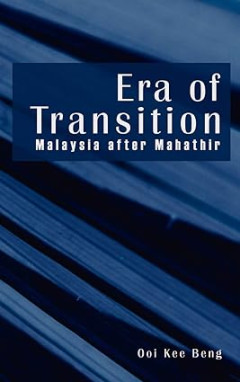
Era of transition: Malaysia after Mahathir
This is a collection of opinion pieces written by Ooi Kee Beng and published in the mass media after Abdullah Badawi became Malaysia's Prime Minister in October 2004. The articles analyse the many difficult aspects of leadership that have been facing Abdullah Badawi over the last two years. The book discusses the country's underlying problems, the dilemma involved in succeeding Mahathir Mohamad…
- Edisi
- First Published
- ISBN/ISSN
- 981-230-379-0
- Deskripsi Fisik
- xxiii, 183 pages : index ; 21 cm
- Judul Seri
- -
- No. Panggil
- 320.9595 Ben e

Refugees and regional security in South Asia
Regional relations in South Asia have always been afflicted by the movements of people across territorial boundaries of the states. Rapidly growing dimensions of refugee flows during the past decades have seriously affected security and stability of both the refugee generating as well as receiving states. This is one of the first studies of how refugee flows have vitiated security environment i…
- Edisi
- -
- ISBN/ISSN
- 81-220-0420-2
- Deskripsi Fisik
- x, 245 pages : index ; 23 cm
- Judul Seri
- -
- No. Panggil
- 325.21959 Mun r

Southeast Asia in the new international era
The fourth edition of Southeast Asia in the New International Era updates the region at a time of critical change. In the 1990s, Southeast Asia was known as an area of stability and movement toward development and democracy. At the beginning of the millennium, many of the region's nations are undergoing rapid change that belies the standard perception of stability. Since January 2000, Indonesia…
- Edisi
- -
- ISBN/ISSN
- 0813339928
- Deskripsi Fisik
- xv, 301 pages : index ; 23 cm
- Judul Seri
- -
- No. Panggil
- 327.59 Neh s

Dreams and dilemmas in the Asia-Pacific: Economic friction and dispute resolu…
The volume consists of two parts. Part 1 discusses economic friction in the Asia-Pacific region from three aspects: macroeconomic and microeconomic friction, and that between the state and the market mechanism. Included in the discussion are the recent financial crisis and the economic friction it entailed, the trend of regional integration and its impact on internal and external trade and fore…
- Edisi
- -
- ISBN/ISSN
- 981-230-068-6
- Deskripsi Fisik
- xxi, 494 pages : illustrations (black and white) : index ; 23 cm
- Judul Seri
- -
- No. Panggil
- 330.959 Ham d
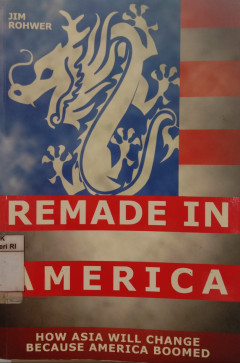
Remade in America: How Asia will change because America boomed
Armed with a thorough knowledge of Asia, Jim Rohwer is a benevolent but sharp witness of the region's fortunes. He gathers hard facts and opinions from impeccable sources and builds around them a very compelling picture of Asia's need to feed on the best standards America can offer. Asia ought to be selective in the process, and Jim Rohwer offers penetrating views on how the countries of the re…
- Edisi
- -
- ISBN/ISSN
- 0-471-47921-7
- Deskripsi Fisik
- xxi, 409 pages : illustrations : index ; 24 cm
- Judul Seri
- -
- No. Panggil
- 330.95 Roh r

Stumbling giant: The threats to China's future
While dozens of recent books and articles have predicted the near-certainty of China's rise to global supremacy, this book boldly counters such widely-held assumptions. Timothy Beardson brings to light the daunting array of challenges that today confront China, as well as the inadequacy of leadership's responses. Threats to China come from many fronts, Beardson shows, and by their number and sh…
- Edisi
- -
- ISBN/ISSN
- 978-0-300-16542-5
- Deskripsi Fisik
- x, 517 pages : bibl: hlm 477-493 : index ; 24 cm
- Judul Seri
- -
- No. Panggil
- 330.951 Bea s

Global Paradox: The bigger the world economy, the more powerful its smallest …
In Global Paradox, John Naisbitt explores the new global environment of the 1990s and the enormous opportunities and challenges that countries, businesses and individuals will face in this period of growth and transformation at the end of the millennium.
- Edisi
- -
- ISBN/ISSN
- 0-380-72489-8
- Deskripsi Fisik
- 392 pages : index ; 18 cm.
- Judul Seri
- -
- No. Panggil
- 330.900112 Nai g

Global Paradox: The bigger the world economy, the more powerful its smallest …
In Global Paradox, John Naisbitt explores the new global environment of the 1990s and the enormous opportunities and challenges that countries, businesses and individuals will face in this period of growth and transformation at the end of the millennium.
- Edisi
- Cet. 1
- ISBN/ISSN
- 1-86373-689-1
- Deskripsi Fisik
- 304 pages : index ; 25 cm
- Judul Seri
- -
- No. Panggil
- 330.900112 Nai g

Indonesia in the new world: Globalisation, nationalism and sovereignty
Globalisation is more complex than ever. The effects of the global financial crisis and increased inequality have spurred anti-globalisation sentiment in many countries and encouraged the adoption of populist and inward-looking policies. This has led to some surprising results: Duterte, Brexit and Trump, to name a few. In Indonesia, the disappointment with globalisation has led to rising protec…
- Edisi
- -
- ISBN/ISSN
- 978-981-4148-22-3
- Deskripsi Fisik
- xix, 333 pages : illustrations (black and white) : index ; 23 cm
- Judul Seri
- -
- No. Panggil
- 330.9598 Pat i
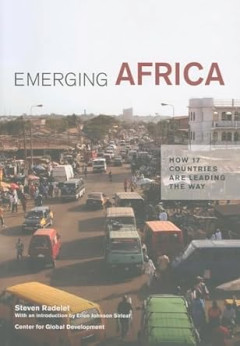
Emerging Africa: How 17 countries are leading the way
Emerging Africa describes the too-often-overlooked positive changes that have taken place in much of Africa since the mid-1990s. In 17 countries, five fundamental and sustained breakthroughs are making old assumptions increasingly untenable: - The rise of democracy brought on by the end of the Cold War and apartheid - Stronger economic management - The end of the debt crisis and a more cons…
- Edisi
- -
- ISBN/ISSN
- 978-1-933286-51-8
- Deskripsi Fisik
- xv, 169 pages : illustrations : index ; 25 cm
- Judul Seri
- -
- No. Panggil
- 330.96 Rad e
 Karya Umum
  Filsafat
  Agama
Agama  Ilmu-ilmu Sosial
  Bahasa
  Ilmu-ilmu Murni
  Ilmu-ilmu Terapan
  Kesenian, Hiburan, dan Olahraga
  Kesusastraan
  Geografi dan Sejarah