Ditapis dengan

Memories of Hồ Chí Minh: Stories from his assistants
Memories of Hồ Chí Minh: Stories from His Assistants compiles personal recollections and eyewitness accounts from individuals who worked closely with President Hồ Chí Minh throughout his revolutionary career. These stories reveal intimate details about his personality, leadership style, daily habits, and his interactions with staff and comrades. The book provides a humanizing perspective …
- Edisi
- -
- ISBN/ISSN
- -
- Deskripsi Fisik
- 156 pages : illustration ; 20 cm
- Judul Seri
- -
- No. Panggil
- 959.704092 TIM m

The Australian constitution
The Australian Constitution by Geoffrey Sawer provides a concise and authoritative explanation of the origins, structure, and functioning of Australia’s constitutional system. Written by a leading legal scholar, the book outlines the historical development of the Constitution, the roles of key founding figures, and the principles that shape federal governance in Australia. It serves as an acc…
- Edisi
- -
- ISBN/ISSN
- -
- Deskripsi Fisik
- 159 pages : illustration ; 17,5 cm
- Judul Seri
- -
- No. Panggil
- 342.94 SAW a
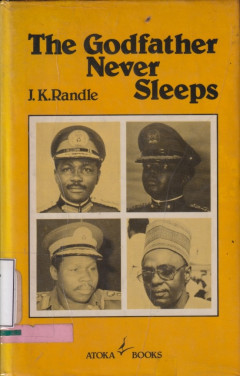
The Godfather never sleeps
The Godfather Never Sleeps is a reflective and critical work by Nigerian author J. K. Randle, presenting a compilation of essays on political, social, and cultural life in Nigeria. Drawing from personal experiences and observations, Randle offers commentary on governance, leadership, corruption, and societal challenges shaping modern Nigeria. Written in an accessible and insightful style, the b…
- Edisi
- -
- ISBN/ISSN
- 978-153-040-5
- Deskripsi Fisik
- 456 pages ; 22 cm
- Judul Seri
- -
- No. Panggil
- 823.914 RAN t
A History of Australia, Volume V
Volume V of C. M. H. Clark’s seminal series traces the political, legal, and social transformation of Australia between 1888 and 1915. In this period, Australians increasingly shaped their own laws, institutions, and national identity. Clark examines the debates surrounding federation, the rise of organized labour, democratic reforms, and the tensions between conservative and progressive visi…
- Edisi
- 5
- ISBN/ISSN
- 0-522-84223-2
- Deskripsi Fisik
- xv, 448 pages : illustration ; 24 cm
- Judul Seri
- -
- No. Panggil
- 994.03 CLA h

Palestine: Peace not apartheid
Written by Jimmy Carter, former President of the United States, this book offers an in-depth analysis of the Palestinian–Israeli conflict and the path to a just and sustainable peace. Carter outlines the diplomatic challenges, Israel's policies in the West Bank and Gaza, the United States' role in the peace process, and the political obstacles that make a two-state solution difficult to achie…
- Edisi
- -
- ISBN/ISSN
- 978-0-7432-8502-5
- Deskripsi Fisik
- xiv, 264 pages : illustration ; 24,5 cm
- Judul Seri
- -
- No. Panggil
- 956.9405 CAR p
Ordeal in Algeria
Ordeal in Algeria presents a detailed narrative and analysis of the Algerian War of Independence against French colonial rule. Written by Richard and Joan Brace, the book explores political tensions, the rise of nationalist movements, armed resistance, and the broader geopolitical implications of the conflict. Combining eyewitness accounts, historical documentation, and political commentary, th…
- Edisi
- -
- ISBN/ISSN
- -
- Deskripsi Fisik
- xi, 453 pages ; 23,5 cm
- Judul Seri
- -
- No. Panggil
- 965.04 RIC o

The Realities of Vietnam: A Ripon society appraisal
The Realities of Vietnam presents an analytical appraisal of the Vietnam situation prepared by the Ripon Society. Edited by Christopher W. Beal with contributions from Anthony A. D’Amato, the book examines the political, social, and military dimensions of the Vietnam conflict as understood in the late 1960s. It evaluates U.S. policy, the nature of the South Vietnamese government, the motivati…
- Edisi
- -
- ISBN/ISSN
- -
- Deskripsi Fisik
- 186 pages ; 23,5 cm
- Judul Seri
- -
- No. Panggil
- 959.7043 BEA r
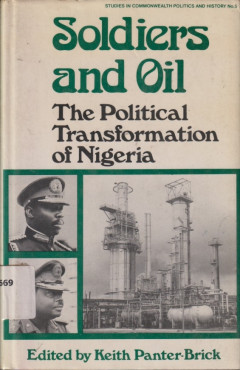
Soldiers and oil: The Political transformation of Nigeria
Soldiers and Oil: The Political Transformation of Nigeria explores the complex relationship between military rule and the oil-driven political economy of Nigeria. Edited by Keith Panter-Brick, this scholarly volume examines how the discovery and exploitation of petroleum reshaped Nigeria’s governance, power structures, and social landscape throughout the post-colonial period. Contributors a…
- Edisi
- -
- ISBN/ISSN
- 0-7146-3098-5
- Deskripsi Fisik
- xii, 375 pages : illustrations ; 22 cm
- Judul Seri
- -
- No. Panggil
- 320.9669 BRI s
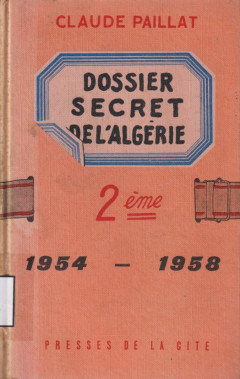
Deuxième dossier secret de l’algérie
“Deuxième dossier secret de l’Algérie” by Claude Paillat is a historical investigative work presenting confidential documents, testimonies, and political analyses related to the Algerian War of Independence. The book provides insight into French military operations, political decision-making, intelligence activities, and key events that shaped the conflict between 1954 and 1962. As a co…
- Edisi
- -
- ISBN/ISSN
- -
- Deskripsi Fisik
- 545 pages ; 21,5 cm
- Judul Seri
- -
- No. Panggil
- 965.04 CLA d
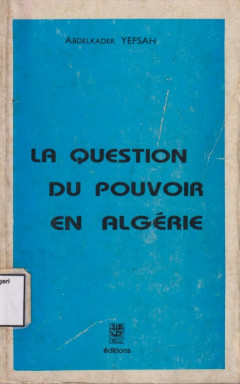
La question du pouvoir en Algérie
La Question du Pouvoir en Algérie by Abdelkader Yefsah is an analytical work exploring the nature, structure, and evolution of political power in Algeria. Published in 1990, the book discusses the dynamics of authority, the mechanisms of governance, and the internal political struggles that shaped Algeria in the post-independence period. Yefsah provides a critical perspective on institutional …
- Edisi
- -
- ISBN/ISSN
- -
- Deskripsi Fisik
- 511 pages ; 21 cm
- Judul Seri
- -
- No. Panggil
- 965.04 ABD l
 Karya Umum
  Filsafat
  Agama
Agama  Ilmu-ilmu Sosial
  Bahasa
  Ilmu-ilmu Murni
  Ilmu-ilmu Terapan
  Kesenian, Hiburan, dan Olahraga
  Kesusastraan
  Geografi dan Sejarah