Ditapis dengan

Capitalizing Consular services as tools of diplomacy
This paper proposes leveraging consular services as instruments of diplomacy, beyond their traditional administrative functions such as visa issuance, passport renewal, and document legalization. In an era of globalization and high mobility, consular services protect citizens abroad, strengthen bilateral relations, and shape Indonesia’s international image. Confusion between consular and publ…
- Edisi
- -
- ISBN/ISSN
- -
- Deskripsi Fisik
- -
- Judul Seri
- -
- No. Panggil
- Sesparlu 77-2025

From waste to watts: Utilizing Indonesia's waste-to-energy ambition through s…
This paper proposes leveraging Indonesia’s Waste-to-Energy (WtE) ambition through strategic collaboration with Europe II partner countries. Indonesia’s waste crisis remains serious, with much of its waste unmanaged and only a small number of WtE facilities operational, undermining climate commitments and the energy transition. Partnerships with Europe II countries, leaders in WtE technology…
- Edisi
- -
- ISBN/ISSN
- -
- Deskripsi Fisik
- -
- Judul Seri
- -
- No. Panggil
- Sesparlu 77-2025

Strategic approach towards the Balkan Nine
This paper provides strategic recommendations to enhance Indonesia's engagement with the Balkan Nine (Albania, Bosnia and Herzegovina, Bulgaria, Croatia, Moldova, Montenegro, North Macedonia, Romania and Serbia) from 2025 to 2029. The main challenge lies in transforming historically rooted yet underdeveloped ties into active, mutually beneficial partnerships. Based on a comprehensive assessment…
- Edisi
- -
- ISBN/ISSN
- -
- Deskripsi Fisik
- -
- Judul Seri
- -
- No. Panggil
- Sesparlu 77-2025

Indonesia's independent and proactive path towards recognition of the Afghan …
This paper examines the policy dilemma faced by Indonesia in determining the conditions for recognising the de facto authorities (DFA) in Afghanistan under the Taliban. Since the Taliban’s takeover in 2021, Indonesia has echoed the international consensus on three conditions for recognition: an inclusive government; assurances that Afghanistan will not be used as a base for terrorism; and gua…
- Edisi
- -
- ISBN/ISSN
- -
- Deskripsi Fisik
- -
- Judul Seri
- -
- No. Panggil
- Sesparlu 77-2025

Visa diplomacy: A strategic tool of Indonesia's soft power
This paper proposes visa diplomacy as a strategic instrument of Indonesia’s soft power in foreign policy. Indonesia’s visa policy remains fragmented, security-centric, and largely transactional, while Indonesian citizens face limited global mobility compared with ASEAN peers. Strategically positioned, visa diplomacy can strengthen bilateral relations through reciprocal facilitation, promote…
- Edisi
- -
- ISBN/ISSN
- -
- Deskripsi Fisik
- -
- Judul Seri
- -
- No. Panggil
- Sesparlu 77-2025

Strategies to improve the understanding of competency standard of Diplomats w…
This paper proposes a new strategy to improve diplomats’ understanding of the Competency Standards of Diplomats (CSD) using the BANI (Brittle, Anxious, Nonlinear, Incomprehensible) framework. The analysis finds that traditional dissemination methods are ill-suited to the complexities of the modern work environment. Of the two policy options, the paper recommends a paradigm shift from informat…
- Edisi
- -
- ISBN/ISSN
- -
- Deskripsi Fisik
- -
- Judul Seri
- -
- No. Panggil
- Sesparlu 77-2025

The voice of a tropical archipelagic nation in polar regions: Indonesia's str…
This paper argues for Indonesia’s active engagement in Arctic and Antarctic governance as part of its climate, maritime, and strategic interests. Accelerating transformations in the polar regions have made them key indicators of global climate dynamics and arenas of geopolitical rivalry and geoeconomic competition. As a tropical archipelagic nation highly vulnerable to sea-level rise, Indones…
- Edisi
- -
- ISBN/ISSN
- -
- Deskripsi Fisik
- -
- Judul Seri
- -
- No. Panggil
- Sesparlu 77-2025

Advancing Indonesia's economic diplomacy: Overcoming challenges to strengthen…
This paper analyses the role of economic diplomacy in strengthening Indonesia’s position as a critical minerals hub in the global energy transition. Indonesia has the world's largest nickel reserves. These account for around 42 percent of global reserves. The country also has copper, bauxite, and tin. Indonesia has the potential to transform from a raw material supplier into a value-added hub…
- Edisi
- -
- ISBN/ISSN
- -
- Deskripsi Fisik
- -
- Judul Seri
- -
- No. Panggil
- Sesparlu 77-2025

From innovation to influence: Tech-Diplomacy and the role of starups in Indon…
This paper proposes the institutionalisation of tech diplomacy and the leveraging of start-ups as strategic instruments in Indonesia’s foreign policy. Boasting over 2,000 startups and eight unicorns, Indonesia has the potential to project technological influence and strengthen its position as a middle digital power. As Southeast Asia's second-largest startup hub, it is well-positioned to do s…
- Edisi
- -
- ISBN/ISSN
- -
- Deskripsi Fisik
- -
- Judul Seri
- -
- No. Panggil
- Sesparlu 77-2025
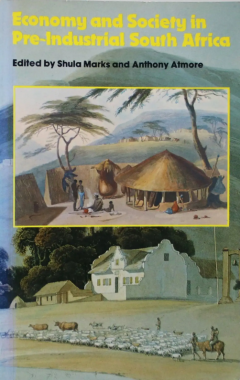
Economy and society in pre-industrial South Africa
Over the past forty years there has been a revolution in South African historiography, yet no broadly interpretative essay on South African history has appeared. The essays in this volume aim to provide such a reinterpretation for the nineteenth century before the discovery of minerals transformed the nature of South African societies, and help to shed light on earlier phases of South Africa's …
- Edisi
- -
- ISBN/ISSN
- 0-582-64656-1
- Deskripsi Fisik
- 385 pages ; 22 cm
- Judul Seri
- -
- No. Panggil
- 330.68 MAR e
 Karya Umum
 Filsafat
 Agama
 Ilmu-ilmu Sosial
 Bahasa
 Ilmu-ilmu Murni
 Ilmu-ilmu Terapan
 Kesenian, Hiburan, dan Olahraga
 Kesusastraan
 Geografi dan Sejarah