Ditapis dengan

Malay politics in Sarawak 1946-1966: The Search for unity and political ascen…
While much has been written about the rule of the 'white rajas' in Sarawak and about the development of politics in this Malaysian state since independence, Malay Politics in Sarawak is the first study to focus on the political evolution of the Malay community in the crucial years from the cession to the British Crown in 1946 to independence in Malaysia and after. The author first sets the back…
- Edisi
- -
- ISBN/ISSN
- 0-19-582572-1
- Deskripsi Fisik
- xv, 166 pages ; 21 cm
- Judul Seri
- -
- No. Panggil
- 959.504 SAI m
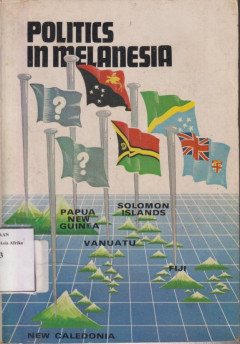
Politics in Melanesia
Politics in Melanesia presents a comprehensive examination of the political structures, governance systems, and historical developments across the Melanesian region, including Papua New Guinea, the Solomon Islands, Vanuatu, and Fiji. Edited by Ahmed Ali and Ronald Gordon Crocombe, the book brings together scholarly analyses from experts in Pacific political studies. It explores the influence of…
- Edisi
- -
- ISBN/ISSN
- -
- Deskripsi Fisik
- xii, 170 pages : illustrations ; 21 cm
- Judul Seri
- -
- No. Panggil
- 320.993 ALI p

Nixon in the white house: The Frustration of power
This book analyzes the presidency of Richard Nixon, focusing on the challenges and limitations of executive power during his administration. Written by journalists Rowland Evans, Jr. and Robert D. Novak, the work explores Nixon’s leadership style, political strategies, and conflicts within the White House and with Congress, the media, and public opinion. It provides an in-depth examination of…
- Edisi
- -
- ISBN/ISSN
- 0-394-46273-4
- Deskripsi Fisik
- 431 pages : 24,2 cm
- Judul Seri
- -
- No. Panggil
- 973.927 EVA n
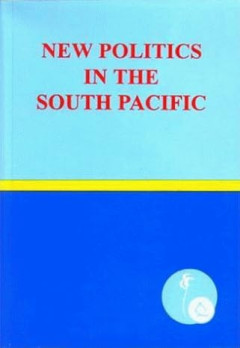
New politics in the South Pacific
New Politics in the South Pacific is a multidisciplinary volume examining the major political, cultural, and social transformations occurring across the Pacific Islands during the late twentieth century. Edited by Werner vom Busch, Fay Alailima, and Peter Larmour, the book brings together contributions from leading scholars of Pacific studies. It explores the emergence of new political movement…
- Edisi
- -
- ISBN/ISSN
- 982-02-0115-2
- Deskripsi Fisik
- viii, 354 pages : illustrations ; 20,5 cm
- Judul Seri
- -
- No. Panggil
- 320.995 BUS n
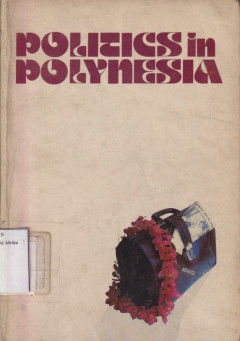
Politics in Polynesia
Politics in Polynesia examines the political systems, governance practices, and social transformations within Polynesian societies. Edited by Ahmed Ali and Ronald Gordon Crocombe, the volume forms part of the Politics in the Pacific Islands series and presents scholarly analyses of political developments across major Polynesian countries and territories, including Samoa, Tonga, Tahiti, and othe…
- Edisi
- -
- ISBN/ISSN
- -
- Deskripsi Fisik
- xii, 262 pages : illustrations ; 21 cm
- Judul Seri
- -
- No. Panggil
- 320.996 ALI p

Gott segne Afrika : Texte und Predigten des Friedensnobelpreisträgers
This book is a collection of texts, sermons, and reflections by Desmond Tutu, Nobel Peace Prize laureate and leading moral voice in the struggle against apartheid in South Africa. Written during a period of intense political repression, the work combines theological insight with sharp social critique, emphasizing justice, reconciliation, and human dignity. Tutu addresses the moral responsibilit…
- Edisi
- -
- ISBN/ISSN
- 3-499-15626-1
- Deskripsi Fisik
- 155 pages : Illustrations ; 19 cm
- Judul Seri
- -
- No. Panggil
- 968.065 TUT g

New Zealand in world affairs : Volume I
This volume presents a collection of authoritative papers examining New Zealand’s role and evolving position in world affairs. Written by leading scholars and diplomats, the book explores the country’s foreign policy development, its involvement in international organizations, and its responses to major global and regional issues during the mid-20th century. The analyses provide historical …
- Edisi
- -
- ISBN/ISSN
- 0-7055-0636-3
- Deskripsi Fisik
- 204 pages ; 21,5 cm
- Judul Seri
- -
- No. Panggil
- 327.93 MCI n
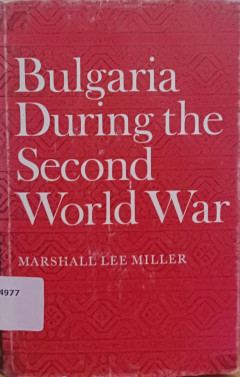
Bulgaria during the second world war
Marshall Lee Miller's Bulgaria During the Second World War offers an in-depth analysis of Bulgaria's political, military, and social position during World War II. Miller explains how Bulgaria navigated geopolitical pressures from Nazi Germany, the Soviet Union, and other Balkan states, as well as the internal factors that shaped the country's policies during the war. The book highlights the Bul…
- Edisi
- -
- ISBN/ISSN
- 0-8047-0870-3
- Deskripsi Fisik
- xii, 290 pages : illustration ; 22,5 cm
- Judul Seri
- -
- No. Panggil
- 949.75 MIL b

The Opening of the apartheid mind: Options for the New South Africa
Revealing the complex political forces involved in disman- thing apartheid, Adam and Moodley argue that although the African National Congress will join the government it may be forced to govern without real constitutional, eco- nomie, or military power. They view a political settlement as a necessary but insufficient condition for reversing the social disintegration and economie decline that i…
- Edisi
- -
- ISBN/ISSN
- 0-520-08199-4
- Deskripsi Fisik
- 256 pages : illustration ; 24 cm
- Judul Seri
- -
- No. Panggil
- 968.064 ADA o
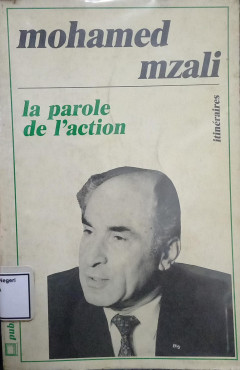
La parole de l’action: Conversation avec Xavière Ulysse
La parole de l’action presents an in-depth political conversation between Mohamed Mzali, a prominent Tunisian political figure, and Xavière Ulysse. Through a dialogical format, the book explores themes of political responsibility, governance, ideology, and action in the context of modern Tunisia and the Arab world. Drawing on Mzali’s intellectual background and political experience, this w…
- Edisi
- -
- ISBN/ISSN
- -
- Deskripsi Fisik
- 281 pages ; 21,5 cm
- Judul Seri
- -
- No. Panggil
- 320.092 MZA l
 Karya Umum
  Filsafat
  Agama
Agama  Ilmu-ilmu Sosial
  Bahasa
  Ilmu-ilmu Murni
  Ilmu-ilmu Terapan
  Kesenian, Hiburan, dan Olahraga
  Kesusastraan
  Geografi dan Sejarah