Ditapis dengan

Indonesië in de Veiligheidsraad van de Verenigde Naties (November 1948 – J…
Collection of documents, reports, and minutes of United Nations Security Council meetings related to the Indonesian issue between November 1948 and January 1949. These documents include statements by delegates, UN resolutions, and notes on the political situation leading up to the Second Dutch Military Aggression and the diplomatic process that took place in handling the Indonesian–Dutch conf…
- Edisi
- -
- ISBN/ISSN
- -
- Deskripsi Fisik
- 632 halaman ; 21,5 cm
- Judul Seri
- -
- No. Panggil
- 959.8 MIN i
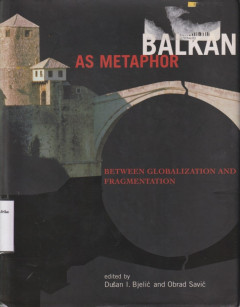
Balkan as metaphor
Balkan as Metaphor is an edited volume led by Dušan I. Bjelić that examines how the Balkans have been represented, imagined, and politically constructed in global discourse. The book explores the region’s shifting identities, ethnic relations, and political transformations following the end of the Cold War. Through interdisciplinary perspectives, the contributors analyze the Balkans as both…
- Edisi
- -
- ISBN/ISSN
- 0-262-02524-8
- Deskripsi Fisik
- xii, 382 pages ; 23,5 cm
- Judul Seri
- -
- No. Panggil
- 305.8 BJE b
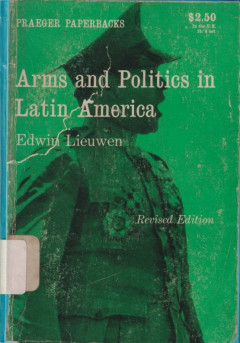
Arms and politics inLatin America
Arms and Politics in Latin America examines the historical and political role of military institutions across Latin American countries. Edwin Lieuwen analyzes how armed forces have shaped national development, political power, policy decisions, and patterns of governance throughout the region. The book discusses the roots of military influence, its expansion during periods of instability, and i…
- Edisi
- -
- ISBN/ISSN
- -
- Deskripsi Fisik
- xvi, 335 pages ; 20 cm
- Judul Seri
- -
- No. Panggil
- 327.8 LIE a

Chile; Política exterior para la democracia
This book is a collection of essays edited by Heraldo Muñoz and examines the new direction of Chilean foreign policy during the transition to democracy in the late 1980s. The authors, prominent academics, diplomats, and political analysts, evaluate Chile's global position, the diplomatic challenges of the post-Pinochet era, and the need to construct a foreign policy that supports democracy, ec…
- Edisi
- -
- ISBN/ISSN
- 956-16-0183-8
- Deskripsi Fisik
- 262 pages ; 21 cm
- Judul Seri
- -
- No. Panggil
- 327.83 MUN c
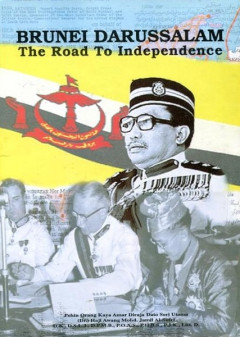
Brunei Darussalam: The Road to independence
This book Brunei Darussalam: the Road to Independence attempts to show the situation of Brunei in the past, and to depict the historical events that occured during that past era. This includes the affairs of the countries that have established relationship with Brunei Darussalam. In this way it is hoped that it will shed light and give better understanding of the details of these past events as…
- Edisi
- -
- ISBN/ISSN
- -
- Deskripsi Fisik
- xlii, 308 pages : illustrations (black and white) ; 26 cm
- Judul Seri
- -
- No. Panggil
- 959.55 HAS b

Malay politics in Sarawak 1946-1966: The Search for unity and political ascen…
While much has been written about the rule of the 'white rajas' in Sarawak and about the development of politics in this Malaysian state since independence, Malay Politics in Sarawak is the first study to focus on the political evolution of the Malay community in the crucial years from the cession to the British Crown in 1946 to independence in Malaysia and after. The author first sets the back…
- Edisi
- -
- ISBN/ISSN
- 0-19-582572-1
- Deskripsi Fisik
- xv, 166 pages ; 21 cm
- Judul Seri
- -
- No. Panggil
- 959.504 SAI m
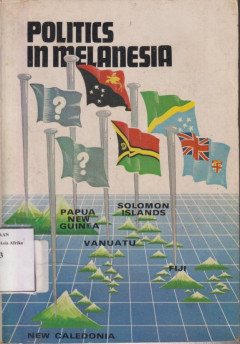
Politics in Melanesia
Politics in Melanesia presents a comprehensive examination of the political structures, governance systems, and historical developments across the Melanesian region, including Papua New Guinea, the Solomon Islands, Vanuatu, and Fiji. Edited by Ahmed Ali and Ronald Gordon Crocombe, the book brings together scholarly analyses from experts in Pacific political studies. It explores the influence of…
- Edisi
- -
- ISBN/ISSN
- -
- Deskripsi Fisik
- xii, 170 pages : illustrations ; 21 cm
- Judul Seri
- -
- No. Panggil
- 320.993 ALI p

Nixon in the white house: The Frustration of power
This book analyzes the presidency of Richard Nixon, focusing on the challenges and limitations of executive power during his administration. Written by journalists Rowland Evans, Jr. and Robert D. Novak, the work explores Nixon’s leadership style, political strategies, and conflicts within the White House and with Congress, the media, and public opinion. It provides an in-depth examination of…
- Edisi
- -
- ISBN/ISSN
- 0-394-46273-4
- Deskripsi Fisik
- 431 pages : 24,2 cm
- Judul Seri
- -
- No. Panggil
- 973.927 EVA n
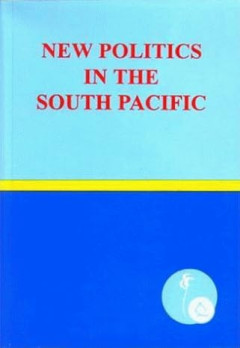
New politics in the South Pacific
New Politics in the South Pacific is a multidisciplinary volume examining the major political, cultural, and social transformations occurring across the Pacific Islands during the late twentieth century. Edited by Werner vom Busch, Fay Alailima, and Peter Larmour, the book brings together contributions from leading scholars of Pacific studies. It explores the emergence of new political movement…
- Edisi
- -
- ISBN/ISSN
- 982-02-0115-2
- Deskripsi Fisik
- viii, 354 pages : illustrations ; 20,5 cm
- Judul Seri
- -
- No. Panggil
- 320.995 BUS n
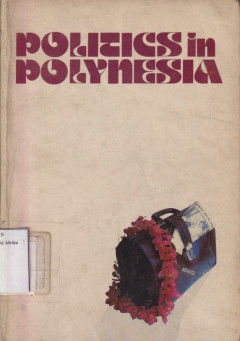
Politics in Polynesia
Politics in Polynesia examines the political systems, governance practices, and social transformations within Polynesian societies. Edited by Ahmed Ali and Ronald Gordon Crocombe, the volume forms part of the Politics in the Pacific Islands series and presents scholarly analyses of political developments across major Polynesian countries and territories, including Samoa, Tonga, Tahiti, and othe…
- Edisi
- -
- ISBN/ISSN
- -
- Deskripsi Fisik
- xii, 262 pages : illustrations ; 21 cm
- Judul Seri
- -
- No. Panggil
- 320.996 ALI p
 Karya Umum
  Filsafat
  Agama
Agama  Ilmu-ilmu Sosial
  Bahasa
  Ilmu-ilmu Murni
  Ilmu-ilmu Terapan
  Kesenian, Hiburan, dan Olahraga
  Kesusastraan
  Geografi dan Sejarah