Ditapis dengan

The Strategy of peace
“The Strategy of Peace” is a collection of speeches, statements, and policy essays by John F. Kennedy prior to his presidency, outlining his vision for American foreign policy in the Cold War era. The book emphasizes diplomatic leadership, nuclear responsibility, and the pursuit of global peace through international cooperation. Edited by historian Allan Nevins, the volume provides insight …
- Edisi
- -
- ISBN/ISSN
- -
- Deskripsi Fisik
- xxvi, 272 pages ; 17,5 cm
- Judul Seri
- -
- No. Panggil
- 327.73 KEN s

American foreign policy: Three essays
American Foreign Policy: Three Essays presents Henry A. Kissinger’s influential analyses of the strategic challenges confronting the United States during the Cold War era. In these essays, Kissinger examines the central issues of American foreign policy, the ideological and geopolitical forces shaping global power, and the need for a coherent national strategy. His reflections provide insight…
- Edisi
- -
- ISBN/ISSN
- 393-09853-2
- Deskripsi Fisik
- 143 pages ; 20,5 cm
- Judul Seri
- -
- No. Panggil
- 327.73 KIS a

French foreign policy under de Gaulle
Alfred Grosser's French Foreign Policy Under de Gaulle is a comprehensive study of the direction and character of French foreign policy during the reign of Charles de Gaulle during the Fifth Republic. It analyzes French diplomatic moves, efforts to strengthen national independence, and relations with the United States, NATO, the Soviet Union, and developing countries. Packed with academic persp…
- Edisi
- -
- ISBN/ISSN
- -
- Deskripsi Fisik
- xiv, 175 pages ; 22 cm
- Judul Seri
- -
- No. Panggil
- 327.44 GRO f

Peranan Indonesia sebagai pendiri Gerakan Non Blok dalam usaha memurnikan tuj…
The book "Indonesia's Role as the Founder of the Non-Aligned Movement in Efforts to Purify Its Goals and Principles" was published by the Research and Development Agency of the Ministry of Foreign Affairs of the Republic of Indonesia in 1986. This book discusses Indonesia's contribution to the birth of the Non-Aligned Movement (NAM) from the 1955 Asian-African Conference to the 1961 Belgrade Su…
- Edisi
- -
- ISBN/ISSN
- -
- Deskripsi Fisik
- iv, 145 pages : illustrations ; 23,5 cm
- Judul Seri
- -
- No. Panggil
- 327.172 BAD p

India and the Nonaligned Summits : Belgrade to Jakarta
Renu Srivastava's book India and the Nonaligned Summits: Belgrade to Jakarta comprehensively examines India's role in various Non-Aligned Movement (NAM) summits, from the first summit in Belgrade to the Jakarta summit. As one of the founders of NAM, India played a key role in formulating the principles of non-alignment, political independence, and cooperation among developing countries. The boo…
- Edisi
- -
- ISBN/ISSN
- 81-7211-063-4
- Deskripsi Fisik
- ix, 195 pages ; 22 cm
- Judul Seri
- -
- No. Panggil
- 327.172 SRI i

Denmark : A trouble welfare state
Denmark in the 1990s promises to be a stark contrast to the postwar years. In this critical introduction, Professor Kenneth Miller examines Danish social, governmental and public policy, focusing on the changes that have transformed it in the past 40 years. He presents a story of stability and change, of a welfare state in times of challenge and difficulty, and of a small country – despite in…
- Edisi
- -
- ISBN/ISSN
- 0-81330834-8
- Deskripsi Fisik
- xiii, 224 pages ; 24 cm
- Judul Seri
- -
- No. Panggil
- 361.6509 MIL d

NAM Summit: New Delhi to Harare
NAM Summit: New Delhi to Harare, edited by V. D. Chopra and published by Patriot Publishers on behalf of the Indian Centre for Regional Affairs, examines the development of the Non-Aligned Movement (NAM) from its first summit in New Delhi to its subsequent summit in Harare. It explores the dynamics of international politics during the mid-Cold War era, as developing countries sought to maintain…
- Edisi
- -
- ISBN/ISSN
- 81-7050-030-3
- Deskripsi Fisik
- xiv, 359 pages ; 21,5 cm
- Judul Seri
- -
- No. Panggil
- 327.172 CHO n
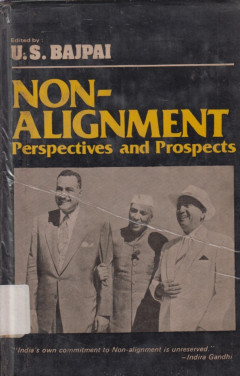
Non-alignment: perspectives and prospects
This volume presents a comprehensive collection of perspectives on the Non-Aligned Movement, examining its historical evolution, political foundations, and emerging challenges in the international system. Edited by U. S. Bajpai, the book gathers contributions from scholars and diplomats who analyze the principles, relevance, and strategic role of non-alignment in global affairs. It explores how…
- Edisi
- -
- ISBN/ISSN
- -
- Deskripsi Fisik
- xxii, 309 pages ; 25 cm
- Judul Seri
- -
- No. Panggil
- 327.17 BAJ n
Non-alignment: Frontiers & dynamics
This book provides a comprehensive examination of the frontiers and evolving dynamics of the Non-Aligned Movement (NAM). Edited by K. P. Misra, it explores the historical background, ideological foundations, political strategies, and global roles of non-aligned countries during the Cold War era. The volume analyzes the shifting international environment and the challenges faced by NAM in mainta…
- Edisi
- -
- ISBN/ISSN
- -
- Deskripsi Fisik
- xi, 512 pages ; 24,5 cm
- Judul Seri
- -
- No. Panggil
- 327.17 MIS n
Non-alignment and information
This book analyzes the role of information policy within the Non-Aligned Movement, focusing on how communication, media, and state information systems influence political positioning among developing countries. Vladislava Bulatović discusses Yugoslavia’s informational strategy and the broader effort of Non-Aligned nations to establish an independent and balanced global information order. The…
- Edisi
- -
- ISBN/ISSN
- -
- Deskripsi Fisik
- 119 pages ; 20 cm
- Judul Seri
- -
- No. Panggil
- 327.17 BUL n
 Karya Umum
  Filsafat
  Agama
Agama  Ilmu-ilmu Sosial
  Bahasa
  Ilmu-ilmu Murni
  Ilmu-ilmu Terapan
  Kesenian, Hiburan, dan Olahraga
  Kesusastraan
  Geografi dan Sejarah