Ditapis dengan

The myth of independence
Shortly after the Indo-Pakistani war of 1965, former foreign minister Zulfikar Ali Bhutto wrote a sweeping treatise on Pakistani foreign policy and the country's precarious position in the region. Advocating a tougher stance against India, stronger relations with the People's Republic of China, and a reassessment of Pakistan's interests aligning themselves with the United States' during the Col…
- Edisi
- -
- ISBN/ISSN
- -
- Deskripsi Fisik
- 188 pages: 20 cm
- Judul Seri
- -
- No. Panggil
- 327.5491 BHU m
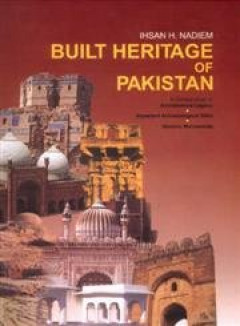
Built heritage of Pakistan
The Built Heritage of Pakistan book is an in-depth study of the architectural and cultural heritage spread throughout Pakistan. Ihsan H. Nadiem presents comprehensive documentation of historical sites, ranging from the remains of ancient civilizations such as Mohenjo-daro and Harappa, monuments of the Buddhist and Gandhara eras, to Islamic, Mughal, and colonial architecture that shape Pakistan'…
- Edisi
- -
- ISBN/ISSN
- 969-35-1329-0
- Deskripsi Fisik
- 160 pages; illustration: 25 cm
- Judul Seri
- -
- No. Panggil
- 954.918 NAD b

Pakistan's foreign policy: An historical analysis
'Change and Continuity' describes the period between 1972 and 1989 as the country's leaders searched for new ways to represent Pakistan's interests while mindful of the need to preserve tradition and ethos. The new section of this edition dovetails with the text of the first and together they describe strenuous efforts made by successive administrators to protect the integrity of the nation, of…
- Edisi
- Second Edition
- ISBN/ISSN
- 0195774078
- Deskripsi Fisik
- xii, 498 pages : bibl: hlm 477-486 : index ; 23 cm.
- Judul Seri
- -
- No. Panggil
- 327.5491 Bur p
Issues in Pakistan's economy
“Issues in Pakistan’s Economy” by S. Akbar Zaidi was first published in 1999. The book provided comprehensive information on different aspects of the economy in Pakistan since independence. The idea of writing this book originated from Oxford University Press as there was no book on the economy of Pakistan to benefit the graduate students, researchers, scholars, academicians, and the gene…
- Edisi
- Ed. 2
- ISBN/ISSN
- 0-19-597914-1
- Deskripsi Fisik
- xii, 530 pages : illustrations (black and white) : index ; 28 cm
- Judul Seri
- -
- No. Panggil
- 330.95491 Zai i

Readings in Pakistan foreign policy 1971-1998
This book discusses Pakistan's foreign policy over the last three decades. Pakistan's relations with the major powers, with its neighbours and the Muslim world have been examined. The book also deals with important issues of foreign policy, such as, Kashmir, nuclear issues, and security imperatives. The post cold war challenges and the impact of unipolar world on foreign policy are also discussed.
- Edisi
- First Published
- ISBN/ISSN
- 0-19-579393-5
- Deskripsi Fisik
- xix, 479 pages : index ; 22 cm
- Judul Seri
- -
- No. Panggil
- 327.5491 Ali r

India, Pakistan, and the Kashmir dispute: On regional conflict and its resolu…
Kashmir is the focal point of an acute regional dispute that has pitted India and Pakistan against one another ever since they gained their independence from Great Britain in 1947. Already, these bitter rivals have gone to war twice over Kashmir, leaving the state physically divided and heavily militarized. The eruption of massive anti-Indian violence in Indian Kashmir in early 1990 has changed…
- Edisi
- -
- ISBN/ISSN
- -
- Deskripsi Fisik
- xii, 337 pages ; ilustration : index ; 21 cm
- Judul Seri
- -
- No. Panggil
- 327.5405491 Wir i

Pakistan's foreign policy, 1947- 2005: A concise history
A distinguished career in Pakistan's Foreign Service has provided Abdul Sattar with a unique, personal insight into the making, implementation and consequences of Pakistan's foreign policy from Partition to post-9/11. This concise history reflects his knowledge and experience, providing a thorough account which will be of interest to both the layman and the scholar.
- Edisi
- First Published
- ISBN/ISSN
- 0-19-547167-9
- Deskripsi Fisik
- xii, 329 pages : illustrations, maps : bibl: hlm 321-322 : index ; 25 cm
- Judul Seri
- -
- No. Panggil
- 327.54 Sat p
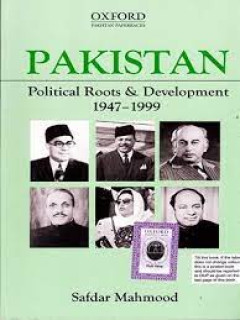
Pakistan: Political roots & development 1947-1999
"The focus of the book is on Pakistan's political history. With a chapter on the establishment of Pakistan as a backgrounder, the book thoroughly examines constitution-making and the characteristic features of various constitutions and why and how these did not work effectively. It analyses the working of the military governments of Ayub Khan, Yahya Khan, and Ziaul Haq as well as the working of…
- Edisi
- -
- ISBN/ISSN
- 0-19-579373-0
- Deskripsi Fisik
- -
- Judul Seri
- -
- No. Panggil
- 320.5491 Mah p
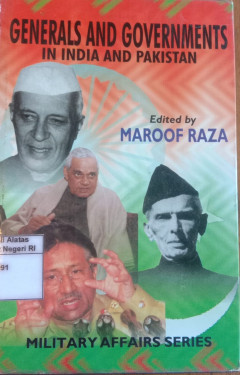
Generals and governments in India and Pakistan
The volume attempts to explain the prevailing civil-military equations in India and Pakistan by examining the plethora of historical, politic and military factors that have shaped the present-day political environment. As leaders in New Delhi and Islamabad appear more determined than ever before, to embark upon nuclear weaponization, there is now a much greater urgency to understand the politic…
- Edisi
- -
- ISBN/ISSN
- 81-241-0762-9
- Deskripsi Fisik
- 144 pages : index ; 23 cm
- Judul Seri
- -
- No. Panggil
- 320.5405491 Raz g
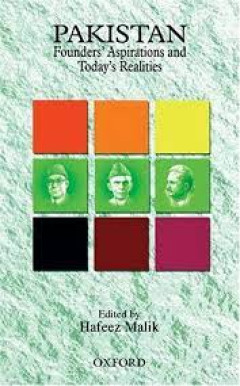
Pakistan founders' aspirations and today's realities
This is a collective scholarly endeavor Pakistani academics and Pakistan's public figures to examine the country's national existence in all walks of life. The contributors make a candid and objective analysis of the political process, the role of the judiciary, the executive, economic development and the role of foreign policy
- Edisi
- First Publication
- ISBN/ISSN
- 0-19-579333-1
- Deskripsi Fisik
- xi, 496 pages : Index ; 20 cm
- Judul Seri
- -
- No. Panggil
- 320.5491 Mal p
 Karya Umum
  Filsafat
  Agama
Agama  Ilmu-ilmu Sosial
  Bahasa
  Ilmu-ilmu Murni
  Ilmu-ilmu Terapan
  Kesenian, Hiburan, dan Olahraga
  Kesusastraan
  Geografi dan Sejarah