Ditapis dengan

Advancing Indonesia's economic diplomacy: Overcoming challenges to strengthen…
This paper analyses the role of economic diplomacy in strengthening Indonesia’s position as a critical minerals hub in the global energy transition. Indonesia has the world's largest nickel reserves. These account for around 42 percent of global reserves. The country also has copper, bauxite, and tin. Indonesia has the potential to transform from a raw material supplier into a value-added hub…
- Edisi
- -
- ISBN/ISSN
- -
- Deskripsi Fisik
- -
- Judul Seri
- -
- No. Panggil
- Sesparlu 77-2025
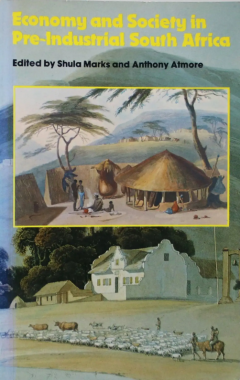
Economy and society in pre-industrial South Africa
Over the past forty years there has been a revolution in South African historiography, yet no broadly interpretative essay on South African history has appeared. The essays in this volume aim to provide such a reinterpretation for the nineteenth century before the discovery of minerals transformed the nature of South African societies, and help to shed light on earlier phases of South Africa's …
- Edisi
- -
- ISBN/ISSN
- 0-582-64656-1
- Deskripsi Fisik
- 385 pages ; 22 cm
- Judul Seri
- -
- No. Panggil
- 330.68 MAR e

Towards a prosperous future together: an analysis of the economic cooperation…
This paper analyzes the economic cooperation areas of the Indonesia–Thailand Strategic Partnership signed on 19 May 2025. For Indonesia, Thailand is the second Southeast Asian country whose bilateral relationship has been elevated to a Strategic Partnership, after Vietnam in 2003. The new status opens cooperation corridors in mutually beneficial economic, political, and socio-cultural areas. …
- Edisi
- -
- ISBN/ISSN
- -
- Deskripsi Fisik
- -
- Judul Seri
- -
- No. Panggil
- Sesparlu 77-2025

From promotion to problem-solving: integrating economic diplomacy and debottl…
Indonesia’s ambition to achieve high-income status by 2045 is hindered by structural bottlenecks that delay government programmes, investment, and business operations. This policy brief examines how the Ministry of Foreign Affairs (MoFA) can integrate economic diplomacy with the P3-MPPE Task Force and the Debottlenecking Channel to address these obstacles. It recommends strengthening the task…
- Edisi
- -
- ISBN/ISSN
- -
- Deskripsi Fisik
- -
- Judul Seri
- -
- No. Panggil
- Sesparlu 79-2026

Feasibility analysis methods for regional trade agreements: case study of Ind…
Indonesia’s concentrated export markets and exposure to global economic disruptions highlight the need to diversify trade partnerships. South Africa presents an opportunity to expand Indonesia’s non-oil-and-gas exports and strengthen economic engagement with Southern Africa. This policy brief recommends a dual-track strategy that uses South Africa as a political anchor while engaging the So…
- Edisi
- -
- ISBN/ISSN
- -
- Deskripsi Fisik
- -
- Judul Seri
- -
- No. Panggil
- Sesparlu 79-2026

Strengthening regional Foreign Affairs from symbolic engagement to strategic …
Indonesia’s regional diplomacy remains underutilized due to ad hoc provincial partnerships, uneven local government capacity, fragmented reporting, and limited alignment with national economic diplomacy priorities. Despite an established legal framework for coordinating foreign affairs, many sister-city and sister-province agreements have yet to produce tangible outcomes. This policy brief re…
- Edisi
- -
- ISBN/ISSN
- -
- Deskripsi Fisik
- -
- Judul Seri
- -
- No. Panggil
- Sesparlu 79-2026

Towards an Indonesia-France comprehensive Strategic Partnership in a changing…
Indonesia’s plan to elevate its Strategic Partnership with France to a Comprehensive Strategic Partnership (CSP) presents an opportunity to strengthen bilateral cooperation amid growing geopolitical uncertainty. Although both countries share converging strategic interests and complementary capabilities, existing cooperation has yet to deliver balanced outcomes in trade, technology, and defenc…
- Edisi
- -
- ISBN/ISSN
- -
- Deskripsi Fisik
- -
- Judul Seri
- -
- No. Panggil
- Sesparlu 79-2026
Sustaining Indonesia’s investment in Myanmar
This paper examines how Indonesia can sustain its investment in Myanmar. In her 2019 speech on Indonesia’s foreign policy priorities, the Minister for Foreign Affairs emphasized that Indonesian companies, including state-owned enterprises, should develop outbound investment strategies in synergy with the national interest and that Indonesian investment abroad must be protected. Indonesia–My…
- Edisi
- -
- ISBN/ISSN
- -
- Deskripsi Fisik
- -
- Judul Seri
- -
- No. Panggil
- Sesdilu 71-2021

Empowering diplomats through economic analysis trainings: A strategy to stren…
This paper explores options for empowering Indonesian diplomats through economic analysis training as a strategy to strengthen Indonesia’s diplomatic infrastructure. Economic diplomacy is one of Indonesia’s “4+1 Priorities” in foreign policy and requires support from all stakeholders, particularly diplomats as the main drivers of Indonesia’s economic diplomacy abroad. The complexity o…
- Edisi
- -
- ISBN/ISSN
- -
- Deskripsi Fisik
- -
- Judul Seri
- -
- No. Panggil
- Sesdilu 71-2021
 Karya Umum
 Filsafat
 Agama
 Ilmu-ilmu Sosial
 Bahasa
 Ilmu-ilmu Murni
 Ilmu-ilmu Terapan
 Kesenian, Hiburan, dan Olahraga
 Kesusastraan
 Geografi dan Sejarah