Ditapis dengan
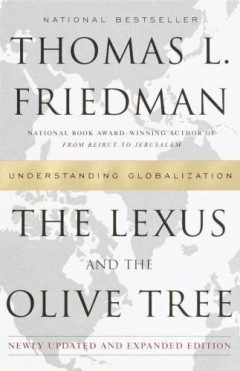
The Lexus and the olive tree: Understanding globalization
In this vivid portrait of the new business world, Thomas L. Friedman shows how technology, capital, and information are transforming the global marketplace, leveling old geographic and geopolitical boundaries. With bold reporting and acute analysis, Friedman dramatizes the conflict between globalizing forces and local cultures, and he shows why a balance between progress and the preservation of…
- Edisi
- Ed. 1
- ISBN/ISSN
- 0-385-49934-5
- Deskripsi Fisik
- xxii, 490 pages : illustrations (black and white) ; 20 cm
- Judul Seri
- -
- No. Panggil
- 337 Fri l

Understanding international conflicts: An introduction to theory and history …
This book contents: 1. Is there an Enduring Logic of Conflict in World Politics? 2. Origins of the Great Twentieth-Century Conflicts. 3. Balance of Power and World War I. 4. The Failure of Collective Security and World War II. 5. The Cold War. 6. Intervention, Institutions, and Regional Conflicts. 7. Interdependence and Globalization. 8. The Information Age. 9. A New World Order?
- Edisi
- Ed. 4
- ISBN/ISSN
- 0-321-08987-1
- Deskripsi Fisik
- xii, 275 pages : illustrations (black and white) ; 23 cm
- Judul Seri
- -
- No. Panggil
- 327.0904 Nye u
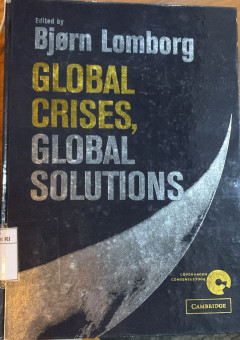
Global crises, global solutions
This volume provides a uniquely rich set of arguments and data for prioritizing our responses to some of the most serious problems facing the world today, such as climate change, communicable diseases, conflicts, education, financial instability, corruption, migration, malnutrition and hunger, trade barriers, and water access. Leading economists evaluate the evidence for costs and benefits of v…
- Edisi
- -
- ISBN/ISSN
- 0-521-84446-0
- Deskripsi Fisik
- xxii, 648 pages : illustrations ; 25 cm
- Judul Seri
- -
- No. Panggil
- 338.91 Lom g

Manual of the terminology of public international law (peace) and internation…
This manual is the third in a series devoted to the terminology of the social sciences and based on a revolutionary principle. Multilingual terminology is no longer treated as a science devoted to the explanation of the meaning of terms in different languages, but as one built on the elucidation of the equivalence in the multilingual plane of identical concepts. The latter are the starting poin…
- Edisi
- -
- ISBN/ISSN
- 2-8027-0283-1
- Deskripsi Fisik
- xlvii, 846 pages ; 29 cm
- Judul Seri
- -
- No. Panggil
- 341 Pae m

ASEAN and the EC: The impact of 1992
European economic integration has gathered new momentum since Member States of the European Community (EC) signed the Single European Act in February 1986 aimed at creating a region with no internal frontiers and with free movement of goods and services, capital, labour and the professions by the end of the year 1992. Since then, numerous decisions have been made by EC heads of governments, the…
- Edisi
- -
- ISBN/ISSN
- 981-3035-70-6
- Deskripsi Fisik
- xii, 344 pages : illustrations (black and white) ; 24 cm
- Judul Seri
- -
- No. Panggil
- 382.959 Wag a

Pacific initiatives for regional trade liberalization and investment cooperat…
This book contains about: 1. Regional assessment of the Uruguay round: Implications for the private sector 2. Regional initiatives for investment cooperation in the Pacific region 3. Issues in regional trade liberalization 4. New issues in GATT.
- Edisi
- -
- ISBN/ISSN
- -
- Deskripsi Fisik
- xxiv, 288 pages : illustrations (black and white) ; 22 cm
- Judul Seri
- -
- No. Panggil
- 382 Pan p
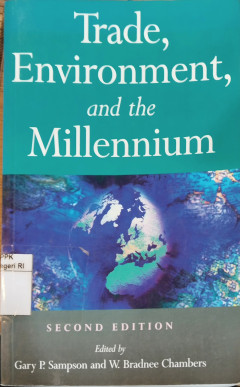
Trade, environment, and the millennium
This book contains about: 1. Trade and environment: Strengthening complementarities 2. Trade and environment: How real is the debate? 3. Breaking the deadlock: A positive agenda on trade, environment, and development 4. The WTO dispute settlement system etc.
- Edisi
- Ed. 2
- ISBN/ISSN
- 92-808-1064-2
- Deskripsi Fisik
- xi, 450 pages ; 23 cm
- Judul Seri
- -
- No. Panggil
- 382.92 Sam t

How developing countries trade: The institutional constraints
Over the last fifteen years there have been dramatic increases in both private and public intervention in international trade. Traditional barriers to market-based trade such as commodity cartels and tariffs have been augmented by new developments such as the rise of regional trade blocs and the growth of intra-firm trade. This book argues that these changes are large and persistent enough to h…
- Edisi
- Cet. 1
- ISBN/ISSN
- 0-415-11778-X
- Deskripsi Fisik
- xv, 309 pages : illustrations (black and white) ; 23 cm
- Judul Seri
- -
- No. Panggil
- 382 Pag h

Common Fund for Commodities: Zinc die casting
This report brings together in printed form the essential content of the series of seminars which formed phase 2 of a project 'Transfer of technology and promotion of demand: zinc die casting'. This project was financed by the Common Fund for Commodities and supervised by the international Lead Zinc Study Group. The aim was to train technologists from selected developing countries to take advan…
- Edisi
- -
- ISBN/ISSN
- -
- Deskripsi Fisik
- iv, 85 pages ; 29 cm.
- Judul Seri
- -
- No. Panggil
- 330 Boe c

Proceedings of the expert consultation on sustainable coconut production thro…
This book contains: 1. Global review of coconut lethal yellowing and similar cononut diseases associated with phytoplasma 2. Coconut global research for development progamme 3. Update on CLY research 4. Pathogen and epidemiology 5. Vectors Etc.
- Edisi
- -
- ISBN/ISSN
- -
- Deskripsi Fisik
- vi, 177 pages ; 29 cm
- Judul Seri
- -
- No. Panggil
- 330 Boe p
 Karya Umum
 Filsafat
 Agama
 Ilmu-ilmu Sosial
 Bahasa
 Ilmu-ilmu Murni
 Ilmu-ilmu Terapan
 Kesenian, Hiburan, dan Olahraga
 Kesusastraan
 Geografi dan Sejarah