Ditapis dengan

Dereliction of duty: Lyndon Johnson, Robert McNamara, the Joint Chiefs of Sta…
An insightful analysis of how and why the U.S. became involved in the war in Southeast Asia outlines the policies and decisions that embroiled America in the conflict and examines the roles of Lyndon Johnson, Robert McNamara, and others in deceiving the American public.
- Edisi
- -
- ISBN/ISSN
- 0-06-018795-6
- Deskripsi Fisik
- xxii, 446 pages ; 24 cm
- Judul Seri
- -
- No. Panggil
- 959.704 Mcm d

A question of balance: The president, the congress, and foreign policy
In recent years, a more active and aggressive Congress has often sharply disagreed with the president over the ends and means of American foreign policy. The normal tensions that arise in the U.S. system of separate institutions sharing power have been exacerbated by the contemporary pattern of split-party control of the two branches. The ensuing conflict in areas ranging from Central America t…
- Edisi
- -
- ISBN/ISSN
- 0-8157-5453-1
- Deskripsi Fisik
- ix, 265 pages ; 23 cm
- Judul Seri
- -
- No. Panggil
- 353.0089 Man q

Cost of disarmament-disarming the costs: Nuclear arms control and nuclear rea…
This study evaluates the costs and benefits of nuclear arms control treaties between the US and the Soviet Union/Russian Federation. The report finds that, although the implementation and verification of nuclear arms control regimes can be expensive, these costs pale into insignificance compared to the costs and risks of nuclear rearmament and the consequences of a nuclear arms race.
- Edisi
- -
- ISBN/ISSN
- 92-9045-154-8
- Deskripsi Fisik
- xviii, 156 pages : illustration ; 21 cm
- Judul Seri
- -
- No. Panggil
- 355.825119 Wil c

The Forgotten Americans
At the end of the prosperous 1980s, the number of Americans living in working-poor families equaled the combined populations of the nation's 25 largest cities. Contrary to conventional wisdom, this situation is not largely confined to minorities, women, the undereducated or young adults. It is commonplace for workers from nearly all segments of society to be employed in low-paying jobs even dur…
- Edisi
- -
- ISBN/ISSN
- 0-393-033388-0
- Deskripsi Fisik
- xvi, 219 pages ; 22 cm
- Judul Seri
- -
- No. Panggil
- 395.305569 Sch f
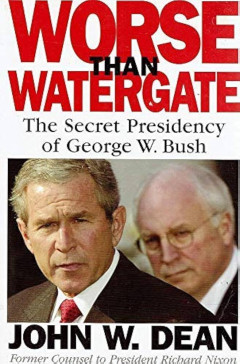
Worse than watergate : The secret Presidency of George W. Bush
The former counsel to President Nixon provides a stinging critique of the current Bush administration, its obsession with secrecy, and its willingness to deceive the American people, emphasizing the president's emphasis on image over substance, mistrustful personality, imperial governing and flawed decision making, and his abuses of national security secrecy.
- Edisi
- -
- ISBN/ISSN
- 0-316-00023-X
- Deskripsi Fisik
- xxI, 281 pages ; 21 cm
- Judul Seri
- -
- No. Panggil
- 973.931 Dea w

Agents of influence: How Japan's lobbyists in the United States manipulate Am…
Assesses the impact of Japanese lobbyists on American politics, economics, and public opinion, discussing why Japan is spending money on lobbyists and analyzing the long-term policy implications for the U.S. government. 1. Japanese Influence 2. Japanese Lobbying 3. Japanese Politicking
- Edisi
- ed. 1
- ISBN/ISSN
- 0-394-57901-1
- Deskripsi Fisik
- xxii, 295 pages : illustrations (black and white) ; 24 cm
- Judul Seri
- -
- No. Panggil
- 337.73052 Cho a

Just war against terror: The burden of American power in a violent world
Jean Bethke Elshtain has been hailed as one of this country's most influential public intellectuals. Michael Walzer called her award-winning Democracy on Trial "the work of a truly independent, deeply serious, politically engaged, and wonderfully provocative political theorist." These rare qualities are once again vividly in force in Just War Against Terrorism.In this hard-hitting book, Elshtai…
- Edisi
- -
- ISBN/ISSN
- 0-465-01910-2
- Deskripsi Fisik
- xi, 240 pages ; 22 cm
- Judul Seri
- -
- No. Panggil
- 363.32 Els j

Ultimate punishment : A lawyer's reflections on dealing with the death penalty
In this vivid account of how his views on the death penalty have evolved, Turow describes his own experiences with capital punishment from his days as an impassioned young prosecutor to his recent service on the Illinois commission which investigated the administration of the death penalty and influenced Governor George Ryanâ€s unprecedented commutation of the sentences of 164 death row inma…
- Edisi
- ed. 1
- ISBN/ISSN
- 0-374-12873-1
- Deskripsi Fisik
- 164 pages ; 20 cm
- Judul Seri
- -
- No. Panggil
- 345.730773 Tur u

The pentagon's new map: War and peace in the twenty-first century
Contents: 1. New rule sets 2. The rise of the "lesser includeds" 3. Disconnectedness defines danger 4. The core and the gap 5. The new ordering principle etc.
- Edisi
- -
- ISBN/ISSN
- 0-399-15175-3
- Deskripsi Fisik
- 435 pages ; 23 cm
- Judul Seri
- -
- No. Panggil
- 355.033 Bar p
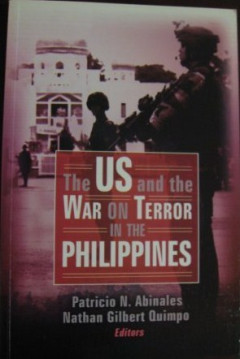
The US and the war on terror in the Philippines
The contents of this book: Chapter 1: 21st-Century Philippines-US Security Relations: Managing an Alliance in the War of the Third Kind Chapter 2: Unconventional Warface: Are US Special Forces Engaged in an "Offensive War" in the Philippines?
- Edisi
- -
- ISBN/ISSN
- 978-971-27-2062-8
- Deskripsi Fisik
- vii, 203 pages ; 22 cm
- Judul Seri
- -
- No. Panggil
- 303.625 Abi u
 Karya Umum
  Filsafat
  Agama
Agama  Ilmu-ilmu Sosial
  Bahasa
  Ilmu-ilmu Murni
  Ilmu-ilmu Terapan
  Kesenian, Hiburan, dan Olahraga
  Kesusastraan
  Geografi dan Sejarah