Ditapis dengan

U.S. Nonproliferation policy towards North Korea: Nuclear program, DPRK belli…
The United States policy for dealing with a nuclear North Korea has been a combination of containment, deterrence, and limited engagement since 1994. While this policy has prevented war on the Korean peninsula, it has not prevented North Korea from developing a nuclear program and proliferating this technology, as well as missile technology, to numerous countries not friendly to the United States.
- Edisi
- -
- ISBN/ISSN
- 978-152-0959-48-1
- Deskripsi Fisik
- 62 pages ; 26 cm
- Judul Seri
- -
- No. Panggil
- 341.5 Man u

United States congress: Security implications of the nuclear non-proliferatio…
Excerpt from Security Implications of the Nuclear Non-Proliferation Agreement With North Korea: Hearing Before the Committee on Armed Services, United States Senate, One Hundred Fourth Congress, First Session, January 26, 1995 Committee staff members present: Richard L. Reynard, staff di rector, George W. Lauffer, deputy staff director, and Christine K. Cimko, press secretary. About the Publish…
- Edisi
- -
- ISBN/ISSN
- 978-0-332-64810-1
- Deskripsi Fisik
- iii, 95 pages ; 24 cm
- Judul Seri
- -
- No. Panggil
- 341.5 Sta u

Humanitarian hypocrisy: Civilian protection and the design of peace operations
In humanitarian Hypocrisy, Andrea L. Everett maps the often glaring differences between declared ambitions to protect civillians in conflict zones and the resources committed for doing so. Examining how powerful governments contribute to peace operations and determine how they are designed, Everett argues that ambitions-resources gaps are a form of organized hypocrisy. Her book shows how politi…
- Edisi
- -
- ISBN/ISSN
- 978-1-5017-1547-1
- Deskripsi Fisik
- xiv, 267 pages ; 24 cm
- Judul Seri
- -
- No. Panggil
- 341.5 84 Eve h

Cost of disarmament-disarming the costs: Nuclear arms control and nuclear rea…
This study evaluates the costs and benefits of nuclear arms control treaties between the US and the Soviet Union/Russian Federation. The report finds that, although the implementation and verification of nuclear arms control regimes can be expensive, these costs pale into insignificance compared to the costs and risks of nuclear rearmament and the consequences of a nuclear arms race.
- Edisi
- -
- ISBN/ISSN
- 92-9045-154-8
- Deskripsi Fisik
- xviii, 156 pages : illustration ; 21 cm
- Judul Seri
- -
- No. Panggil
- 355.825119 Wil c

Changing fortunes: The world's money and the threat to American leadership
Changing Fortunes is based on a series of lectures given at the Woodrow Wilson School, gives an inside view of all the significant economic events of the last four decades, including the formation of the new monetary system that was negotiated at Bretton Woods in 1944, the Latin American debt crisis of the 1970s, and the interest rate shocks of the late '70s and early '80s.
- Edisi
- -
- ISBN/ISSN
- 0-8129-2218-2
- Deskripsi Fisik
- xix, 394 pages : illustrations (black and white) ; 21 cm
- Judul Seri
- -
- No. Panggil
- 332.042 Vol c
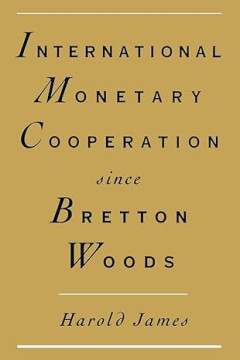
International monetary cooperation since Bretton Woods
This comprehensive history, published jointly by the IMF and Oxford University Press, was written to mark the fiftieth anniversary of international monetary cooperation. From the establishment of the postwar international monetary system in 1944 to how the framework functions in a vastly expanded world economy, historian Harol James describes the tensions, negotiations, challenges, and progress…
- Edisi
- -
- ISBN/ISSN
- 0-19-510448-X
- Deskripsi Fisik
- xvi, 742 pages : illustrations (black and white) ; 24 cm
- Judul Seri
- -
- No. Panggil
- 332.042 Jam i

International financial markets and the firm
Presents a rigorous and balanced presentation of international financial markets and international corporate finance. Takes a unified approach based on arbitrage-fee pricing. Includes an in-depth discussion of the economic role of the forward rate and the value of the forward contract, a comprehensive discussion of when and why the firm can increase its value by hedging foreign exchange risk, a…
- Edisi
- -
- ISBN/ISSN
- 0-538-84023-4
- Deskripsi Fisik
- xvi, 731 pages : illustrations (black and white) ; 24 cm
- Judul Seri
- -
- No. Panggil
- 332.1 Ser i

International trade and business law annual: April 2000 volume v
The International trade and Business Law Annual is the official publication of the Australian institute of Foreign and Comparative Law. The Annual includes leading articles, case notes, and comments, as well as book reviews dealing with international trade and business law issues.
- Edisi
- Cet. 1
- ISBN/ISSN
- 1-876213-35-3
- Deskripsi Fisik
- xii, 432 pages ; 23 cm
- Judul Seri
- -
- No. Panggil
- 346.07 Kin i

International migration and development: Continuing the dialogue: Legal and p…
International migration has reached the top of the global political agenda. In addition to nations and regional groups, the larger international community is struggling with the question of how best to manage international migration, especially with regard to development and human rights. There is little agreement on what should be done or, indeed, whether this is even an appropriate topic for …
- Edisi
- Ed. 1
- ISBN/ISSN
- 1-57703-047-8
- Deskripsi Fisik
- 256 pages : illustrations ; 23 cm
- Judul Seri
- -
- No. Panggil
- 304.8 Cha i

United nations convention on the use of electronic communications in internat…
This book contains: A. United nations convention on the use of electronic communications in international contracts 1. Sphere of application 2. General provisions 3. Use of electronic communications in international contracts 4. Final provisions B. Explanatory note by the UNCITRAL secretariat on the United Nations convention on the use of electronic communications in international con…
- Edisi
- -
- ISBN/ISSN
- 978-92-1-133756-3
- Deskripsi Fisik
- v, 100 pages ; 24 cm
- Judul Seri
- -
- No. Panggil
- 341.7 Nat u
 Karya Umum
 Filsafat
 Agama
 Ilmu-ilmu Sosial
 Bahasa
 Ilmu-ilmu Murni
 Ilmu-ilmu Terapan
 Kesenian, Hiburan, dan Olahraga
 Kesusastraan
 Geografi dan Sejarah