Ditapis dengan
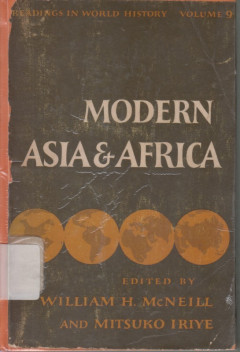
Modern Asia and Africa
This edited volume provides an extensive comparative survey of social, political, and historical developments in Asia and Africa during the modern era. Bringing together contributions from leading scholars, the book explores the transformation of societies across both continents in the context of colonialism, nationalism, economic change, and global political shifts. The essays highlight region…
- Edisi
- -
- ISBN/ISSN
- -
- Deskripsi Fisik
- xiii, 285 pages : illustrations ; 20,1 cm
- Judul Seri
- -
- No. Panggil
- 909.097 MCN m
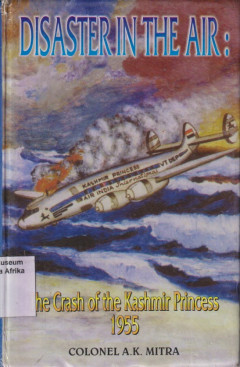
Disaster in the Air: The Crash of the Kashmir Princess 1955
This book provides a detailed account of the 1955 crash of the Air India aircraft Kashmir Princess, which was carrying delegates related to the Asian-African Conference in Bandung. Colonel A.K. Mitra reconstructs the events leading to the sabotage, examines the geopolitical context of the Cold War, and analyzes the investigation that followed the incident. The narrative highlights the political…
- Edisi
- -
- ISBN/ISSN
- 81-7510-123-7
- Deskripsi Fisik
- xvi, 125 pages : illustrations ; 21,5 cm
- Judul Seri
- -
- No. Panggil
- 363.124 MIT d

What went wrong? : The Clash between Islam and modernity in the Middle East
This book explores the historical, cultural, and political factors that shaped the relationship between the Islamic world and modernity. Bernard Lewis examines key turning points in Middle Eastern history, addressing why modernization and technological development progressed differently in Islamic societies compared to the West. Through historical analysis, Lewis discusses political structures,…
- Edisi
- -
- ISBN/ISSN
- 0-06-051605-4
- Deskripsi Fisik
- 186 pages : illustration ; 20,5 cm
- Judul Seri
- -
- No. Panggil
- 956.015 LEW w

Bandoung: Tournant de l’Histoire (18 avril 1955)
This book by Arthur Conte provides a French analytical perspective on the Asian-African Conference held in Bandung on April 18, 1955. It examines the political climate of the Cold War, the rise of newly independent nations, and the significance of the Bandung meeting as a turning point in world history. Conte highlights the ideological debates, diplomatic tensions, and aspirations of Asian and …
- Edisi
- -
- ISBN/ISSN
- -
- Deskripsi Fisik
- 322 pages : illustrations ; 24 cm
- Judul Seri
- -
- No. Panggil
- 327.17 CON b

The Emergence of the modern Middle East
The Emergence of the Modern Middle East by Albert Hourani provides a comprehensive analysis of the historical transformation of the Middle East from the eighteenth century to the twentieth century. Hourani explores the political, social, and intellectual developments that shaped modern Middle Eastern societies, including the impact of European influence, internal reforms, nationalism, and cultu…
- Edisi
- -
- ISBN/ISSN
- 0-520-03862-6
- Deskripsi Fisik
- xx, 243 pages ; 22 cm
- Judul Seri
- -
- No. Panggil
- 956 HOU e

South-East Asia 1930–1970: The legacy of colonialism and nationalism
This book provides a comprehensive analysis of Southeast Asia from 1930 to 1970, focusing on the profound political, social, and economic transformations that shaped the region. Fred R. von der Mehden examines the long-lasting impact of colonialism and the rise of nationalist movements that ultimately led to independence across Southeast Asian nations. Through historical interpretation and comp…
- Edisi
- -
- ISBN/ISSN
- 0-500-71004-X
- Deskripsi Fisik
- 144 pages : illustration ; 21 cm
- Judul Seri
- -
- No. Panggil
- 959.05 MEH s

Gideon’s Spies: Sejarah rahasia mossad 2
This second volume continues Gordon Thomas’s investigation into the inner workings of Mossad. It expands on major intelligence missions, technological developments, political manipulation, and Israel’s regional and global security strategies. The book highlights Mossad’s involvement in key geopolitical events, offering deeper insights into its operational philosophy, alliances, and the co…
- Edisi
- -
- ISBN/ISSN
- 978-979-93027-5
- Deskripsi Fisik
- xxi, 339 pages : illustrations ; 20,5 cm
- Judul Seri
- -
- No. Panggil
- 327.125694 THO g

Gideon’s spies: Sejarah rahasia mossad 1
Gideon’s Spies reveals the secret history and covert operations of Mossad, Israel’s intelligence agency, from its early missions to modern global activities. Based on interviews, classified documents, insider testimonies, and intelligence leaks, the book details Mossad’s involvement in international espionage, targeted assassinations, high-level political influence, counterterrorism missi…
- Edisi
- -
- ISBN/ISSN
- 978-979-3930-20-6
- Deskripsi Fisik
- xxi, 360 pages : illustrations ; 20,5 cm
- Judul Seri
- -
- No. Panggil
- 327.125694 THO g

After the cataclysm: Postwar Indochina and the reconstruction of imperial ide…
After the Cataclysm examines the political, social, and ideological aftermath of the Indochina wars, focusing on Vietnam, Cambodia, and Laos following the withdrawal of the United States. Chomsky and Herman analyze how Western media and political institutions constructed narratives about postwar Indochina to justify American foreign policy and sustain Cold War ideological frameworks. The book c…
- Edisi
- -
- ISBN/ISSN
- 0-89608-100-1
- Deskripsi Fisik
- 392 pages ; 21 cm
- Judul Seri
- -
- No. Panggil
- 959.704 CHO a
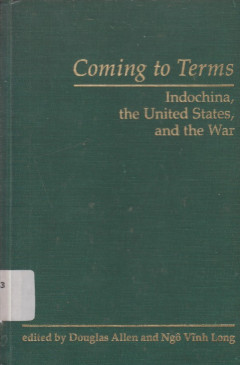
Coming to terms: Indochina, the United States, and the war
Coming to Terms is a scholarly examination of the political, social, and historical dimensions of the Indochina conflict and the role of the United States. Edited by Douglas Allen and Ngô Vĩnh Long, the book brings together contributions from leading researchers who analyze the roots of the war, the consequences for Vietnam, Laos, and Cambodia, and the broader geopolitical implications for So…
- Edisi
- -
- ISBN/ISSN
- 0-8133-1249-3
- Deskripsi Fisik
- ix, 350 pages : illustrations ; 23,5 cm
- Judul Seri
- -
- No. Panggil
- 959.7043 ALL c
 Karya Umum
  Filsafat
  Agama
Agama  Ilmu-ilmu Sosial
  Bahasa
  Ilmu-ilmu Murni
  Ilmu-ilmu Terapan
  Kesenian, Hiburan, dan Olahraga
  Kesusastraan
  Geografi dan Sejarah