Ditapis dengan

A beginner's guide to the world economy: Eighty-one basic economic concepts t…
In a time of rapid change in the world economy, this fascinating, concise, and user-friendly primer is the most reliable tool for keeping track of what's happening. What is the new economy? What is globalization? Is the euro the final seal on European Union? How is e-commerce transforming our world beyond economics? What is virtual money, and does it have real value? How do social concerns …
- Edisi
- -
- ISBN/ISSN
- 0-375-72579-2
- Deskripsi Fisik
- xv, 232 pages : illustrations (black and white) ; 20 cm
- Judul Seri
- -
- No. Panggil
- 332 Epp b

International excellence: Seven breakthrough strategies for personal and prof…
The contents of this book: 1. Strategy I: Adopting a Global Vision 2. Strategy II: Developing Cultural Empathy 3. Strategy III: Acquiring Interpersonal Expertise 4. Strategy IV: Utilizing Global Negotiating Skills, etc.
- Edisi
- -
- ISBN/ISSN
- 1-56836-082-7
- Deskripsi Fisik
- 229 pages ; 22 cm
- Judul Seri
- -
- No. Panggil
- 658.04 Eng i
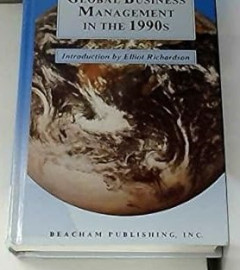
Global business management in the 1990s
Contents: 1. The impact of culture on international operations 2. Political risks for the MNC 3. International law and agreements 4. Strategies for global operations 5. International marketing 6. International Financial consideration 7. International tax, etc.
- Edisi
- -
- ISBN/ISSN
- 0-933833-07-5
- Deskripsi Fisik
- xi, 485 pages ; 23 cm
- Judul Seri
- -
- No. Panggil
- 658.049 Ric g

The end of the nations state: The rise of regional economies
Nation states, asserts the world-renowned business strategist Kenichi Ohmae, are dinosaurs waiting to die. In the profoundly important book Ohmae argues that not only have nation states lost their ability to control exchange rates and protect their currencies, but they no langer generate real economic activity.
- Edisi
- -
- ISBN/ISSN
- 0-02-923341-0
- Deskripsi Fisik
- x, 214 pages : illustration ; 24 cm
- Judul Seri
- -
- No. Panggil
- 337.1 Ohm e
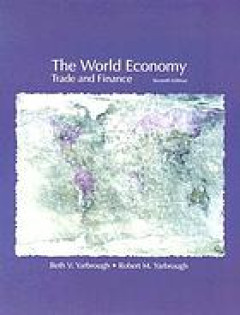
The world economy: Trade and finance
The contents of this book: 1. Introduction to International Trade in the World Economy 2. Comparative Advantage I: Labor Productivity and Trade 3. Comparative Advantage II: Factor Endowments and Trade 4. Trade, Distribution, and Welfare 5. Beyond Comparative Advantage: Empirical Evidence and New Trade Theories 6. Tariffs, etc.
- Edisi
- ed. 7
- ISBN/ISSN
- 0-324-20397-7
- Deskripsi Fisik
- xvi, 763 pages : illustrations ; 25 cm
- Judul Seri
- -
- No. Panggil
- 337 Yar w

Forward engagement: RSIS as a think tank of international studies and securit…
In many ways, the S. Rajaratnam School of International Studies (RSIS) is a microcosm of the Singapore brand of government. The DNA of Singapore's policymaking is its forward-looking nature. S. Rajaratnam's trademark is taking the long view while Lee Kuan Yew articulated his wish for leadership foresight and the admiration for 'helicopter quality' candidates in policymaking. This was how RSIS' …
- Edisi
- -
- ISBN/ISSN
- 978-0-00-098716-7
- Deskripsi Fisik
- xviii, 155 pages ; 23 cm
- Judul Seri
- -
- No. Panggil
- 355.03 Cho f

The conduct of hostilities under the law of international armed conflict
This book focuses on issues arising in the course of hostilities between States, emphasizing the most recent conflicts in Iraq and Afghanistan. Main themes considered are lawful and unlawful combatants, war crimes (including command responsibility and defenses), prohibited weapons, the distinction between combatants and civilians, legitimate military objectives, and the protection of the enviro…
- Edisi
- -
- ISBN/ISSN
- 0-521-54227-8
- Deskripsi Fisik
- xx, 275 pages ; 23 cm
- Judul Seri
- -
- No. Panggil
- 341.62 Din c

The U.S. and us: The future of an alliance
This is the eighth in a series of occasional papers to be produced by the Pacific Security Research Institute (PSRI). The PSRI was established in Sydney by the Institute of Public Affairs (Incorporated in the ACT. ACN 008 627 727) in April 1989 to undertake research and to play an active part in debate on foreign and defence policy issues in the Asia-Pacific region, in terms of Australia's l…
- Edisi
- -
- ISBN/ISSN
- 0-909536-27-9
- Deskripsi Fisik
- 45 pages : illustrations (black and white) ; 25 cm
- Judul Seri
- -
- No. Panggil
- 341.7 Sna u

Kepentingan negara berkembang terhadap hak atas indikasi geografis, sumber da…
Buku ini berisi: Bagian 1: Prosiding Lokakarya Bagian 2: Berbagai Pemikiran Mengenai: "Kepentingan Negara Berkembang Atas Indikasi Geografis, Sumber Daya Genetika, dan Pengetahuan Tradisional"
- Edisi
- cet. 1
- ISBN/ISSN
- 979-98911-1-6
- Deskripsi Fisik
- xiii, 290 halaman ; 23 cm
- Judul Seri
- -
- No. Panggil
- 346.0488 Ind k

Beyond arms control: Challenges and choices for nuclear disarmament
Beyond arms control: challenges and choices for nuclear disarmament is a collaborative work of non-governmental researchers and activists who critically examine the mainstream discourse of nuclear weapons. The book explores some of the most important challenges that governments and civil society will face at the 2010 NPT Review Conference and beyond, highlighting the prospects and pitfalls for …
- Edisi
- -
- ISBN/ISSN
- -
- Deskripsi Fisik
- xii, 250 pages ; 21, 5 cm
- Judul Seri
- -
- No. Panggil
- 355.825119 Ach b
 Karya Umum
  Filsafat
  Agama
Agama  Ilmu-ilmu Sosial
  Bahasa
  Ilmu-ilmu Murni
  Ilmu-ilmu Terapan
  Kesenian, Hiburan, dan Olahraga
  Kesusastraan
  Geografi dan Sejarah