Ditapis dengan

The grand chessboard: American primacy and its geostrategic imperatives
The heart of The Grand Chessboard is Brzezinski's analysis of the four critical regions of Eurasia and of the stakes for America in each arena - Europe, Russia, Central Asia, and East Asia. The crucial fault lines may seem familiar, but the implosion of the Soviet Union has created new rivalries and new relationships, and Brzezinski maps out the strategic ramifications of the new geopolitical r…
- Edisi
- -
- ISBN/ISSN
- 0-465-02726-1
- Deskripsi Fisik
- xiv, 223 pages : maps : index ; 25 cm.
- Judul Seri
- -
- No. Panggil
- 327.73 Brz t
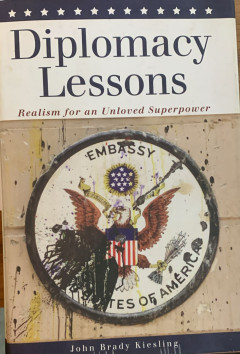
Diplomacy lessons: Realism for an unloved superpower
In Diplomacy Lessons, Kiesling reminds readers that U.S. power does not rest on military might alone and that anger at America has real consequences for U.S. national interests. The security and prosperity of the American people depend on efficient cooperation with foreigners on a range of issues, not only terrorism and nuclear nonproliferation but also trade policy, environmental protection, a…
- Edisi
- Ed. 1
- ISBN/ISSN
- 978-1-59797-017-4
- Deskripsi Fisik
- ix, 317 pages : index ; 23 cm
- Judul Seri
- -
- No. Panggil
- 327.73 Bra d

How America got it right: The U.S. march to military and political supremacy
As the world's dominant political force and military power, he says, we are the only nation that will actually go into the world and strike down evil. And we must not shirk that responsibility - especially because we cannot rely on our so-called allies to defend our freedoms. Alexander tells the dramatic and sometimes surprising story of how, from the American Revolution to the War on Terror, A…
- Edisi
- -
- ISBN/ISSN
- 1-4000-5288-2
- Deskripsi Fisik
- viii, 309 pages : bibl: hlm 293-296 : index ; 25 cm
- Judul Seri
- -
- No. Panggil
- 327.73 Ale h
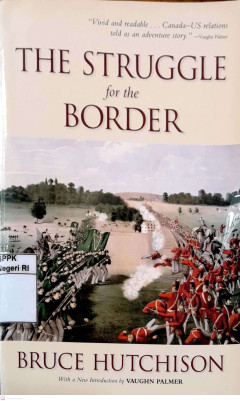
The struggle for the border
The boundary between Canada and the United States is famously described as the world's longest undefended border. It was not always so. In The Struggle for the Border, renowned journalist and popular historian Bruce Hutchison tells the little-known story of how that border was established-a story of frontier war, Fenian raids, the burning of Washington, and diplomatic intrigues.
- Edisi
- 1st edition
- ISBN/ISSN
- 978-0-19-544792-7
- Deskripsi Fisik
- vii, 500 pages : illustrations : index ; 22 cm
- Judul Seri
- -
- No. Panggil
- 327.71073 Hut s

International diplomacy in Southern Africa: From Reagan to Mandela
This book will prove an essential resource for students and scholars of political science, international affairs and history. It is useful to journalists, government officials, diplomats and all those with a keen interest in con- temporary Southern African politics and events in that region.
- Edisi
- -
- ISBN/ISSN
- 0951635409
- Deskripsi Fisik
- 195 pages : index ; 21 cm
- Judul Seri
- -
- No. Panggil
- 327.68073 Cha i

Subversion as foreign policy: The secret Eisenhower and Dulles debacle in Ind…
This account of US foreign policy reveals the story of the covert activity in Indonesia undertaken by President Eisenhower and Secretary of State John Foster Dulles in the late 1950s
- Edisi
- Cetakan pertama
- ISBN/ISSN
- 1-56584-244-8
- Deskripsi Fisik
- 318 pages : maps : index ; 25 cm
- Judul Seri
- -
- No. Panggil
- 327.598073 Kah s

The U.S.-Japan security alliance: Why it matters and how to strengthen it
For more than three decades, the multifaceted alliance between the United States and Japan has contributed significantly to the security of Japan and the maintenance of peace and security in the Far East.
- Edisi
- -
- ISBN/ISSN
- 0-275-97806-0
- Deskripsi Fisik
- xvi, 106 pages : bibl: hlm 93-98 : index ; 22 cm
- Judul Seri
- -
- No. Panggil
- 327.52 Osi u

In confidence : Moscow's ambassador to America's six Cold War presidents
Anatoly Dobrynin arrived in Washington in 1962. He was only forty-three, the youngest man ever to serve as Soviet ambassador to the United States. Amazingly he remained in Washington through the presidencies of Kennedy, Johnson, Nixon, Ford, Carter, and Reagan. Dobrynin became the main back channel for the White House and the Kremlin to exchange ideas, negotiate in secret, and set up summit mee…
- Edisi
- -
- ISBN/ISSN
- 0-8129-2328-6
- Deskripsi Fisik
- xiii, 672 pages : illustrations : index ; 25 cm
- Judul Seri
- -
- No. Panggil
- 327.2092 Dob c

Deterrence in the second nuclear age
Keith Payne begins by asking, "Did we really learn how to deter predictably and reliably during the Cold War?" He answers cautiously in the negative, pointing out that we know only that our policies toward the Soviet Union did not fail. What we can be more certain of, in Payne's view, is that such policies will almost assuredly fail in the Second Nuclear Age―a period in which direct nuclear t…
- Edisi
- -
- ISBN/ISSN
- 0-8131-0895-0
- Deskripsi Fisik
- xiv, 168 pages : index ; 23 cm
- Judul Seri
- -
- No. Panggil
- 327.17 Pay d
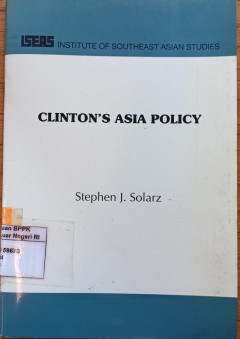
Clinton's Asia policy
A related adjustment in American policy toward China has been the extent to which the United States has re-initiated a high-level dialogue with the PRC President Bush, perhaps because he did not want to be seen as being too soft on China in the wake of the Tiananmen incident, suspended a high-level dialogue with Beijing. Under President Clinton, to some extent perhaps because the Administration…
- Edisi
- -
- ISBN/ISSN
- 981-3016-88-4
- Deskripsi Fisik
- viii, 22 pages ; 25 cm
- Judul Seri
- -
- No. Panggil
- 327.16959673 Sol c
 Karya Umum
  Filsafat
  Agama
Agama  Ilmu-ilmu Sosial
  Bahasa
  Ilmu-ilmu Murni
  Ilmu-ilmu Terapan
  Kesenian, Hiburan, dan Olahraga
  Kesusastraan
  Geografi dan Sejarah