Ditapis dengan
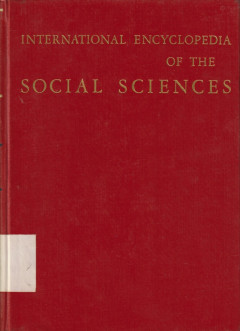
International encyclopedia of the social sciences. Volume 1
The International Encyclopedia of the Social Sciences, Volume 1, provides comprehensive scholarly coverage of major concepts, theories, methods, and historical development within the social sciences. Edited by David L. Sills, the encyclopedia brings together contributions from leading experts across disciplines such as sociology, anthropology, economics, political science, psychology, and relat…
- Edisi
- 1
- ISBN/ISSN
- -
- Deskripsi Fisik
- xxx, 567 pages ; 26 cm
- Judul Seri
- -
- No. Panggil
- 303.03 SIL i

Cuba: A Journey
This book is Jacobo Timerman's travelogue and political analysis of Cuba in the post-1959 era. Written from a previously unpublished Spanish manuscript, it describes the political, social, and human rights conditions in Cuba after the revolution and the changes that occurred under Fidel Castro's rule. Using a journalistic and reflective approach, Timerman presents a critical view of modern Cuba…
- Edisi
- -
- ISBN/ISSN
- 0-679-73631-X
- Deskripsi Fisik
- 129 pages; 20 cm
- Judul Seri
- -
- No. Panggil
- 972.9106 TIM c

A Concise history of Brazil
This book presents a concise yet comprehensive overview of Brazilian history from prehistoric times, Portuguese colonization, the imperial period, the formation of the republic, and modern development. Boris Fausto outlines changes in Brazilian politics, economy, society, and culture in a coherent and in-depth manner. This English edition, translated by Arthur Brakel, is one of the primary acad…
- Edisi
- -
- ISBN/ISSN
- 978-0-521-56526-4
- Deskripsi Fisik
- 362 pages, 22 x 14 cm
- Judul Seri
- -
- No. Panggil
- 981 FAU c

Brazil on the rise
This book charts Brazil's dramatic transformation from a challenging developing nation to an increasingly influential economic and political power in the 21st century. Larry Rohter, former Brazil correspondent for The New York Times, explores the political, economic, social, and cultural changes that shaped Brazil's new face. Through in-depth analysis and interviews with key figures, the book e…
- Edisi
- -
- ISBN/ISSN
- 978-0-230-61887-9
- Deskripsi Fisik
- 292 pages ; 24 cm
- Judul Seri
- -
- No. Panggil
- 981 ROH b
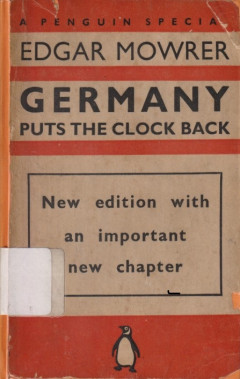
Germany puts the clock back
This book contains Edgar Ansel Mowrer's sharp analysis of German political developments after the Nazi Party rose to power. Written by a renowned international journalist, this book describes how the policies of Adolf Hitler and Nazi leaders changed the course of German history in the early 1930s. Using an investigative style, Mowrer highlights political oppression, propaganda, social change, a…
- Edisi
- -
- ISBN/ISSN
- -
- Deskripsi Fisik
- v, 284 pages ; 18 cm
- Judul Seri
- -
- No. Panggil
- 943.086 MOW g

A German generation: An Experiential history of the twentieth century
This book is an experiential history study of the German generation that lived throughout the 20th century, particularly during World War I, the Weimar Republic, the Nazi era, World War II, and the postwar period. Through narrative analysis and oral history interviews, Thomas A. Kohut reveals how identity, experience, and collective memory shaped how this generation understood themselves and th…
- Edisi
- -
- ISBN/ISSN
- 978-0-300-17003-0
- Deskripsi Fisik
- xi, 335 pages ; 24 cm
- Judul Seri
- -
- No. Panggil
- 943.087 KOH g
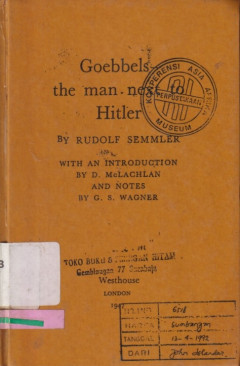
Goebbels: The Man next to Hitler
This book is the personal account of Rudolf Semmler, one of Joseph Goebbels' closest associates, the Nazi German Minister of Propaganda. Through the author's personal experiences, this book describes Goebbels' personality, leadership style, propaganda strategies, and his relationship with Adolf Hitler and the inner circle of the Nazi Party. With an introduction by D. McLachlan and additional no…
- Edisi
- -
- ISBN/ISSN
- -
- Deskripsi Fisik
- 234 pages : illustration ; 18,5 cm
- Judul Seri
- -
- No. Panggil
- 943.086092 SEM g

The Third reich: Its Beginnings, its development, its end
This book outlines the complete history of the establishment of the Third Reich in Germany, from its inception and rise to power to its collapse in 1945. Hans Buchheim explains the political, social, and ideological factors that enabled the growth of the Nazi regime, including the internal dynamics of the government, propaganda, and the impact of Hitler's policies on the German people. Written …
- Edisi
- -
- ISBN/ISSN
- -
- Deskripsi Fisik
- 98 pages ; 19 cm
- Judul Seri
- -
- No. Panggil
- 943.086 BUC t

Injustice: The Social bases of obedience and revolt
This book discusses the social roots of injustice, obedience, and revolution in society. Barrington Moore, Jr. explores how social structures, political power, and economic inequality shape both obedient and rebellious behavior. Through historical and comparative analysis, Moore explains the conditions that make societies submit to oppressive authorities, as well as the factors that can trigger…
- Edisi
- -
- ISBN/ISSN
- 0-87332-114-6
- Deskripsi Fisik
- xviii, 540 pages ; 23,5 cm
- Judul Seri
- -
- No. Panggil
- 303.3 MOO i

Der islam in der gegenwart
“Der Islam in der Gegenwart” provides a comprehensive and authoritative overview of the contemporary Islamic world. Edited by Werner Ende and Udo Steinbach, this volume presents scholarly analyses of political, social, and cultural developments within Muslim-majority societies. The book covers key themes such as modern Islamic thought, political movements, demographic trends, regional confl…
- Edisi
- -
- ISBN/ISSN
- 3-89331-625-6
- Deskripsi Fisik
- 1064 pages : illustration ; 24 cm
- Judul Seri
- -
- No. Panggil
- 297.09 END d
 Karya Umum
  Filsafat
  Agama
Agama  Ilmu-ilmu Sosial
  Bahasa
  Ilmu-ilmu Murni
  Ilmu-ilmu Terapan
  Kesenian, Hiburan, dan Olahraga
  Kesusastraan
  Geografi dan Sejarah