Ditapis dengan

Disarmament: The world at a critical turning point
This publication includes the edited transcripts of the panel discussions held in the United Nations by the NGO Committee on Disarmament in 1998 and early 1999 and the presentations made by NGOs on May 11, 1999 at the third Prep Com for the Non-Proliferation Treary Review Conference to be held in the year 2000. We are very much dependent upon your reactions and suggestions to help us plan what …
- Edisi
- -
- ISBN/ISSN
- 92-1-142231-0
- Deskripsi Fisik
- vi, 356 pages ; 28 cm
- Judul Seri
- -
- No. Panggil
- 327.17405 Uni d

The age of deception: Nuclear diplomacy in treacherous times
The author gives us his account from the centre of the nuclear fray. Readers will sit at the dinner table with Iraqi officials in Baghdad, listening as they bleakly predict the coming war. They will eavesdrop on the exchanges between UN inspectors and U.S. officials observing the behind-the-scenes formulation of an approach to foreign policy and diplomacy that would come to characterise the Bus…
- Edisi
- -
- ISBN/ISSN
- 978-1-4088-2224-1
- Deskripsi Fisik
- 340 pages : index ; 24 cm
- Judul Seri
- -
- No. Panggil
- 327.174 Elb a
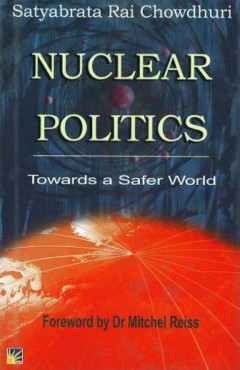
Nuclear politics: Towards a safer world
The past few years have witnessed a number of remarkable developments in the field of nuclear arms control and non proliferation. The United States and the Soviet Union (now Russia) signed the START I and II agreements, which promised to reduce the nuclear arsenals of the two countries by two-thirds, to approximately 3,000 nuclear warheads each by the year 2003. President Bush's announcement on…
- Edisi
- -
- ISBN/ISSN
- 1-932705-02-3
- Deskripsi Fisik
- ix, 672 pages : bibl: hlm 626-650 : index ; 22 cm
- Judul Seri
- -
- No. Panggil
- 327.174 Cho m
Epicenter of peace
This book describes how the people of Kazakstan's reached the decision to rid themselves of nuclear weapons and argues that peace will come to our multipolar world only through nonproliferation and denuclearization. President Nazarbayev sets the record straight on Kazakstan's dauntless decision to lead the way to a secure future for all our children and grandchildren.
- Edisi
- -
- ISBN/ISSN
- 1-884186-13-0
- Deskripsi Fisik
- xix, 170 pages : illustrations (black and white) : index ; 24 cm
- Judul Seri
- -
- No. Panggil
- 327.16 Naz e
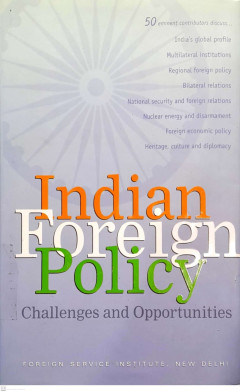
Indian foreign policy: Challenges and opportunities
The world is now engaged with India already established as a major power, advancing in every sphere of development: political, diplomatic, socio-economic, scientific, technological, and cultural. The distinguished foreign affairs analysts, scholars and eminent diplomats invited by the Foreign Service Institute (Government of India) to write chapters for this book on Indian foreign policy, have …
- Edisi
- -
- ISBN/ISSN
- 81-7188-593-4
- Deskripsi Fisik
- 1149 pages ; 24 cm
- Judul Seri
- -
- No. Panggil
- 327.54 Muk i

Weapons of terror : Freeing the world of nuclear biological and chemical arms
In this report, the Independent Weapons of Mass Destruction Commission, chaired by Hands Blix, confronts this global challenge and presents 60 recommendations on what the world community-national governments and civil society-an and should do. Contents: 1. Reviving disarmament 2. Weapons of terror : threats and responses 3. Nuclear weapons 4. Biological and toxin weapons, etc.
- Edisi
- -
- ISBN/ISSN
- 91-38-22582-4
- Deskripsi Fisik
- 227 pages : index ; 24 cm
- Judul Seri
- -
- No. Panggil
- 303.625 Bli w
Nuclear Pakistan
Nuclear Pakistan is virtually, Pakistan's Islamic Nuclear Decoction. After the cession of Islamic States and the disintegration of Union of Soviet Socialist Republics, the destablishing process in the region has started. Pakistan's ambition to fill the void created by Weakening of Iraq and Iran and to emerge as the leader of the conglomeration of Islamic nations is a great threat to peace and s…
- Edisi
- -
- ISBN/ISSN
- 81-7024-767-5
- Deskripsi Fisik
- xv, 332 pages ; 22 cm
- Judul Seri
- -
- No. Panggil
- 355.825119 Chi n
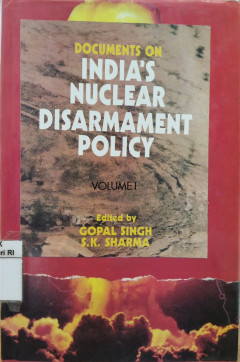
Documents on India's nuclear disarmament policy volume I
Contents: 1. Text of the UN general assembly resolution on principles governing the general regulations and reduction of armaments 41 (I) adopted on 14 December 1946. India supported it 2. Statement made by Vijaya Laxmi Pandit in the UN general assembly, 25 September 1948 (Extracts) 3. Statement made by Vijaya Laxmi Pandit in the UN general assembly, 4 November 1948 4. Text of the UN genera…
- Edisi
- Vol. 1 ; Cet. 1
- ISBN/ISSN
- 81-86565-64-7
- Deskripsi Fisik
- xviii, 573 pages ; 22 cm
- Judul Seri
- -
- No. Panggil
- 355.825119 Sin d
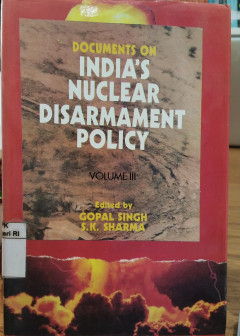
Documents on India's nuclear disarmament policy volume III
Contents: 1. Statement made by M. Dubey in the first committee of the UN on 15 November 1984 on disarmament 2. Statement made by M. Dubey in UN first committee on 27 November 1984 on draft resolutions on disarmament 3. Statement made by Khursheed Alan Khan in the UN general assembly on 26 September 1985 on nuclear disarmament (Extracts) 4. Statement made by G.G. Swell in the first committee…
- Edisi
- Vol. 3 ; Cet. 1
- ISBN/ISSN
- 81-86565-64-7
- Deskripsi Fisik
- xx, 1007-1562 pages ; 22 cm
- Judul Seri
- -
- No. Panggil
- 355.825119 Sin d
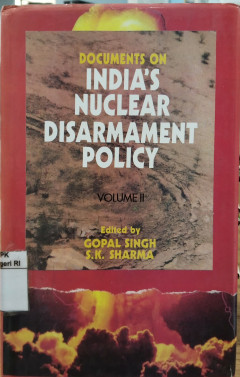
Documents on India's nuclear disarmament policy volume II
Contents: 1. Statement made by Sardar Swaran Singh in UN general assembly on 14 December 1964 2. Statement made by Sardar Swaran Singh in Rajya Sabha on 22 December 1964 (Extracts) 3. Statement made by V.C. Trivedi in the disarmament commission on 14 May 1965 on Chinese second nuclear explosion 4. The prime minister Lal Bahadur Shastri's statement on 15 May 1965 at an Indo-Soviet friendship…
- Edisi
- Vol. 2 ; Cet. 1
- ISBN/ISSN
- 81-86565-64-7
- Deskripsi Fisik
- xiv, 575-1006 pages ; 22 cm
- Judul Seri
- -
- No. Panggil
- 355.825119 Sin d
 Karya Umum
  Filsafat
  Agama
Agama  Ilmu-ilmu Sosial
  Bahasa
  Ilmu-ilmu Murni
  Ilmu-ilmu Terapan
  Kesenian, Hiburan, dan Olahraga
  Kesusastraan
  Geografi dan Sejarah