Ditapis dengan

Blood money: Wasted billions, lost lives, and corporate greed in Iraq
An explosive indictment of how the Bush Administration wasted billions in Iraq--through sweetheart deals to G.O.P. supporters, outrageous contracts to corrupt companies, and absurdly naïve assumptions. It was supposed to be quick and easy. The Bush Administration even promised that it wouldn't cost American taxpayers a thing Iraqi oil revenues would pay for it all. But billions and billions of…
- Edisi
- -
- ISBN/ISSN
- 978-0-316-16628-7
- Deskripsi Fisik
- xviii, 340 pages ; 21 cm
- Judul Seri
- -
- No. Panggil
- 956.7 Mil b

Bush in Babylon: The recolinisation of Iraq
The assault and capture of Iraq and the resistance it has provoked will shape the politics of the twenty-first century. In this passionate and provocative book, Tariq Ali provides a history of Iraqi resistance against empires old and new, and argues against the view that sees imperialist occupation as the only viable solution to bring about regime-change in corrupt and dictatorial states. Like …
- Edisi
- -
- ISBN/ISSN
- 1-84467-512-2
- Deskripsi Fisik
- 262 pages ; 20 cm
- Judul Seri
- -
- No. Panggil
- 956.7 Ali b

The future of Iraq: Dictatorship, democracy, or division?
The Future of Iraq provides a primer on the history and political dynamics of this pivotal state divided by ethnic, religious and political antagonisms, and provocatively argues that the least discussed future of Iraq might be the best: managed partition. that even a significant American presence will not stabilize Iraq because it is an artificial state and its people have never shared a common…
- Edisi
- ed. 1
- ISBN/ISSN
- 1-4039-6354-1
- Deskripsi Fisik
- x, 260 pages : illustrations (black and white) ; 25 cm
- Judul Seri
- -
- No. Panggil
- 956.7044 And f
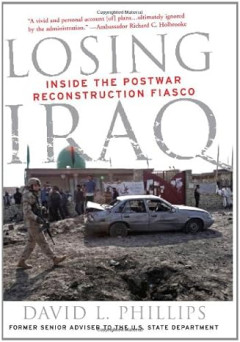
Losing Iraq: Inside the postwar reconstruction fiasco
Things didn't go wrong in postwar Iraq because the United States lacked a plan. Things went wrong because the United States was blinded by ideology and ignored planning that was already underway. Losing Iraq tells the story of the tragedy of Iraq, from the first discreet meetings to plan the political transition through the debacle the United States finally created. Losing Iraq is a stunning an…
- Edisi
- -
- ISBN/ISSN
- 0-8133-4304-6
- Deskripsi Fisik
- ix, 292 pages ; 23 cm
- Judul Seri
- -
- No. Panggil
- 956.704431 Phi l

The right war ?: The conservative debate on Iraq
This book brings together the most articulate and influential voices in the debate among conservatives over the tactics and strategy of America's engagement in Iraq. Its contribution run the gamut from protests to second thoughts to full-throated endorsements, and represent a vivid sampling of the ideological currents likely to influence the Bush administration in its ongoing efforts in Iraq an…
- Edisi
- -
- ISBN/ISSN
- 978-0-521-67318-1
- Deskripsi Fisik
- ix, 254 pages ; 23 cm
- Judul Seri
- -
- No. Panggil
- 956.7 Ros r
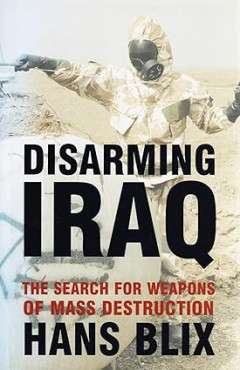
Disarming Iraq : The search for weapons of mass destruction
His book will consider a wide range of questions including- Could the war have been prevented? Was it inevitable? Does Iraq have weapons of mass destruction? Why couldn't the US and the UK secure the backing of the member states of the UN Security Council? What can be learnt from the Iraq war for the prevention of the spread and use of WMDs?. Contents: 1. Disarming Iraq 2. Inspection 3. Out…
- Edisi
- -
- ISBN/ISSN
- 0-7475-7358-1
- Deskripsi Fisik
- x, 285 pages ; 23 cm
- Judul Seri
- -
- No. Panggil
- 355.825 Bli d

Cobra II: The inside story of the invasion and occupation of Iraq
Contents: 1. Snowflakes from the secretary 2. The generated start 3. Smaller is beautiful 4. The other side of the hill 5. Back to the future 6. 'Round and round we go etc.
- Edisi
- -
- ISBN/ISSN
- 0-375-42262-5
- Deskripsi Fisik
- xxxii, 603 pages : illustrations (black and white) ; 24 cm
- Judul Seri
- -
- No. Panggil
- 956.70443 Gor c

Kuwait: Statehood and boundaries objective facts and Iraqi claims
This book contains: 1. The 1990 Gulf crisis: Precursors, development and dimensions 2. Kuwait: Historical status 3. International Law vis-a-vis the Iraqi aggression on Kuwait 4. Economic effects of the Iraqi aggression on Kuwait
- Edisi
- Ed. 3
- ISBN/ISSN
- 99906-32-20-0
- Deskripsi Fisik
- 265 pages ; 24 cm
- Judul Seri
- -
- No. Panggil
- 327.5367 Ghu k

Saddam's bombmaker: The terrifying inside story of the Iraqi nuclear and biol…
Among the book's revelations: Iraq already has biological weapons and is capable of completing a nuclear weapon within months if international sanctions are lifted; Western corporations and governments facilitated Iraq's nuclear programmme by putting profits ahead of security and averting their eyes as Saddam obtained his necessary nuclear technology; if threatened, Saddam has sworn to create a…
- Edisi
- -
- ISBN/ISSN
- 0-684-87386-9
- Deskripsi Fisik
- 352 pages ; 24 cm
- Judul Seri
- -
- No. Panggil
- 355.021709567 Ham s

The United Nations and the Iraq-Kuwait conflict, 1990-1996
This volume includes more than 200 key United Nations documents relating to all aspects of the situation. An extensive introduction by Secretary-General Boutros Boutros-Ghali and a detailed chronology complement the texts.
- Edisi
- Vol.9
- ISBN/ISSN
- 92-1-100596-5
- Deskripsi Fisik
- 844 pages ; 26 cm
- Judul Seri
- -
- No. Panggil
- 341.23 Gha u
 Karya Umum
  Filsafat
  Agama
Agama  Ilmu-ilmu Sosial
  Bahasa
  Ilmu-ilmu Murni
  Ilmu-ilmu Terapan
  Kesenian, Hiburan, dan Olahraga
  Kesusastraan
  Geografi dan Sejarah