Ditapis dengan
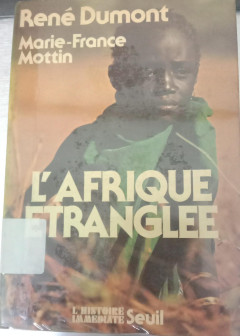
L’Afrique étranglée : Zambie, Tanzanie, Sénégal, Côte-d’Ivoire, Guin…
René Dumont and Marie-France Mottin's book, "L'Afrique Étranglée," examines the economic, political, and social crises that plagued various African countries after independence. Through case studies of Zambia, Tanzania, Senegal, Côte-d'Ivoire, Guinea-Bissau, and Cap-Vert, the authors outline how colonialism, mismanagement, economic dependency, and flawed development policies led to stagnant…
- Edisi
- -
- ISBN/ISSN
- -
- Deskripsi Fisik
- 264 pages ; 20,5 cm
- Judul Seri
- -
- No. Panggil
- 960 DUM I
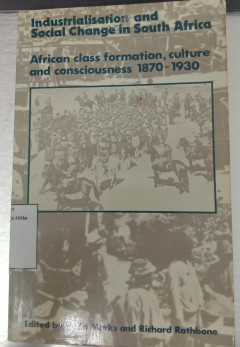
Industrialisation and social change in South Africa: African class formation,…
This book is a collection of essays examining the impact of industrialization on social change in South Africa between 1870 and 1930. Edited by Shula Marks and Richard Rathbone, it examines the formation of African social classes, cultural developments, and changes in social consciousness resulting from modernization and capitalism. It highlights how economic and political dynamics shaped socia…
- Edisi
- -
- ISBN/ISSN
- 0-582-64337-6
- Deskripsi Fisik
- 383 pages; 21 cm
- Judul Seri
- -
- No. Panggil
- 968 MAR i

Slaves, spices & ivory in Zanzibar: Integration of an East African commercial…
This book is an in-depth study of Zanzibar's development as an international trading center in East Africa between 1770 and 1873. Abdul Sheriff analyzes how the slave, spice, and ivory trades shaped Zanzibar's economic structure and integrated it into the world economy. Using an economic history approach, the author traces the role of Arab, Swahili, and Indian traders, as well as colonial power…
- Edisi
- -
- ISBN/ISSN
- 0-85255-015-4
- Deskripsi Fisik
- xx, 297 pages : illustration ; 21,5 cm
- Judul Seri
- -
- No. Panggil
- 330.9678 SHE e
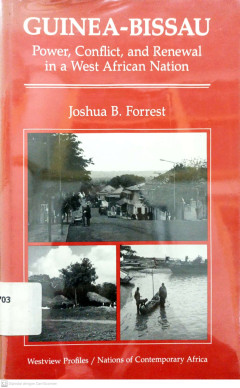
Guinea - Bissau: Power, conflict, and renewal in a West African nation
This book examines the political dynamics, conflicts, and processes of national renewal in Guinea-Bissau since its independence in 1974. Joshua B. Forrest traces the development of state power, relations among political elites, social structures, and the economic challenges facing this small West African nation. Through in-depth historical and political analysis, Forrest presents a comprehensiv…
- Edisi
- -
- ISBN/ISSN
- 0-86531-681-3
- Deskripsi Fisik
- x, 165 pages; 24 cm
- Judul Seri
- -
- No. Panggil
- 966.5703 FOR g
La Côte d'Ivoire
La Côte d’Ivoire, written by geographer Gabriel Rougerie, provides a concise yet comprehensive overview of Ivory Coast’s geography, population, economy, society, and political evolution. As part of the "Que sais-je?" series, the book presents an analytical introduction to the country’s physical landscape, natural resources, demographic patterns, cultural diversity, and developmental chal…
- Edisi
- -
- ISBN/ISSN
- -
- Deskripsi Fisik
- 126 pages ; 18 cm
- Judul Seri
- -
- No. Panggil
- 966.68 ROU c

Zimbabwe: The Political economy of transition 1980–1986
Zimbabwe: The Political Economy of Transition 1980–1986 is a comprehensive analysis of Zimbabwe’s formative post-independence years. Edited by Ibbo Mandaza, the volume brings together contributions from leading scholars who examine the country’s economic restructuring, political developments, state-building process, and challenges faced during the early 1980s. The book explores issues suc…
- Edisi
- -
- ISBN/ISSN
- 0-7974-0837-1
- Deskripsi Fisik
- xii, 439 pages ; 22 cm
- Judul Seri
- -
- No. Panggil
- 338.968 MAN z

Pyidawtha: The New Burma. A Report from the Government to the People of the U…
This book describes Burma's national development program during the early years of independence. It covers the government's goals and priorities, as well as economic development plans covering agriculture, forestry, transportation, telecommunications, energy, mining, industry, health, education, housing, and social welfare. This book is a concise document on the government's strategy for creati…
- Edisi
- -
- ISBN/ISSN
- -
- Deskripsi Fisik
- 128 pages : ilustrations ; 25 cm
- Judul Seri
- -
- No. Panggil
- 330.959 ECO p

New Guinea: Problems and prospects
Peter Hastings's New Guinea: Problems and Prospects is an in-depth analysis of the political, social, and economic conditions of New Guinea during its transition to self-government. It highlights the key challenges facing the region, including its high ethnic diversity, geographic barriers, limited infrastructure, and the dynamics of the colonial relationship between Australia and Papua New Gui…
- Edisi
- Second Edition
- ISBN/ISSN
- 0-7015-1570-8
- Deskripsi Fisik
- xii+303 pages; 22 cm
- Judul Seri
- -
- No. Panggil
- 995 HAS n
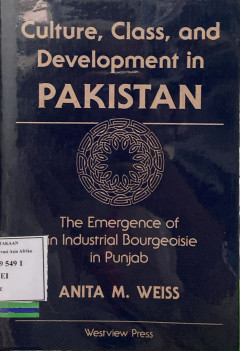
Culture, class, and development in Pakistan
This book is concerned with social change in Pakistan, particularly the relationship between indigenous sociocultural orientations, the development process, and the rise of a new middle-level entrepreneurial class in the Punjab.
- Edisi
- -
- ISBN/ISSN
- 0-8133-7910-5
- Deskripsi Fisik
- x, 207 pages: illustration; 22 cm
- Judul Seri
- -
- No. Panggil
- 305.509 WEI c
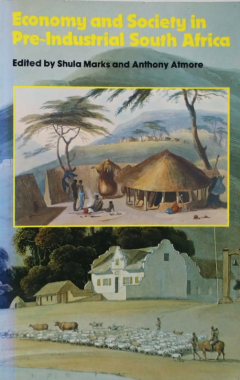
Economy and society in pre-industrial South Africa
Over the past forty years there has been a revolution in South African historiography, yet no broadly interpretative essay on South African history has appeared. The essays in this volume aim to provide such a reinterpretation for the nineteenth century before the discovery of minerals transformed the nature of South African societies, and help to shed light on earlier phases of South Africa's …
- Edisi
- -
- ISBN/ISSN
- 0-582-64656-1
- Deskripsi Fisik
- 385 pages ; 22 cm
- Judul Seri
- -
- No. Panggil
- 330.68 MAR e
 Karya Umum
  Filsafat
  Agama
Agama  Ilmu-ilmu Sosial
  Bahasa
  Ilmu-ilmu Murni
  Ilmu-ilmu Terapan
  Kesenian, Hiburan, dan Olahraga
  Kesusastraan
  Geografi dan Sejarah