Ditapis dengan

First things first: Meeting basic human needs in the developing countries
First Things First examines the concept of “basic human needs” as a central priority in development policy for low-income countries. Written by Paul Streeten with contributions from several development economists, the book evaluates how governments and international institutions can address poverty through targeted investments in nutrition, health, education, and employment. It presents ana…
- Edisi
- -
- ISBN/ISSN
- 0-19-520368-2
- Deskripsi Fisik
- xii, 206 pages ; 23 cm
- Judul Seri
- -
- No. Panggil
- 338.9 STR f

The Weak in the world of the strong
This book examines the structural disadvantages faced by developing countries in the global political and economic system. Rothstein analyzes how weaker nations interact with major powers, emphasizing the limitations they encounter in diplomacy, trade, and international negotiations. By exploring historical patterns and case studies, the work provides insight into the persistent inequalities sh…
- Edisi
- -
- ISBN/ISSN
- 0-231-04339-2
- Deskripsi Fisik
- x, 384 pages ; 23 cm
- Judul Seri
- -
- No. Panggil
- 382.1 ROH w

The Third world
This book provides a comprehensive analysis of the political, social, and economic conditions that shape what has historically been known as the “Third World.” Peter Worsley examines the origins of the term, the legacy of colonialism, and the structural inequalities that affect developing countries. Through a multidisciplinary approach, the book explores issues such as poverty, modernizatio…
- Edisi
- -
- ISBN/ISSN
- 0-297-76197-8
- Deskripsi Fisik
- xvi, 373 pages ; 21,5 cm
- Judul Seri
- -
- No. Panggil
- 320.91724 WOR t

Decisions and diplomacy: Essays in twentieth century international history: I…
Some of the most formidable names in international history focus on the themes: the League of Nations and collective security, problems in British foreign policy, and European/international security in the interwar years.
- Edisi
- First Published
- ISBN/ISSN
- 0-415-09795-9
- Deskripsi Fisik
- xiv, 230 pages : index ; 23 cm
- Judul Seri
- -
- No. Panggil
- 327.090 4 Ric d

Confessions of an economic hit man
Confessions of an Economic Hit Man is the story of one man's experiences inside the intrigue, greed, corruption, and little-known government and corporate activities that America has been involved in since World War II, and which have dire consequences for the future of democracy and the world.
- Edisi
- -
- ISBN/ISSN
- 978-0-452-28708-2
- Deskripsi Fisik
- xxv, 303 pages ; 20 cm
- Judul Seri
- -
- No. Panggil
- 332.042092 Per c

The imperial mantle: The United States, decolonization, and the Third World
The Imperial Mantle traces the upheavals in the post-war era as the peoples of British, Dutch, Belgian, and Portuguese empires demanded and gained independence. As the most powerful leader of the free world, despite its anti-colonial heritage, the United States tended to inherit the imperial mantle in this period, becoming the focus of both expectations and demands from the new nations. How the…
- Edisi
- -
- ISBN/ISSN
- 0-253-33834-4
- Deskripsi Fisik
- x, 241 pages : bibl: hlm 225-231 : index ; 25 cm
- Judul Seri
- -
- No. Panggil
- 327.7301724 New i
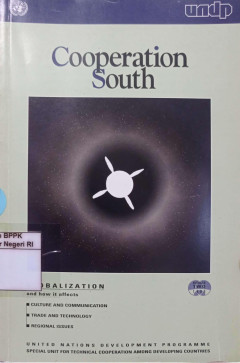
Cooperation South (Number Two)
The South in an Era of Globalization, Cultural Globalization: Living on a Frontierless Land, Globalization of Mass Media: Opportunities and Challenges for the South, Knowledge Networking for Technology "Leapfrogging", Repositioning Developing Countries in the World Trade Organization, Technological Implications of New Growth Theory for the South, Expanding Lateral Partnerships, Latin American P…
- Edisi
- -
- ISBN/ISSN
- -
- Deskripsi Fisik
- 149 pages, 23 cm
- Judul Seri
- -
- No. Panggil
- 382 Nat c

Moscow and the third world under Gorbachev
Since Gorbachev assumed power in 1985, Soviet attitudes towards the developing world have changed dramatically. This book explores the shape and scope of the "new thinking" in Moscow's foreign policy
- Edisi
- -
- ISBN/ISSN
- 0-8133-1052-0
- Deskripsi Fisik
- xvi, 260 pages : maps : bibl: hlm 241-243 : index ; 24 cm
- Judul Seri
- -
- No. Panggil
- 327.470 172 4 Dun m

Why nations fail: The origins of power, prosperity, and poverty
Daron Acemoglu and James Robinson conclusively show that it is man-made political and economic institutions that underlie economic success (or lack of it). Korea, to take just one of their fascinating examples, is a remarkably homogeneous nation, yet the people of North Korea are among the poorest on earth while their brothers and sisters in South Korea are among the richest. The south forged a…
- Edisi
- First Edition
- ISBN/ISSN
- 978-0-307-71922-5
- Deskripsi Fisik
- 529 pages : illustration : bibl: hlm 465-482 : index ; 25 cm
- Judul Seri
- -
- No. Panggil
- 330 Ace w

Why states recover : Changing walking societies into winning nations-from Afg…
State failure takes many forms, from the collapse of central authority à la Somalia to the subversion of democracy in Venezuela and Zimbabwe. Assessing why and how states fail is only half of the story, however. More important is pinpointing why they recover. Based on fieldwork in over 40 countries, Why States Recover incorporates first-hand interviews with leadership to disaggregate various s…
- Edisi
- -
- ISBN/ISSN
- 978-1-77010-325-2
- Deskripsi Fisik
- xiv, 689 pages : illustrations : index ; 23 cm
- Judul Seri
- -
- No. Panggil
- 330.96891 Mil w
 Karya Umum
  Filsafat
  Agama
Agama  Ilmu-ilmu Sosial
  Bahasa
  Ilmu-ilmu Murni
  Ilmu-ilmu Terapan
  Kesenian, Hiburan, dan Olahraga
  Kesusastraan
  Geografi dan Sejarah