Ditapis dengan

Foreign policy of African states : Politics of dependence and confrontation
This book examines the dynamics of African countries' foreign policies since the post-independence period. Dr. S. C. Saxena examines how economic, political, and military dependence on great powers shaped the diplomatic orientation of various African states. In addition to examining patterns of confrontation and cooperation, the book also highlights internal and external factors that influenced…
- Edisi
- -
- ISBN/ISSN
- -
- Deskripsi Fisik
- 227 pages ; 22 cm
- Judul Seri
- -
- No. Panggil
- 327.6 SAX f

African diplomacy: Studies in the determinants of foreign policy
African Diplomacy is a collection of academic studies examining the determinants of African countries' foreign policies in the post-independence era. Edited by Vernon McKay, this book highlights the dynamics of diplomacy, the influence of colonialism, regional interests, and Africa's position in global politics. Each essay explores how African countries formulated foreign policies based on dome…
- Edisi
- -
- ISBN/ISSN
- -
- Deskripsi Fisik
- viii, 210 pages ; 21 cm
- Judul Seri
- -
- No. Panggil
- 327.096 MCK a

The Origins of the cold war in the near east: Great power conflict and diplom…
This book is a comprehensive study of the origins of the Cold War in the Near East, focusing on the great power rivalry in Iran, Turkey, and Greece after World War II. Bruce R. Kuniholm analyzes the dynamics of international politics between the United States, the Soviet Union, and regional states, and how conflict and diplomacy shaped the postwar geopolitical architecture. Drawing on archival …
- Edisi
- -
- ISBN/ISSN
- 0-691-04665-4
- Deskripsi Fisik
- xxiii, 485 pages ; 24 cm
- Judul Seri
- -
- No. Panggil
- 327.09045 KUN o
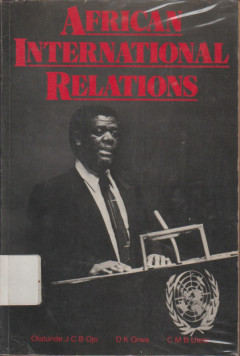
African international relations
African International Relations is a comprehensive study of the international relations of African countries since independence in the 1960s. This book examines political dynamics, economic conditions, diplomatic relations, and development challenges in African countries within the context of the international system. The authors highlight the role of great powers, economic interdependence, dev…
- Edisi
- -
- ISBN/ISSN
- 0-582-64393-7
- Deskripsi Fisik
- v, 186 pages : illustration ; 23 cm
- Judul Seri
- -
- No. Panggil
- 327.096 OJO a
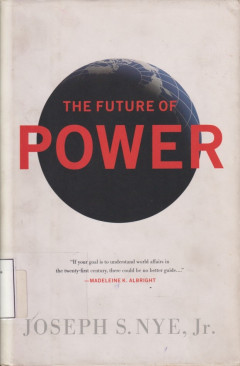
The Future of power
This book examines the changing dynamics of power in the era of globalization and information technology. Joseph S. Nye Jr., the figure who introduced the concept of "soft power," describes how traditional forms of power are shifting due to economic power, information flows, and global networks. Nye believes that the future of international relations will no longer be determined solely by milit…
- Edisi
- -
- ISBN/ISSN
- 978-1-58648-891-8
- Deskripsi Fisik
- xviii, 300 pages : illustration ; 24 cm
- Judul Seri
- -
- No. Panggil
- 303.33 NYE f
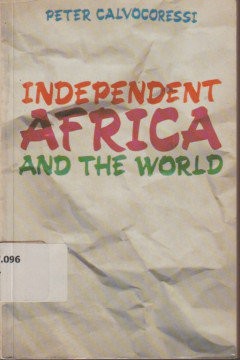
Independent Africa and the world
Peter Calvocoressi's "Independent Africa and the World" examines the political dynamics, international relations, and economic challenges of African countries after gaining independence in the 1960s. The book outlines how independent African states interacted with major world powers, the issue of economic dependency, internal political developments, and Africa's position in the modern internati…
- Edisi
- -
- ISBN/ISSN
- 0-582-29654-4
- Deskripsi Fisik
- 151 pages : illustration ; 20 cm
- Judul Seri
- -
- No. Panggil
- 327.096 CAL i
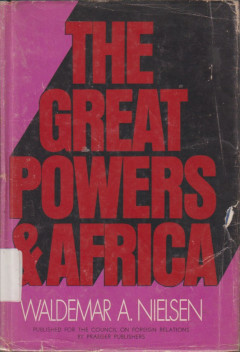
The Great powers and Africa
The book "The Great Powers and Africa" examines the involvement of major powers—such as the United States, the Soviet Union, the United Kingdom, France, and China—in the political, economic, and strategic dynamics of the African continent in the post-independence era. Waldemar A. Nielsen illustrates how global geopolitical interests shaped the development of African states, including …
- Edisi
- -
- ISBN/ISSN
- -
- Deskripsi Fisik
- xiii, 431 pages ; 22 cm
- Judul Seri
- -
- No. Panggil
- 327.6 NIE g
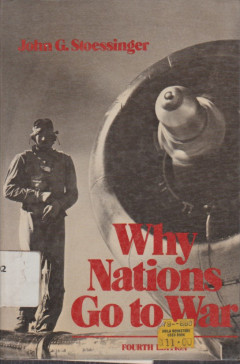
Why nations go to war
John G. Stoessinger's Why Nations Go to War is a classic analysis of the factors that drive states to war. Using a case study approach, this fourth edition examines major conflicts of the 20th century and highlights the role of political leaders, misperceptions, miscalculations, and international dynamics as crucial factors underlying the outbreak of war. Stoessinger emphasizes that the decisio…
- Edisi
- -
- ISBN/ISSN
- 0-312-87856-7
- Deskripsi Fisik
- xiii, 221 pages ; 21 cm
- Judul Seri
- -
- No. Panggil
- 355.02 STO w

Political realism and international morality: Ethics in the nuclear age
This book is a collection of papers presented at the Tenth Plenary Conference of the American Section of the International Association for Philosophy of Law and Social Philosophy, held in 1984 at the University of Notre Dame. It provides an in-depth discussion of the relationship between political realism and international morality, particularly in the context of the nuclear age. The contributo…
- Edisi
- -
- ISBN/ISSN
- 0-8133-0456-3
- Deskripsi Fisik
- x, 271 pages ; 23 cm
- Judul Seri
- -
- No. Panggil
- 172.4 KIP p
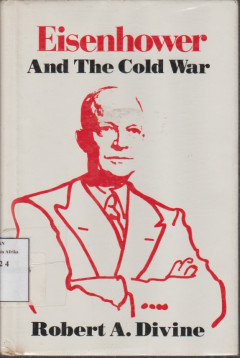
Eisenhower and the cold war
Robert A. Divine's Eisenhower and the Cold War explores President Dwight D. Eisenhower's foreign policy during the Cold War (1953–1961). Divine demonstrates that Eisenhower, despite his cautious approach, played a crucial role in shaping the United States' global strategy through his policies of containing communism, strengthening international alliances, and using nuclear power as a deterren…
- Edisi
- -
- ISBN/ISSN
- 0-19-502823-6
- Deskripsi Fisik
- ix, 181 pages ; 22 cm
- Judul Seri
- -
- No. Panggil
- 327.73 DIV e
 Karya Umum
 Filsafat
 Agama
 Ilmu-ilmu Sosial
 Bahasa
 Ilmu-ilmu Murni
 Ilmu-ilmu Terapan
 Kesenian, Hiburan, dan Olahraga
 Kesusastraan
 Geografi dan Sejarah