Ditapis dengan
Major governments of Asia
This book provides a comprehensive examination of the political systems and governmental structures of major Asian countries. Written by leading scholars, it analyzes the historical development, political institutions, leadership patterns, and policy dynamics within nations across East, South, and Southeast Asia. The volume offers comparative insights into how different Asian governments evolve…
- Edisi
- -
- ISBN/ISSN
- -
- Deskripsi Fisik
- xiii, 719 pages : illustrations ; 24 cm
- Judul Seri
- -
- No. Panggil
- 320.95 HIN m

Asian-African identity in world affairs: Its Impact and prospects for the fut…
This book explores the evolving political, legal, and cultural identity of Asian and African nations in global affairs, with particular emphasis on international and environmental law. Written by Prof. Munadjat Danusaputro, the work was prepared for the 21st Regular Session of the Asian-African Legal Consultative Committee (AALCC) held in conjunction with the 25th anniversary of the 1955 Bandun…
- Edisi
- -
- ISBN/ISSN
- -
- Deskripsi Fisik
- xiv, 240 pages : illustrations ; 21 cm
- Judul Seri
- -
- No. Panggil
- 327.172 DAN a
The League of Arab States and regional disputes
This book examines the role of the League of Arab States in managing and responding to regional disputes within the Arab world. Hussein A. Hassouna analyzes the League’s legal foundations, institutional structure, and political functions, highlighting its efforts to address inter-Arab conflicts and promote regional stability. The study evaluates the effectiveness of the League’s dispute-set…
- Edisi
- -
- ISBN/ISSN
- 0-379-00290-4
- Deskripsi Fisik
- xxi, 512 pages ; 24 cm
- Judul Seri
- -
- No. Panggil
- 341.2477 HAS l
The Hypocrites
This historical–political novel follows events in the Middle East between 1959 and 1989, blending real geopolitical developments with fictional narratives. Andrew M. Patterson presents an epic story that explores political intrigue, shifting alliances, cultural tensions, and the human experiences shaped by decades of regional conflict. Through multiple characters and intertwined storylines, t…
- Edisi
- -
- ISBN/ISSN
- -
- Deskripsi Fisik
- 239 pages ; 23 cm
- Judul Seri
- -
- No. Panggil
- 813.54 PAT h
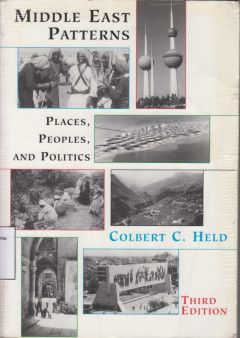
Middle East patterns: Places, peoples, and politics
This third edition of Middle East Patterns offers a comprehensive exploration of the geography, peoples, cultures, and political landscapes of the Middle East. Colbert C. Held provides detailed analyses of the region’s physical environment, demographic patterns, ethnic and religious diversity, and the historical forces shaping contemporary political realities. The book integrates maps, photog…
- Edisi
- 3
- ISBN/ISSN
- 0-8133-3488-8
- Deskripsi Fisik
- xv, 562 pages : illustrations ; 25,5 cm
- Judul Seri
- -
- No. Panggil
- 956 HEL m
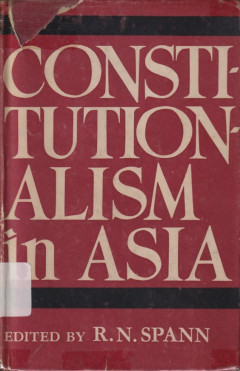
Constitutionalism in Asia
This volume explores the development of constitutionalism across various Asian countries during the post-colonial period. Edited by R. N. Spann, the book examines the formation of modern constitutions, institutional structures, and political systems in Asia. Contributors discuss the challenges faced by newly independent states, including nation-building, governance, legal reform, and the adapta…
- Edisi
- -
- ISBN/ISSN
- -
- Deskripsi Fisik
- xii, 249 pages ; 22 cm
- Judul Seri
- -
- No. Panggil
- 342.5 SPA c

South-East Asia between two worlds
This classic study by Tibor Mende examines the geopolitical and social conditions of Southeast Asia during the mid-twentieth century. Written at the height of the Cold War, the book analyzes how the region found itself caught between opposing global powers and competing ideological influences. Mende discusses the political struggles, economic challenges, and emerging national identities of Sout…
- Edisi
- -
- ISBN/ISSN
- -
- Deskripsi Fisik
- viii, 338 pages : illustrations ; 22 cm
- Judul Seri
- -
- No. Panggil
- 959 MEN s
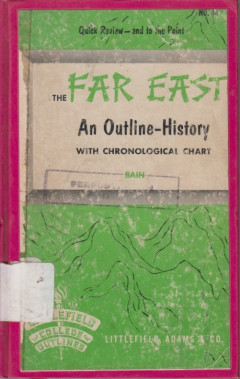
The Far east
This third edition of “The Far East” provides a comprehensive survey of the history, culture, and political development of East Asia. Written by Chester A. Bain and edited by Helmut G. Callis, the book offers an overview of major historical events, social transformations, and regional interactions in China, Japan, Korea, and neighboring areas. The text serves as an introductory guide to Ori…
- Edisi
- -
- ISBN/ISSN
- -
- Deskripsi Fisik
- xv, 248 pages : illustrations ; 20 cm
- Judul Seri
- -
- No. Panggil
- 950 BAI f

The Westernization of Asia: A Comparative political analysis
This book provides a comparative political analysis of the Westernization process in Asia. Frank C. Darling examines how Asian societies responded politically, culturally, and institutionally to Western influence from the nineteenth to the twentieth century. The study explores major themes including political modernization, social transformation, colonial legacies, and the development of contem…
- Edisi
- -
- ISBN/ISSN
- 0-8161-9005-4
- Deskripsi Fisik
- xxii, 503 pages : illustrations ; 24 cm
- Judul Seri
- -
- No. Panggil
- 320.95 DAR w

The Westernization of Asia: A Comparative political analysis
This book offers a comparative political analysis of the Westernization process in Asia. Frank C. Darling examines the historical, political, and social forces that have shaped the region’s responses to Western influence. The study explores how Asian countries adapted or resisted Western political models, and evaluates the impact of Westernization on governance, social structures, and nationa…
- Edisi
- -
- ISBN/ISSN
- 0-8161-9005-4
- Deskripsi Fisik
- xxii, 503 pages ; 21 cm
- Judul Seri
- -
- No. Panggil
- 320.95 DAR w
 Karya Umum
  Filsafat
  Agama
Agama  Ilmu-ilmu Sosial
  Bahasa
  Ilmu-ilmu Murni
  Ilmu-ilmu Terapan
  Kesenian, Hiburan, dan Olahraga
  Kesusastraan
  Geografi dan Sejarah