Ditapis dengan

India’s Eastward Engagement
India's Eastward Engagement: From Antiquity to Act East Policy presents India's engagement with its extended eastern neighbours from ancient times to the present. It argues that this engagement has been long rooted in India's geographical location, its civilizational evolution and historical transformations. The book critically examines all the important phases—Nehru and Post-Nehru periods, a…
- Edisi
- First Published
- ISBN/ISSN
- 978-93-532-8268-4
- Deskripsi Fisik
- xiv, 329 pages : ilustrations : index ; 22 cm
- Judul Seri
- -
- No. Panggil
- 327.5405 Mun i

India in a turbulent world: Perspective in foreign and security policies
- Edisi
- -
- ISBN/ISSN
- 81-7003-265-2
- Deskripsi Fisik
- xiv,321 Halaman : index ;21 cm
- Judul Seri
- -
- No. Panggil
- 327.54 Pat i
- Edisi
- -
- ISBN/ISSN
- 81-7003-265-2
- Deskripsi Fisik
- xiv,321 Halaman : index ;21 cm
- Judul Seri
- -
- No. Panggil
- 327.54 Pat i
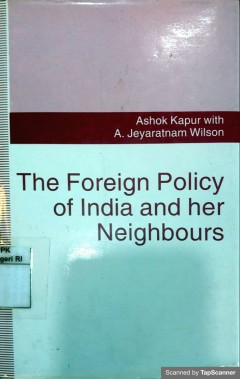
Foreign policy of India and her neighbours
This study of perceptions, interests and strategies of South Asian states reveals the analytical and empirical richness of three kinds of states in the region: India - the regional hegemon; Pakistan-India's permanent competitor; and other South Asian states who do not accept Pakistani perceptions, interests and strategies concerning India. This book assesses the diplomatic and strategic princip…
- Edisi
- First Published
- ISBN/ISSN
- 0-333-55829-4
- Deskripsi Fisik
- ix, 186 pages : illustrations : index ; 23 cm
- Judul Seri
- -
- No. Panggil
- 327.54 Kap f

The fukuda doctrine and ASEAN: New dimensions in Japanese foreign policy
A burgeoning Japanese rote in the Asia-Pacific region has been one of the most contentious issues to the Southeast Asian Countries in recent years with its positive and negative implications. It is thus timely and significant to come to terms with Japan's "design" in the region from a historical perspective. Attributing Japan's active involvement in Southeast Asian affairs to the proclamation o…
- Edisi
- -
- ISBN/ISSN
- 981-3016-14-0
- Deskripsi Fisik
- xiv, 277 pages : bibl: hlm 256-271 : index ; 23 cm
- Judul Seri
- -
- No. Panggil
- 327.520595 Sud f

Japan-ASEAN Intellectual Exchange Open Symposium: Japan and ASEAN toward a ne…
In particular, we wish to express our sincere appreciation to ambassador Yushita and secretary siazon for gracing this occasion with their presence and for having graciously agreed to deliver keynote addresses.
- Edisi
- -
- ISBN/ISSN
- 971-8916-06-7
- Deskripsi Fisik
- 165 pages ; 22 cm
- Judul Seri
- -
- No. Panggil
- 327.52059 Ins j

Peace building in the Asia Pacific Region: Perspectives from Japan and Australia
This collection canvasses the current requirements of T achieving and consolidating peace in the Asia Pacific region, from the special perspectives of two 'outsiders' in the region, Australia and Japan. It explores the strategic, political, economic and cultural dimensions of peace building, with special emphasis on ASEAN and APEC, and concludes that Japan's role as indispensable economic hub a…
- Edisi
- Frist Published
- ISBN/ISSN
- 1-86448-115-3
- Deskripsi Fisik
- ix, 150 pages : index ; 22 cm
- Judul Seri
- -
- No. Panggil
- 327.52 Kin p

Tensions of empire: Japan and Southeast Asia in the colonial and postcolonial…
Beginning with the closing decade of European colonial rule in Southeast Asia and covering the wartime Japanese empire and its postwar disintegration, Tensions of Empire focuses on the Japanese in Southeast Asia, Indonesians in Japan, and the legacy of the war in Southeast Asia. It also examines Japanese perceptions of Southeast Asia and the lingering ambivalence toward Japanese involvement in …
- Edisi
- -
- ISBN/ISSN
- 9971-69-281-3
- Deskripsi Fisik
- xxiv, 349 pages : illustrations, map : index ; 22 cm.
- Judul Seri
- -
- No. Panggil
- 327.52 Got t

Japan and China as charm rivals: Soft power in regional diplomacy
In international relations today, influence is a essential as military and economic might. Consequently, leaders promote favorable images of the state in order to attract allies and win support for their policies.
- Edisi
- -
- ISBN/ISSN
- 978-0-472-11833-5
- Deskripsi Fisik
- xii, 231 pages : bibl: hlm 199-213 : index ; 25 cm
- Judul Seri
- -
- No. Panggil
- 327.51052 Sun j

China rising: Peace, power, and order in East Asia
Throughout the past three decades East Asia has seen more peace and stability than at any time since the Opium Wars of 1839-1841. During this period China has rapidly emerged as a major regional power, averaging over nine percent economic growth per year since the introduction of its market reforms in 1978. Foreign businesses have flocked to invest in China, and Chinese exports have begun to fl…
- Edisi
- -
- ISBN/ISSN
- 978-0-231-14188-8
- Deskripsi Fisik
- xiii, 274 pages : illustrations : bibl: hlm 252-262 : index ; 24 cm
- Judul Seri
- -
- No. Panggil
- 327.5105 Kan c

China's footprints in Southeast Asia
This is the first book to survey China growing role in Southeast Asia along multiple dimensions. It looks closely and skeptically at the multitude of ways that China has built connections in the region, including through trade, foreign aid, and cultural diplomacy. It incorporates examples such as the operation of Confucius Institutes in Indonesia or the promotion of the concept of guangxi. Chin…
- Edisi
- -
- ISBN/ISSN
- 978-981-4722-89-6
- Deskripsi Fisik
- vi, 249 pages : index ; 23 cm
- Judul Seri
- -
- No. Panggil
- 327.510 Dio c
 Karya Umum
 Filsafat
 Agama
 Ilmu-ilmu Sosial
 Bahasa
 Ilmu-ilmu Murni
 Ilmu-ilmu Terapan
 Kesenian, Hiburan, dan Olahraga
 Kesusastraan
 Geografi dan Sejarah