Ditapis dengan
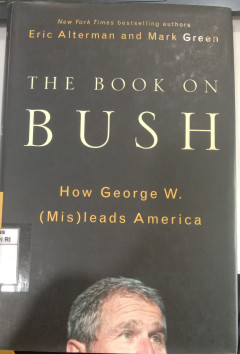
The book on bush: How George W. (mis)leads America
A critical look at the presidency of George W. Bush reveals how the current administration has used misstatements, half-truths, distortions, and other deceptions to mislead Americans and how this manipulation has led to failed policies, hindered homeland security, damaged foreign relations, and undermined efforts to improve the economy.
- Edisi
- First Edition
- ISBN/ISSN
- 0670032735
- Deskripsi Fisik
- 419 pages : notes, index ; 24 cm
- Judul Seri
- -
- No. Panggil
- 973.931092 Alt b

When presidents lie: A history of official deception and its consequences
Like it or not, most Americans take it for granted that deception is entrenched in the highest levels of government. Up until now most of the arguments about lying have been moral. But in this groundbreak- ing and closely reasoned book, bestselling political commentator Eric Alterman lays bare the disastrous practical consequences of presidential duplicity since World War II.
- Edisi
- -
- ISBN/ISSN
- 0-14-303604-1
- Deskripsi Fisik
- ix, 447 pages : index ; 24 cm.
- Judul Seri
- -
- No. Panggil
- 327.73 Alt w

The choice: Global domination or global leadership
The foreign policy expert offers an assessment of recent American foreign policy, arguing for a more sophisticated posture in the world that positions America as a supporter of reform and justice in the world.
- Edisi
- -
- ISBN/ISSN
- 0-465-00800-3
- Deskripsi Fisik
- xi, 242 pages : index ; 22 cm
- Judul Seri
- -
- No. Panggil
- 327.73 Brz c
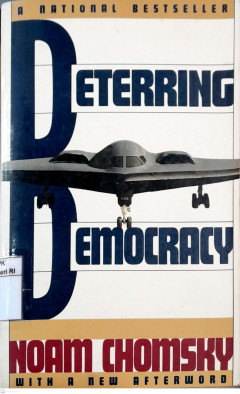
Deterring democracy: With a new afterword
History does not come neatly packaged into distinct periods, but by imposing such a structure upon it, we can sometimes gain clarity without doing too much violence to the facts. One such period was initiated with the Second World War, a new phase in world affairs in which "the United States was the hegemonic power in a system of world order" (Harvard government professor and foreign policy adv…
- Edisi
- -
- ISBN/ISSN
- 0-374-52349-5
- Deskripsi Fisik
- viii, 455 pages : index ; 24 cm
- Judul Seri
- -
- No. Panggil
- 327.73 Cho d
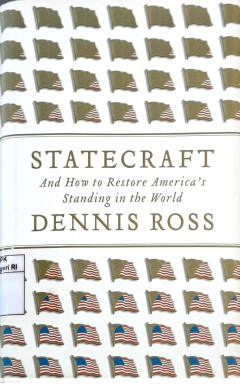
Statecraft: And how to restore America's standing in the world
Statecraft is as old as politics: Plato wrote about it, Machiavelli practiced it. After the demise of Communism, some predicted that statecraft would wither away. But Ross explains that in the globalized world--with its fluid borders, terrorist networks, and violent unrest--statecraft is necessary simply to keep the peace. He outlines how statecraft helped shape a new world order after 1989. He…
- Edisi
- -
- ISBN/ISSN
- 978-0-374-29928-6
- Deskripsi Fisik
- xii, 370 pages : index ; 24 cm
- Judul Seri
- -
- No. Panggil
- 327.73 Ros s
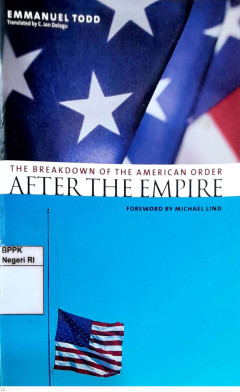
After the empire: The breakdown of the American order
After the Empire is a provocative and sobering look at America's changing role on the global stage. Emmanuel Todd uses demographic and economic factors to diagnose America's waning hegemony. Burdened by enormous domestic and foreign trade deficits, the declining value of the US dollar, the bankruptcy of several prominent companies, and the fact that it can no longer subsist on its own productio…
- Edisi
- -
- ISBN/ISSN
- 0-231-13103-8
- Deskripsi Fisik
- xxiii, 233 pages : index ; 22 cm
- Judul Seri
- -
- No. Panggil
- 327.73 Tod a

Monsoon: The Indian Ocean and the battle for supremacy in the 21st century
For most of the twentieth century, Europe dominated global attention. Two world wars were won and lost on its battlefields, and the great ideological struggles of the Cold War were played out in its cities. The Atlantic Ocean was the locus of international power.
- Edisi
- -
- ISBN/ISSN
- 9781863955027
- Deskripsi Fisik
- xvi, 366 pages : maps : index ; 24 cm
- Judul Seri
- -
- No. Panggil
- 327.7301824 Kap m

America's other War: Terrorizing Colombia
Colombia is the worst humanitarian catastrophe in the hemisphere. The sources are deeply rooted in Colombia's own history, and in policies of the hegemonic power that are no less deeply rooted in its own history and institutions. This study provides a uniquely perceptive analysis of the tragic interaction, and its far-reaching implications for understanding the past and the evolving global or…
- Edisi
- -
- ISBN/ISSN
- 1842775472
- Deskripsi Fisik
- 147 pages : index ; 23 cm
- Judul Seri
- -
- No. Panggil
- 327.730861 Sto a
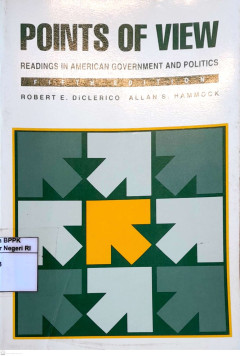
Points of view: Readings in American government and politics
Reflecting the press of events, we have made numerous changes in this, the fifth edition of Points of View. One or more of the selections that fall under the topics of "Federalism." "Interest Groups." "Congress." "Bureaucracy." "The Supreme Court," "Civil Liberties" (Free Speech. Pornography), and "Civil Rights" (Abortion) have been changed. The basic goals of the book remain the same-namely, t…
- Edisi
- -
- ISBN/ISSN
- 0-07-016849-0
- Deskripsi Fisik
- 341 pages ; 24 cm
- Judul Seri
- -
- No. Panggil
- 320.973 Dic p
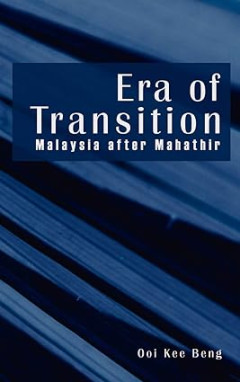
Era of transition: Malaysia after Mahathir
This is a collection of opinion pieces written by Ooi Kee Beng and published in the mass media after Abdullah Badawi became Malaysia's Prime Minister in October 2004. The articles analyse the many difficult aspects of leadership that have been facing Abdullah Badawi over the last two years. The book discusses the country's underlying problems, the dilemma involved in succeeding Mahathir Mohamad…
- Edisi
- First Published
- ISBN/ISSN
- 981-230-379-0
- Deskripsi Fisik
- xxiii, 183 pages : index ; 21 cm
- Judul Seri
- -
- No. Panggil
- 320.9595 Ben e
 Karya Umum
  Filsafat
  Agama
Agama  Ilmu-ilmu Sosial
  Bahasa
  Ilmu-ilmu Murni
  Ilmu-ilmu Terapan
  Kesenian, Hiburan, dan Olahraga
  Kesusastraan
  Geografi dan Sejarah