Ditapis dengan

Spending more or spending better: Improving education financing in Indonesia
This book contains: 1. How is the Indonesian education system financed and managed 2. The "20 percent rule": Where did resources go? 3. How have outcomes changed? the unfinished agenda for equity and quality education 4. Improving the quality of spending on basic education 5. A framework for action: Policy options for improving the quality of spending
- Edisi
- -
- ISBN/ISSN
- -
- Deskripsi Fisik
- ix, 114 pages ; 28 cm
- Judul Seri
- -
- No. Panggil
- 370 Ban s
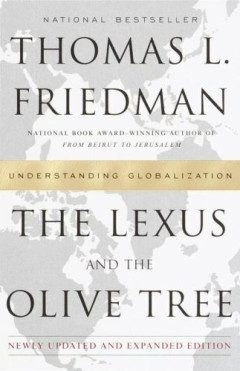
The Lexus and the olive tree: Understanding globalization
In this vivid portrait of the new business world, Thomas L. Friedman shows how technology, capital, and information are transforming the global marketplace, leveling old geographic and geopolitical boundaries. With bold reporting and acute analysis, Friedman dramatizes the conflict between globalizing forces and local cultures, and he shows why a balance between progress and the preservation of…
- Edisi
- Ed. 1
- ISBN/ISSN
- 0-385-49934-5
- Deskripsi Fisik
- xxii, 490 pages : illustrations (black and white) ; 20 cm
- Judul Seri
- -
- No. Panggil
- 337 Fri l

Don't they know it's Friday: A cross-cultural guide for business and life in …
Don't They Know it's Friday? has been the definitive guide to business culture and etiquette in the Gulf since it was first published in 1998. This exciting and informative book has been reprinted thirteen times. Motivate Publishing is now releasing a new edition fully updated with new information, maps and illustrations. This modern and enlarged second edition is packed with remarkable insight…
- Edisi
- -
- ISBN/ISSN
- 978-1-86063-074-3
- Deskripsi Fisik
- xix, 280 pages ; 22 cm.
- Judul Seri
- -
- No. Panggil
- 382.09536 Wil d

Freefall : America, free markets, and the sinking of the world economy
The current global financial crisis carries a “made-in-America” label. In this forthright and incisive book, Nobel Laureate Joseph E. Stiglitz explains how America exported bad economics, bad policies, and bad behavior to the rest of the world, only to cobble together a haphazard and ineffective response when the markets finally seized up. Drawing on his academic expertise, his years spent …
- Edisi
- -
- ISBN/ISSN
- 978-0-393-07596-0
- Deskripsi Fisik
- xxx, 361 pages ; 24 cm
- Judul Seri
- -
- No. Panggil
- 330.973 Sti f

Southeast Asia in the WTO: Southeast Asia background series no.5
In this large-scale ISEAS study, Razeen Sally looks at Southeast Asia in the World Trade Organization, against the background of national trade policy trends post-Asian crisis, sluggish ASEAN economic integration, and the recent high-speed proliferation of bilateral and regional trade negotiations. ASEAN co-operation in the WTO has broken down, with little prospect of revival. Nevertheless, Sal…
- Edisi
- Cet. 1
- ISBN/ISSN
- 981-230-268-9
- Deskripsi Fisik
- vi, 98 pages ; 22 cm
- Judul Seri
- -
- No. Panggil
- 382.959 Sal s
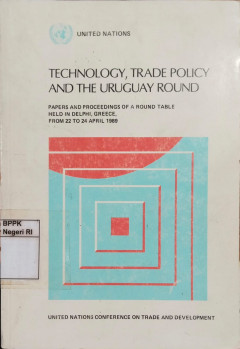
Technology, trade policy and the Uruguay round
This book contains about: - Opportunities for and limitations to technological leapfrogging - Perspectives for the international technology system: The challenge ahead for newly industrializing countries etc.
- Edisi
- -
- ISBN/ISSN
- -
- Deskripsi Fisik
- xxiv, 270 pages : illustrations (black and white) ; 21 cm
- Judul Seri
- -
- No. Panggil
- 381.3 Nat t

Myanmar's external trade: An overview in the Southeast Asian context
The grim state of the Myanmar economy in the second half of the 1980s forced the previous government of the Burma Socialist Programme Party to liberalize its external and internal trade. Since the military coup following political chaos in the later part of 1988, Japan, the European Community and the United States have suspended new economic aid to Myanmar. This has led to the present military …
- Edisi
- -
- ISBN/ISSN
- 981-3016-13-2
- Deskripsi Fisik
- viii, 116 pages : illustrations (black and white) ; 23 cm
- Judul Seri
- -
- No. Panggil
- 382 Tha m
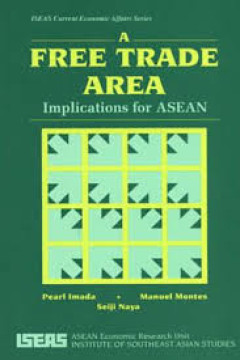
A free trade area: Implication for ASEAN
Presently, ASEAN stands ready to make a major step towards economic integration. This book looks at the issues involved in moving ASEAN towards a free trade area. It examines some indicators of gains and costs of integration and presents two quantitive analyses of the potential effects of integration on growth and trade in the region. The first, a partial equilibrium analysis, provides a disagg…
- Edisi
- -
- ISBN/ISSN
- 981-3016-16-7
- Deskripsi Fisik
- 39 pages : illustrations (black and white) ; 23 cm
- Judul Seri
- -
- No. Panggil
- 382.71 Ima f

Transaksi kotor : Kebenaran yang tidak terungkap tentang pencucian uang dunia…
Buku ini tidak semata-mata berisi tentang pencucian uang dan kejahatan terorganisir, tetapi juga tentang akibatnya, pengaruhnya, dan cabang-cabangnya pada aktivitas bisnis global, ekonomi dan infrastruktur dunia. Kejahatan terorganisir dipandang sebagai meningkatnya peran yang signifikan yang mengancam keselamatan dan keamanan institusi-institusi rakyat, negara dan demokrasi.
- Edisi
- ed.2 ; cet.1
- ISBN/ISSN
- 979-98798-0-9
- Deskripsi Fisik
- vi, 404 halaman ; 20 cm
- Judul Seri
- -
- No. Panggil
- 363.25 Lil t

APEC as an institution: Multilateral governance in the Asia-Pacific
APEC is an experimental multilateralism, relying not on a large bureaucracy but rather upon national government agencies, semi-autonomous inter-govermental committees and "virtual" associations. Organized around the principles of enforced through monitoring and robust compliance mechanisms. This volume assesses the strengths and weaknesses of APEC's "soft" institutionalism, and it's the credibi…
- Edisi
- -
- ISBN/ISSN
- 981-230-209-3
- Deskripsi Fisik
- xvi, 275 pages ; 23 cm
- Judul Seri
- -
- No. Panggil
- 337.1 Fei a
 Karya Umum
  Filsafat
  Agama
Agama  Ilmu-ilmu Sosial
  Bahasa
  Ilmu-ilmu Murni
  Ilmu-ilmu Terapan
  Kesenian, Hiburan, dan Olahraga
  Kesusastraan
  Geografi dan Sejarah