Ditapis dengan

White tribe of Asia: An Indonesian view of Australia
What do our Asian neighbours say about us when they're talking to each other? In the case of Indonesia we now have the opportunity to find out. This translation of the first contemporary book written for Indonesians about Australia describes for others our history, culture, contemporary politics, and what the author sees as the current coming of age of "the land of the kangaroo". Full of unexpe…
- Edisi
- -
- ISBN/ISSN
- 0-7326-0446-X
- Deskripsi Fisik
- ix, 249 pages : bibliography, index ; 22 cm
- Judul Seri
- -
- No. Panggil
- 994 Har w
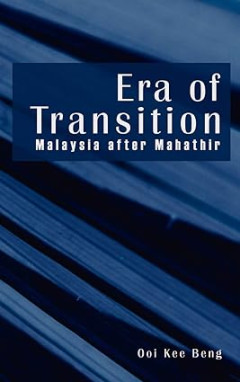
Era of transition: Malaysia after Mahathir
This is a collection of opinion pieces written by Ooi Kee Beng and published in the mass media after Abdullah Badawi became Malaysia's Prime Minister in October 2004. The articles analyse the many difficult aspects of leadership that have been facing Abdullah Badawi over the last two years. The book discusses the country's underlying problems, the dilemma involved in succeeding Mahathir Mohamad…
- Edisi
- First Published
- ISBN/ISSN
- 981-230-379-0
- Deskripsi Fisik
- xxiii, 183 pages : index ; 21 cm
- Judul Seri
- -
- No. Panggil
- 320.9595 Ben e

Refugees and regional security in South Asia
Regional relations in South Asia have always been afflicted by the movements of people across territorial boundaries of the states. Rapidly growing dimensions of refugee flows during the past decades have seriously affected security and stability of both the refugee generating as well as receiving states. This is one of the first studies of how refugee flows have vitiated security environment i…
- Edisi
- -
- ISBN/ISSN
- 81-220-0420-2
- Deskripsi Fisik
- x, 245 pages : index ; 23 cm
- Judul Seri
- -
- No. Panggil
- 325.21959 Mun r

Southeast Asia in the new international era
The fourth edition of Southeast Asia in the New International Era updates the region at a time of critical change. In the 1990s, Southeast Asia was known as an area of stability and movement toward development and democracy. At the beginning of the millennium, many of the region's nations are undergoing rapid change that belies the standard perception of stability. Since January 2000, Indonesia…
- Edisi
- -
- ISBN/ISSN
- 0813339928
- Deskripsi Fisik
- xv, 301 pages : index ; 23 cm
- Judul Seri
- -
- No. Panggil
- 327.59 Neh s

Stumbling giant: The threats to China's future
While dozens of recent books and articles have predicted the near-certainty of China's rise to global supremacy, this book boldly counters such widely-held assumptions. Timothy Beardson brings to light the daunting array of challenges that today confront China, as well as the inadequacy of leadership's responses. Threats to China come from many fronts, Beardson shows, and by their number and sh…
- Edisi
- -
- ISBN/ISSN
- 978-0-300-16542-5
- Deskripsi Fisik
- x, 517 pages : bibl: hlm 477-493 : index ; 24 cm
- Judul Seri
- -
- No. Panggil
- 330.951 Bea s

Indonesia in the new world: Globalisation, nationalism and sovereignty
Globalisation is more complex than ever. The effects of the global financial crisis and increased inequality have spurred anti-globalisation sentiment in many countries and encouraged the adoption of populist and inward-looking policies. This has led to some surprising results: Duterte, Brexit and Trump, to name a few. In Indonesia, the disappointment with globalisation has led to rising protec…
- Edisi
- -
- ISBN/ISSN
- 978-981-4148-22-3
- Deskripsi Fisik
- xix, 333 pages : illustrations (black and white) : index ; 23 cm
- Judul Seri
- -
- No. Panggil
- 330.9598 Pat i
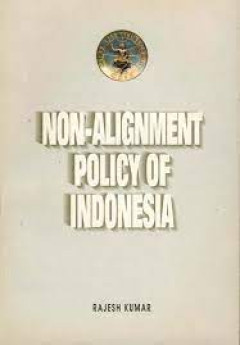
Non-alignment policy of Indonesia
This book is a study of Non-Alignment as an element of Indo- nesia's foreign policy It examines how Indonesia framed its policy of Non-Alignment, how far Indonesia's policy is in consonance with that of Non-Alignment, and how far the contribution of Indonesia is in various fields of NAM interests. In this book, the author also compares Indonesia's policy of Non-Alignment with that of India
- Edisi
- First Published
- ISBN/ISSN
- 979-8026-54-3
- Deskripsi Fisik
- x, 103 pages ; 25 cm
- Judul Seri
- -
- No. Panggil
- 327.9598 Kum n

National insecurity : the Howard government's betrayal of Australia
Uncovers the truth behind the Howard Government's international trade treaties with the US and how crucial parts of Australia's domestic economy, international markets, defence and health security, research, energy policy and culture are being handed over to the US
- Edisi
- -
- ISBN/ISSN
- 9781741750515
- Deskripsi Fisik
- xi, 298 pages : illustrations : bibl: hlm 287-298 ; 20 cm
- Judul Seri
- -
- No. Panggil
- 327.94073 Wei n

The Howard paradox : Australian diplomacy in Asia, 1996-2006
Paul Keating famously said that Asian countries wouldn't deal with John Howard. In the early years of the Howard Government, Australia's relations with China and Indonesia had never been worse. More than ten years later, the Howard Government, the reality is completely different. The Howard Government has achieved an intimacy in diplomatic ties with Asian countries and gained seats at regional …
- Edisi
- -
- ISBN/ISSN
- 9780733320781
- Deskripsi Fisik
- viii, 264 pages : illustrations : index ; 21 cm
- Judul Seri
- -
- No. Panggil
- 327.9405 Wes h

Facing north: A century of Australian engagement with Asia
Presents a history of Australia's relations with Asia since Federation. This volume chronicles Australian-Asian relations from 1901 to the 1970s. It explains the major changes in official Australian policies towards Asia, together with the broader cultural challenges. It is aimed at those interested in Australia's relations with Asian countries.
- Edisi
- Volume 1
- ISBN/ISSN
- 0522849539
- Deskripsi Fisik
- xx, 523 pages : ilustrations : bibl: hlm 470-495 : index ; 25 cm
- Judul Seri
- -
- No. Panggil
- 327.9405 Gol f
 Karya Umum
  Filsafat
  Agama
Agama  Ilmu-ilmu Sosial
  Bahasa
  Ilmu-ilmu Murni
  Ilmu-ilmu Terapan
  Kesenian, Hiburan, dan Olahraga
  Kesusastraan
  Geografi dan Sejarah