Ditapis dengan

The Centenary of Dogali: Proceedings of the International Symposium, Addis Ab…
The Centenary of Dogali is a collection of scientific papers from the International Symposium held in Addis Ababa and Asmara on January 24–25, 1987, to commemorate the 100th anniversary of the Battle of Dogali (1887), an important event in the history of Ethiopia's resistance to Italian colonial expansion. Edited by Taddesse Beyene, Taddesse Tamrat, and Richard Pankhurst, this book contains h…
- Edisi
- -
- ISBN/ISSN
- -
- Deskripsi Fisik
- 344 pages : illustration ; 20,5 cm
- Judul Seri
- -
- No. Panggil
- 963.055 TAD c

Central Africa to 1870: Zambezia, Zaire and the South Atlantic
Central Africa to 1870: Zambezia, Zaïre and the South Atlantic provides an in-depth historical analysis of Central Africa before European colonial domination. Compiled from key chapters of the Cambridge History of Africa, this volume examines the political, economic, and cultural developments of major Central African regions, including Zambezia and the Congo basin. Birmingham presents the evol…
- Edisi
- -
- ISBN/ISSN
- 0-521-28444-9
- Deskripsi Fisik
- vii, 177 pages ; 23 cm
- Judul Seri
- -
- No. Panggil
- 967.02 BIR c
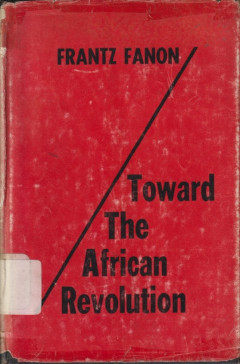
Toward the African revolution: Political essays
Toward the African Revolution is a collection of Frantz Fanon's political essays written during the struggle for African decolonization. This book highlights Fanon's analysis of colonialism, racism, national liberation struggles, and power dynamics between colonizers and oppressed peoples. Through pithy and sharp writings, Fanon discusses the Algerian conflict, African–European relations, and…
- Edisi
- -
- ISBN/ISSN
- -
- Deskripsi Fisik
- x, 197 pages ; 21,5 cm
- Judul Seri
- -
- No. Panggil
- 325.6 FAN

The White tribe of Africa : South Africa in perspective
To their many detractors, Afrikaners are impractical, wild-eyed, racist fanatics. To their less numerous supporters, they are fervent anti-Communist crusaders, safeguarding stability and progress at the tip of the 'dark continent'. These strongly held, politically charged, and incompatible views make it virtually impossible for outsiders to distance themselves sufficiently, both intellectually …
- Edisi
- -
- ISBN/ISSN
- 0-520-05066-5
- Deskripsi Fisik
- vii, 307 pages : illustrations ; 24 cm
- Judul Seri
- -
- No. Panggil
- 305.896 HAR w
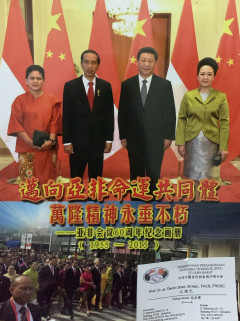
Mài xiàng yà fēi mìngyùn gòngtóngtǐ wàn lóng jīngshén yǒngchuí…
This illustrated commemorative album is dedicated to the 60th anniversary of the Asian-African Conference (1955-2015). It visually and narratively documents the development of Asian-African nations, the significance of the Ten Principles of Bandung (Dasa Sila Bandung), and the ongoing efforts to build a community of shared destiny (Mìngyùn Gòngtóngtǐ). The album highlights the spirit of so…
- Edisi
- -
- ISBN/ISSN
- 978-602-74781-2-1
- Deskripsi Fisik
- iv, 378 pages : illustrations ; 28 cm
- Judul Seri
- -
- No. Panggil
- 950.42 ZHU m

South Africa: Time running out
South Africa. Many Americans regard it as remote and of little concern United States. Yet within the past few yegrs it has become increasingly important to our country. How dependent is America on South Africa's strategic minerals? Can the United States do anything to help end apartheid? How dangerous is South Africa as a potential point of entry for Soviet influence? Is the Cape sea route u…
- Edisi
- -
- ISBN/ISSN
- 0-520-04594-1
- Deskripsi Fisik
- xxvii, 517 pages : illustrations ; 23 cm
- Judul Seri
- -
- No. Panggil
- 327.73068 STU s
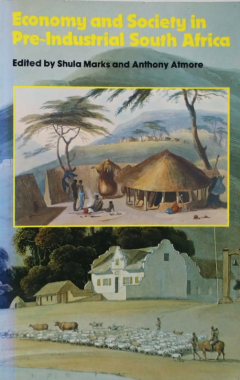
Economy and society in pre-industrial South Africa
Over the past forty years there has been a revolution in South African historiography, yet no broadly interpretative essay on South African history has appeared. The essays in this volume aim to provide such a reinterpretation for the nineteenth century before the discovery of minerals transformed the nature of South African societies, and help to shed light on earlier phases of South Africa's …
- Edisi
- -
- ISBN/ISSN
- 0-582-64656-1
- Deskripsi Fisik
- 385 pages ; 22 cm
- Judul Seri
- -
- No. Panggil
- 330.68 MAR e
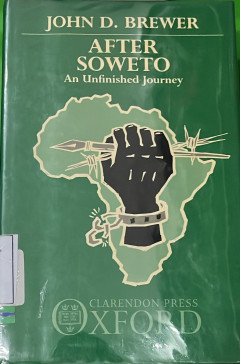
After Soweto : An Unfinished journey
The 1976 uprising in Soweto transformed the nature of both internal and external opposition to apartheid in South Africa, and the effects of this vociferous and sustained protest are felt more strongly than ever today. This book examines the nature of opposition among the African community to apartheid in the crucial years since Soweto by analysing internal African initiatives for bringing abou…
- Edisi
- -
- ISBN/ISSN
- 0-19-827480-7
- Deskripsi Fisik
- xv, 448 pages ; 22 cm
- Judul Seri
- -
- No. Panggil
- 305.800968 BRE a

Up against apartheid : The Role and the plight of the press in South Africa
A firsthand report of the workings of the press in the intensely troubled nation, complete with portions of the Erasmus Commission Reports never before published in the United States on the so-called Muldergate scandal. Pollak was the co-founder and editor of MORE magazine, which specialized in media analysis. After observing the workings of the press in South Africa, he believes that in…
- Edisi
- -
- ISBN/ISSN
- 0-8093-1013-9
- Deskripsi Fisik
- 157 pages ; 21 cm
- Judul Seri
- -
- No. Panggil
- 079.68 POL u

Senegal
Of course, they will tell you about the sun and the golden beaches fringed with foam, the refreshing and fragrant breeze known locally as the “alizé,” and the coves filled with birds and flowers, where adventurers and poets alike can find their sweet spot. What they don't tell you is that there is above all plenty of sunshine in the hearts of the women and men of this country, which is s…
- Edisi
- -
- ISBN/ISSN
- 2-901151-29-9
- Deskripsi Fisik
- 128 pages : ilustrations ; 30 cm
- Judul Seri
- -
- No. Panggil
- 916.63 REN s
 Karya Umum
  Filsafat
  Agama
Agama  Ilmu-ilmu Sosial
  Bahasa
  Ilmu-ilmu Murni
  Ilmu-ilmu Terapan
  Kesenian, Hiburan, dan Olahraga
  Kesusastraan
  Geografi dan Sejarah