Ditapis dengan

Soft Power: The means to sucess in world politics
Joseph Nye coined the term "soft power" in the late 1980s. It is now used frequently - and often incorrectly - by political leaders, editorial writers, and academics around the world. So what is soft power? Soft power lies in the ability to attract and persuade. Whereas hard power - the ability to coerce - grows out of a country's military or economic might, soft power arises from the attractiv…
- Edisi
- -
- ISBN/ISSN
- 1586483064
- Deskripsi Fisik
- xvi, 191 pages : illustrations ; 22 cm
- Judul Seri
- -
- No. Panggil
- 327.73 Nye s
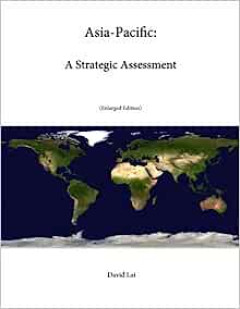
Asia-Pacific: a strategic assesment
Dr. David Lai provides a timely assessment of the geostrategic significance of Asia-Pacific. His monograph is also a thought-provoking analysis of the U.S. strategic shift toward the region and its implications. Dr. Lai judiciously offers the following key points. First, Asia-Pacific, which covers China, Northeast Asia, and Southeast Asia, is a region with complex currents. On the one hand, the…
- Edisi
- -
- ISBN/ISSN
- 1584875739
- Deskripsi Fisik
- 23 cm
- Judul Seri
- -
- No. Panggil
- 355. 07 Lai a

Singapore and the Indonesian revolution 1945-50 : Recollections of Suryono Da…
Singapore became a base for Indonesian specil operations during the years 1945 50, both as a sports b material needed by the newly Independent Bopulle f Indonesia in the fara of probable designs on the part of the Netherlands East Indies government to force » milltary solution to the nilics, and as a tromalt port in the commendal Velovions between the neighbouring countries. This book, based o…
- Edisi
- -
- ISBN/ISSN
- 981-3016-17-5
- Deskripsi Fisik
- x, 73 pages : illustrations ; 23 cm
- Judul Seri
- -
- No. Panggil
- 959.8035 Dar s

Moscow and the third world under Gorbachev
Since Gorbachev assumed power in 1985, Soviet attitudes towards the developing world have changed dramatically. This book explores the shape and scope of the "new thinking" in Moscow's foreign policy
- Edisi
- -
- ISBN/ISSN
- 0-8133-1052-0
- Deskripsi Fisik
- xvi, 260 pages : maps : bibl: hlm 241-243 : index ; 24 cm
- Judul Seri
- -
- No. Panggil
- 327.470 172 4 Dun m

Europe in emerging Asia: Opportunities and obstacles in political and economi…
Written by leading statesmen and scholars, this book examines the economic, political and cultural relations between Europe and emerging Asian nations
- Edisi
- -
- ISBN/ISSN
- 978-1-78348-227-6
- Deskripsi Fisik
- xiv, 292 pages : bibl: hlm 273-282 : index ; 23 cm
- Judul Seri
- -
- No. Panggil
- 327.504 Eri e

China, India and the future of international society
This volume unpicks common assumptions about the global influence of China and India to examine their future impact on international society. China and India have huge potential to exert global influence due to their geography, population size and material resources. Now their spectacular economic growth has led many commentators to predict a shift in power from West to East and the dawn of an …
- Edisi
- -
- ISBN/ISSN
- 978-1-78348-260-3
- Deskripsi Fisik
- vii, 176 pages : bibliography: page 155-171 : index ; 23 cm
- Judul Seri
- -
- No. Panggil
- 327.51 Gas c
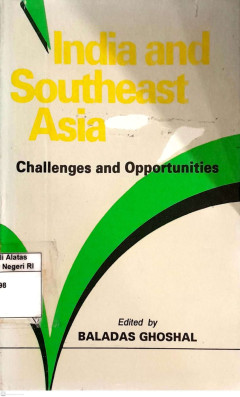
India and Southeast Asia: Challenges and opportunities
Today, India and Southeast Asia look at each other in a more positive light than perhaps at any other time over the last three decades. In this book, seven specialists and scholars on Southeast Asia look at the challenges and opportunities before India to develop more meaningful and cooperative relationship with the region. The study also charts out a programme of action and policies to attract…
- Edisi
- -
- ISBN/ISSN
- 81-220-04121
- Deskripsi Fisik
- viii, 127 pages : index ; 23 cm
- Judul Seri
- -
- No. Panggil
- 327.54059 Gho i

International relations in Southeast Asia: Between bilateralism and multilate…
For observers outside of Southeast Asia, this book opens up a world of conflicts, rivalries, and reconciliations that is terra incognita. It is easy to assume that all is well under the consensual Association of Southeast Asian Nations (ASEAN) umbrella. These expert authors detail the sometimes stormy and often tense bilateral relationships in the region. In doing so they delineate the profound…
- Edisi
- First Published
- ISBN/ISSN
- 978-981-4279-57-4
- Deskripsi Fisik
- xix, 350 pages : index ; 24 cm
- Judul Seri
- -
- No. Panggil
- 327.59 Gan i

Getting back in the game: A foreign policy playbook for Canada
In Getting Back in the Game, Heinbecker presents his compelling vision for the future of Canadian foreign policy, a future in which Canada can work both with the United Nations and apart from it; in which our government can take a stand and effect change on issues of the day from climate change to the Middle East; in which this country has a key role to play in the rehabilitation of global gove…
- Edisi
- -
- ISBN/ISSN
- 978-1-55470-298-5
- Deskripsi Fisik
- 311 pages : index ; 23 cm
- Judul Seri
- -
- No. Panggil
- 327.71 Hei g
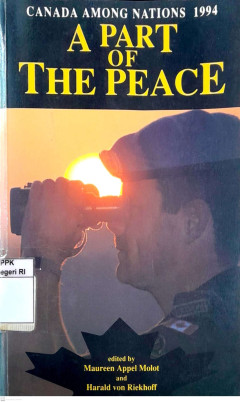
A part of peace: Canada among nations 1994
A Part of the Peace addresses three areas in international affairs which are of particular concern to Canadian foreign policy makers: Multilateralism, regionalism and peacekeeping. The authors consider Canada's continuing involvement within various multilateral institutions, in particular the United Nations and the GATT.
- Edisi
- -
- ISBN/ISSN
- 0-88629-227-1
- Deskripsi Fisik
- 365 pages ; 24 cm
- Judul Seri
- -
- No. Panggil
- 327.71 Mol a
 Karya Umum
 Filsafat
 Agama
 Ilmu-ilmu Sosial
 Bahasa
 Ilmu-ilmu Murni
 Ilmu-ilmu Terapan
 Kesenian, Hiburan, dan Olahraga
 Kesusastraan
 Geografi dan Sejarah