Ditapis dengan

No easy walk to freedom: Articles, speeches and trial addresses of Nelson Man…
No Easy Walk to Freedom is a collection of articles, speeches, and official statements by Nelson Mandela during his struggle against apartheid. It contains key texts reflecting Mandela's political thought, including his historic inquiry speech, his defense at the Rivonia trial, and a socio-political analysis of South Africa under apartheid. With a new foreword by Ruth First, the book provides a…
- Edisi
- -
- ISBN/ISSN
- 0-435-90123-0
- Deskripsi Fisik
- xiv, 189 pages : illustrations ; 18,5 cm
- Judul Seri
- -
- No. Panggil
- 923.26 MAN n

The World that made mandela: A Heritage trail
The World That Made Mandela is a visual and historical documentation of the significant places that shaped Nelson Mandela's life. Written by historian Luli Callinicos, the book presents a "heritage trail" that traces the social, cultural, and political environments that influenced Mandela from childhood through the anti-apartheid struggle. Through photographs, maps, and historical narratives, t…
- Edisi
- -
- ISBN/ISSN
- 1-919855-01-7
- Deskripsi Fisik
- 338 pages : illustration ; 29 cm
- Judul Seri
- -
- No. Panggil
- 968.06092 CAL w

Council of the elders: A Tribute to the veterans of the South African liberat…
Council of the Elders is a visual and documentary work that pays tribute to the veterans of South Africa's liberation struggle. Edited by Firdose Bulbulia and Faith Isiakpere, the book presents photographs, short biographies, and narratives documenting the contributions of those involved in the anti-apartheid struggle. Through a pictorial and narrative approach, the work highlights the long his…
- Edisi
- -
- ISBN/ISSN
- 978-3-3665-7-2
- Deskripsi Fisik
- illustration ; 30 cm
- Judul Seri
- -
- No. Panggil
- 968.06 BUL c

Long walk to freedom: The autobiography of Nelson Mandela
This book is the autobiography of Nelson Mandela, the first black former President of South Africa and also the first president elected through a general election. Written by the character himself, this book contains memories and experiences full of drama that shaped Nelson Mandela's personality. His life story is an epic story, full of continuous obstacles and difficulties until he finally suc…
- Edisi
- -
- ISBN/ISSN
- 0-316-87496-5
- Deskripsi Fisik
- ix, 630 pages : index ; 24 cm
- Judul Seri
- -
- No. Panggil
- 920 MAN l

Flying with pride: The Story of the South Arican flag
Flying With Pride explains the history, development, and symbolic meaning of the South African national flag. Written by Denis Beckett, it details the creative and political process behind the design of the new post-apartheid flag, including its symbolism of the values of unity within South Africa's diverse society. In addition to the historical narrative, the book includes technical info…
- Edisi
- -
- ISBN/ISSN
- 0-620-28903-1
- Deskripsi Fisik
- 161 pages : illustration ; 28,5 cm
- Judul Seri
- -
- No. Panggil
- 929.920968 BEC f
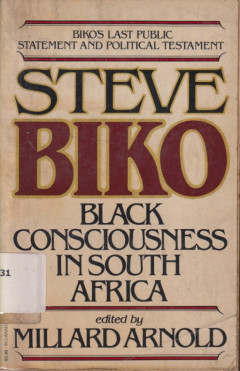
Black consciousness in South Africa
Black Consciousness in South Africa is a collection of essays, letters, and important documents related to the thinking of Steve Biko, a leading figure in the Black Consciousness Movement. Edited by Millard Arnold, the book presents Biko's views on black identity, resistance to apartheid, and the political struggle in South Africa. In addition to Biko's writings, the book also includes historic…
- Edisi
- -
- ISBN/ISSN
- 0-394-72739-8
- Deskripsi Fisik
- xxxvi, 360 pages ; 20 cm
- Judul Seri
- -
- No. Panggil
- 305.8986 BIK b

South Africa's labor empire: A History of black migrancy to the gold mines
South Africa’s Labor Empire examines the history of Black labor migration to South Africa’s gold mines from the 19th century through the apartheid era. Jonathan Crush, Alan Jeeves, and David Yudelman explore how labor recruitment systems, colonial policies, and racial regulations shaped the mining industry. The book highlights economic exploitation, racial segregation, harsh working conditi…
- Edisi
- -
- ISBN/ISSN
- 0-8133-7417-0
- Deskripsi Fisik
- xvi, 266 pages : illustration ; 23,5 cm
- Judul Seri
- -
- No. Panggil
- 331.6 CRU s

Power! Black workers, their unions and the struggle for freedom in South Africa
POWER! examines the crucial role of Black workers and trade unions in the struggle against apartheid in South Africa. Written by Denis MacShane, Martin Plaut, and David Ward, the book illustrates how the labor movement contributed to social and political change through industrial action, grassroots organizing, and civil disobedience. The analysis demonstrates the close relationship between econ…
- Edisi
- -
- ISBN/ISSN
- 0-89608-244-X
- Deskripsi Fisik
- 195 pages ; 21 cm
- Judul Seri
- -
- No. Panggil
- 331.88 MAC p
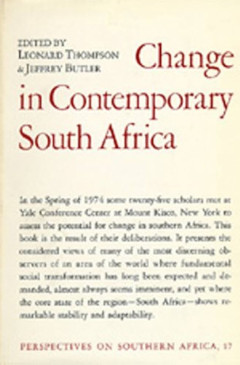
Change in contemporary South Africa
In the Spring of 1974 some twenty-five scholars met at Yale Conference Center at Mount Kisco, New York to assess the potential for change in southern Africa. This book is the result of their deliberations. It presents the considered views of many of the most discerning observers of an area of the world where fundamental social transformation has long been expected and de-manded, almost always s…
- Edisi
- -
- ISBN/ISSN
- 0-520-02839-2
- Deskripsi Fisik
- 447 pages; 24 cm
- Judul Seri
- -
- No. Panggil
- 320.968 THO c
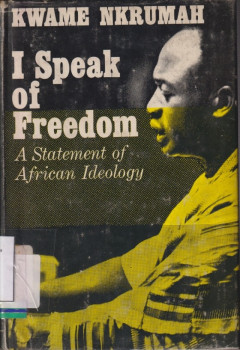
I Speak of freedom: A Statement of African ideology
In this influential work, Kwame Nkrumah outlines his vision for African unity, political freedom, and postcolonial development. I Speak of Freedom presents Nkrumah’s reflections on nationalism, anti-colonial struggle, and the responsibilities of independent African states. Through speeches, essays, and policy statements, he articulates the ideological foundations of Pan-Africanism and emphasi…
- Edisi
- -
- ISBN/ISSN
- -
- Deskripsi Fisik
- xii, 291 pages : illustration ; 21 cm
- Judul Seri
- -
- No. Panggil
- 320.9667 KWA i
 Karya Umum
  Filsafat
  Agama
Agama  Ilmu-ilmu Sosial
  Bahasa
  Ilmu-ilmu Murni
  Ilmu-ilmu Terapan
  Kesenian, Hiburan, dan Olahraga
  Kesusastraan
  Geografi dan Sejarah