Ditapis dengan
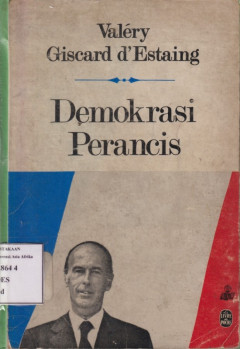
Demokrasi Perancis
Demokrasi Perancis adalah terjemahan dari karya Valéry Giscard d’Estaing yang membahas prinsip, perkembangan, dan praktik demokrasi di Prancis. Buku ini menjelaskan bagaimana sistem politik Prancis berkembang dari masa ke masa, peranan lembaga negara, dinamika pemerintahan, serta hubungan antara eksekutif, legislatif, dan rakyat. Sebagai mantan Presiden Prancis, Giscard d’Estaing memberika…
- Edisi
- -
- ISBN/ISSN
- -
- Deskripsi Fisik
- 147 halaman ; 23 cm
- Judul Seri
- -
- No. Panggil
- 320.944 GIS d

Alexis de Tocqueville: His social and political theory
Whitney Pope's Alexis de Tocqueville: His Social and Political Theory provides a comprehensive study of the social and political thought of Alexis de Tocqueville, one of the most influential theorists in the history of the social sciences. Pope examines Tocqueville's ideas on democracy, civil society, equality, liberty, and the dangers of the tyranny of the majority, as well as their relevance …
- Edisi
- -
- ISBN/ISSN
- 0-8039-2557-3
- Deskripsi Fisik
- 158 pages ; 21,5 cm
- Judul Seri
- -
- No. Panggil
- 301.0924 POP a

Gaullist Africa: Cameroon under Ahmadu Ahidjo
Gaullist Africa: Cameroon under Ahmadou Ahidjo is a scholarly examination of Cameroon’s political evolution during the presidency of Ahmadou Ahidjo, one of Africa’s pivotal post-colonial leaders. Edited by Richard Joseph, the book explores how French Gaullist policies shaped Cameroon’s political structures, governance style, and international relations after independence.
- Edisi
- -
- ISBN/ISSN
- 978-156-004-5
- Deskripsi Fisik
- xiv,217 pages, ; 24cm.
- Judul Seri
- -
- No. Panggil
- 967.110 4 JOS g

Nonaligned solidarity and national security
This book examines the political significance of the Non-Aligned Movement and its role in shaping national security policies among developing countries. Attar Chand explores how nonalignment emerged as an alternative strategy during the Cold War, offering smaller nations a framework for independence, cooperation, and security outside the major power blocs. The work analyzes the principles of no…
- Edisi
- -
- ISBN/ISSN
- -
- Deskripsi Fisik
- xxxii, 346 pages ; 22,5 cm
- Judul Seri
- -
- No. Panggil
- 327.172 CHA n

The Political history of Finland 1809–1966
L. A. Puntila's The Political History of Finland 1809–1966 examines the political development of Finland from the time of the Russian Empire (Grand Duchy of Finland) to the era of independence and the consolidation of the modern state. Through in-depth historical analysis, the author outlines changes in government structure, the process of democratization, the role of political parties, and t…
- Edisi
- -
- ISBN/ISSN
- 951-1-01366-1
- Deskripsi Fisik
- 248 pages : illustration ; 22,5 cm
- Judul Seri
- -
- No. Panggil
- 948.97 PUN p
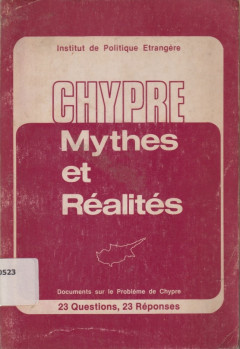
Chypre: Mythes et réalités
Chypre: Mythes et Réalités is the official publication of the Institut de Politique Étrangère, presenting documents on the Cyprus issue from the perspective of the Turkish government. The book provides political analysis, a history of the conflict, and an explanation of ethnic issues and the relationship between the Turkish and Greek communities in Cyprus. Using the “23 Questions – 23 A…
- Edisi
- -
- ISBN/ISSN
- -
- Deskripsi Fisik
- vii, 205 pages : illustration ; 24 cm
- Judul Seri
- -
- No. Panggil
- 956.45 INS c

Report of the Chairman of the Non-Aligned Movement on the Activities of the M…
The book Report of the Chairman of the Non-Aligned Movement on the Activities of the Movement, September 1992 – October 1995 is an official report prepared by the Office of the Executive Assistant to the Chairman of the Non-Aligned Movement. This report summarizes various activities, work programs, political initiatives, as well as high-level meetings and ministerial meetings held during the …
- Edisi
- -
- ISBN/ISSN
- 979-553-703-2
- Deskripsi Fisik
- xi, 885 pages ; 24,5 cm
- Judul Seri
- -
- No. Panggil
- 327.172 OFF r
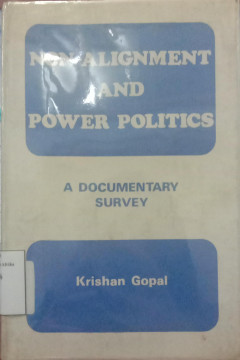
Non-Alignment and power politics : A Document survey
This documentary survey explores the concept, evolution, and political implications of the Non-Aligned Movement within global power dynamics. Compiled by Krishan Gopal, the book presents key documents, speeches, and policy statements that illustrate how non-alignment emerged as a significant force in international relations. It examines the movement’s strategies in navigating superpower rival…
- Edisi
- -
- ISBN/ISSN
- -
- Deskripsi Fisik
- xiv, 215 pages ; 22,5 cm
- Judul Seri
- -
- No. Panggil
- 327.172 GOP n

Nonaligned states: A Great leap forward — A Study in new international econ…
“This book analyzes the role of nonaligned states in shaping the New International Economic Order during the early 1980s. Attar Chand examines the political and economic aspirations of the Non-Aligned Movement, emphasizing its collective efforts to restructure global economic relations in favor of developing countries. Through detailed assessments of policy positions, international negotiatio…
- Edisi
- -
- ISBN/ISSN
- -
- Deskripsi Fisik
- xxxi, 308 pages ; 22 cm
- Judul Seri
- -
- No. Panggil
- 327.17 CHA n

Indonesian notebook: A Sourcebook on Richard Wright and the Bandung Conference
Indonesian Notebook presents a rare compilation of writings, reflections, and contextual documents surrounding the participation of African American author Richard Wright in the 1955 Bandung Conference. Edited by Brian Russell Roberts and Keith Foulcher, the book offers insights into Wright’s encounters in Indonesia, his observations on Afro-Asian political solidarity, and the global signific…
- Edisi
- -
- ISBN/ISSN
- 978-0-8223-6067-4
- Deskripsi Fisik
- xxiv, 262 pages : illustrations ; 23 cm
- Judul Seri
- -
- No. Panggil
- 327.0958 ROB i
 Karya Umum
  Filsafat
  Agama
Agama  Ilmu-ilmu Sosial
  Bahasa
  Ilmu-ilmu Murni
  Ilmu-ilmu Terapan
  Kesenian, Hiburan, dan Olahraga
  Kesusastraan
  Geografi dan Sejarah