Ditapis dengan

Confronting environmental change in East & Southeast Asia: Eco-politics, fore…
An edited collection of essays by a group of international experts and scholars that address the politics and policy of environmental change and sustainable development in East and Southeast Asia. The book pays particular attention to the ways in which foreign policy and international relations theories help explain eco-politics and sustainable development in the region. Case studies cover e…
- Edisi
- -
- ISBN/ISSN
- 9280811134
- Deskripsi Fisik
- xviii, 269 pages : illustrations (black and white) ; 23 cm
- Judul Seri
- -
- No. Panggil
- 333.72095 Har c
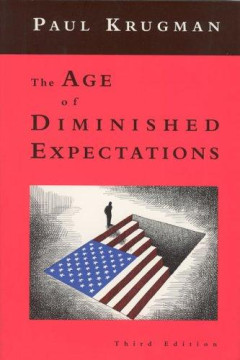
The age of diminished expectations
Paul Krugman's popular guide to the economic landscape of the 1990s has been revised and updated to take into account economic developments of the past three years. New material in the third edition includes: - A new chapter—complete with colorful examples from Lloyds of London and Sumitomo Metals—on how risky behavior can lead to disaster in private markets. - An evaluation of the Federa…
- Edisi
- Ed. 3 ; Cet. 3
- ISBN/ISSN
- 0-262-61134-1
- Deskripsi Fisik
- xii, 232 pages : illustrations (black and white) ; 23 cm
- Judul Seri
- -
- No. Panggil
- 338.973 Kru a

Public policy : Teori kebijakan - analisis kebijakan - proses kebijakan perum…
Daftar Isi Bagian 1 : Memahami kebijakan publik Bagian 2 : Analisis kebijakan Bagian 3 : Proses kebijakan Bagian 4 : Penelitian kebijakan Bagian 5 : Agenda ke depan.
- Edisi
- -
- ISBN/ISSN
- 978-979-27-2566-7
- Deskripsi Fisik
- viii, 657 halaman : ilustrasi ; 23 cm
- Judul Seri
- -
- No. Panggil
- 320.6 Nug p

Central bank policy mix: Issues, challenges, and policy responses
This book is an integration of keynote speeches, lectures, and related teaching materials during the five years of the "Central Bank Policy Mix: Issues, Challenges and Policy Responses" flagship program of the BI Institute, the learning and research centre of Bank Indonesia. The book examines the interactions among central bank policies including monetary policy, exchange rate policy, macroprud…
- Edisi
- Ed. 1
- ISBN/ISSN
- 978-623-90661-7-8
- Deskripsi Fisik
- xviii, 374 pages : illustrations ; 23 cm
- Judul Seri
- -
- No. Panggil
- 332.46 War c
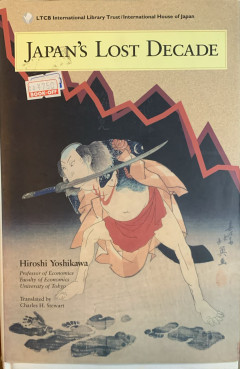
Japan's lost decade
In this incisive analysis of Japan's lost decade of the 1990's, Professor Hiroshi Yoshikawa comprehensively explains how the world's second largest economy has come to a standstill and the difficult choices facing the nation at this crucial moment of transition. This book contains: 1. Macroeconomic analysis of the 1990s 2. Bad debts and the Japanese Economy 3. Exchange rates 4. Japan's M…
- Edisi
- -
- ISBN/ISSN
- -
- Deskripsi Fisik
- xiv, 240 pages ; 24 cm
- Judul Seri
- -
- No. Panggil
- 338.952 Hir j

Transitions and interdependence: India and its neighbours
Developments in South Asia in the areas of democracy, political economy and security in the last couple of years are intriguing and raise questions about whether the region is on the road to transformation. The years 2013 and 2014, particularly, have been ‘years of transition’ in South Asia. Almost all South Asia countries have undergone political transitions with cascading effects. These e…
- Edisi
- -
- ISBN/ISSN
- 978-93-83649-59-4
- Deskripsi Fisik
- xiii, 191 pages : illustrations (black and white) ; 24 cm
- Judul Seri
- -
- No. Panggil
- 320.6 Jha t
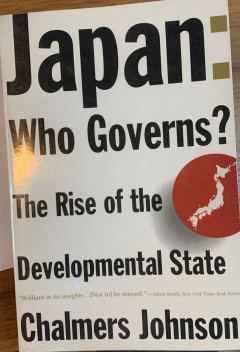
Japan, who governs? : The rise of the developmental state
The godfather of Japanese revisionism, author of MITI and the Japanese Miracle and president of the Japan Policy Research Institute explains how--and why--Japan has become a world power in the past 25 years. Johnson lucidly explains here how the Japanese economy will thrive as it moves from a producer-dominated economy to a consumer-oriented headquarters for all of East Asia.
- Edisi
- -
- ISBN/ISSN
- 0-393-03739-8
- Deskripsi Fisik
- 384 pages ; 21 cm.
- Judul Seri
- -
- No. Panggil
- 338.952 Joh j
Reliving APEC 1996: Select documents & speeches
This book contains: 1. The President on APEC 2. Building the spirit of community 3. Trade and investment liberalization and facilitation 4. Economic and technical cooperation 5. Select APEC 1996 documents
- Edisi
- -
- ISBN/ISSN
- -
- Deskripsi Fisik
- 165 pages ; 23 cm.
- Judul Seri
- -
- No. Panggil
- 337.1 Mac r
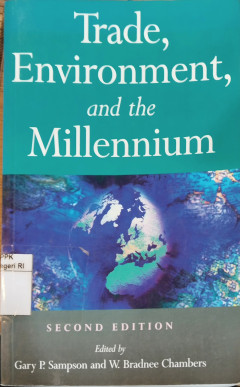
Trade, environment, and the millennium
This book contains about: 1. Trade and environment: Strengthening complementarities 2. Trade and environment: How real is the debate? 3. Breaking the deadlock: A positive agenda on trade, environment, and development 4. The WTO dispute settlement system etc.
- Edisi
- Ed. 2
- ISBN/ISSN
- 92-808-1064-2
- Deskripsi Fisik
- xi, 450 pages ; 23 cm
- Judul Seri
- -
- No. Panggil
- 382.92 Sam t
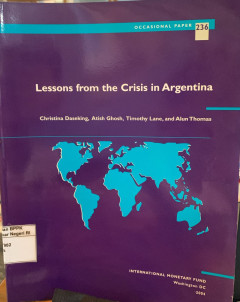
Lessons from the crisis in Argentina
This book contains: 1. Boom years and buildup of Vulnerabilities: 1992-98 2. Downturn and deeping depression: 1998-2000 3. Crisis: 2001 4. Aftermath: 2002 5. Role of the IMF
- Edisi
- -
- ISBN/ISSN
- 1-58906-359-7
- Deskripsi Fisik
- V, 55 pages ; 28 cm.
- Judul Seri
- -
- No. Panggil
- 330.9982 Das l
 Karya Umum
 Filsafat
 Agama
 Ilmu-ilmu Sosial
 Bahasa
 Ilmu-ilmu Murni
 Ilmu-ilmu Terapan
 Kesenian, Hiburan, dan Olahraga
 Kesusastraan
 Geografi dan Sejarah